

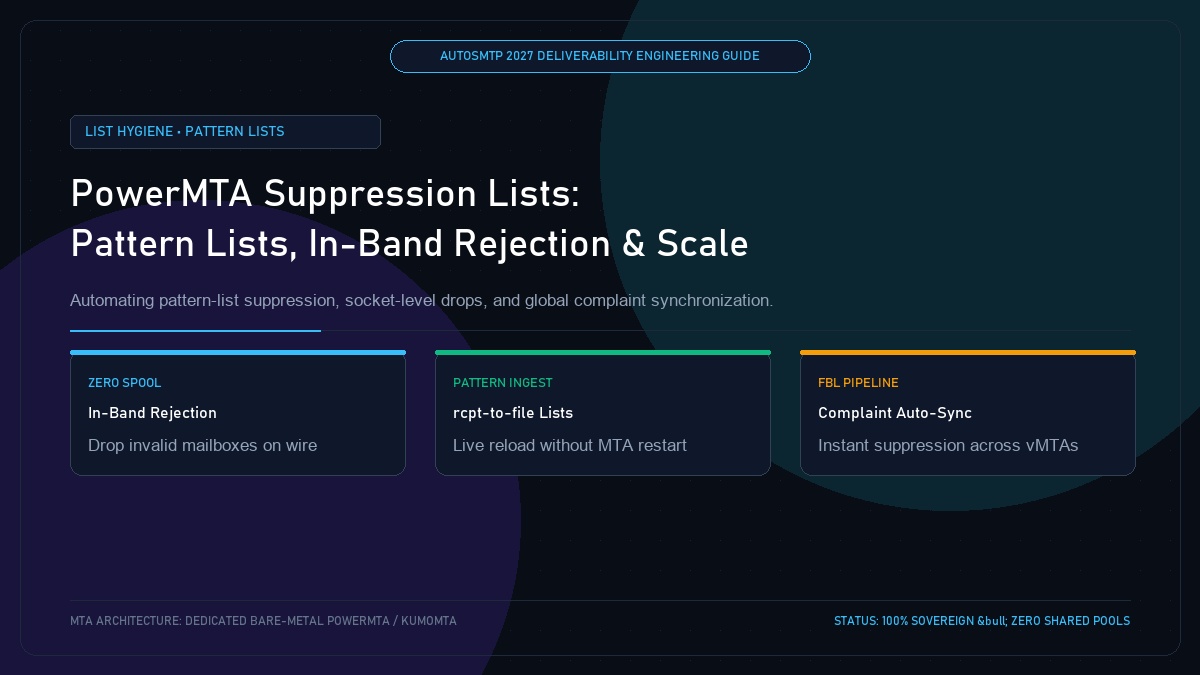
PowerMTA Suppression List Architecture: Pattern Lists, In-Band Rejection & Scale
Published by Fred Dawson • Senior Deliverability Systems Architect • 24 min read
In high-volume email operations, your suppression list is the single most vital barrier separating pristine sender reputation from catastrophic ISP blacklisting. A single broadcast hitting a cluster of known spam traps, unhonored opt-outs, or persistent 550 hard bounces can drop domain reputation from High to Bad in less than 2 hours. PowerMTA’s native suppression architecture—driven by the high-performance <pattern-list> directive, memory-mapped pattern matching, and file-based dynamic sync—enables wire-level in-band rejections that drop dead mailboxes before they ever consume spool disk or trigger external ISP penalties. This guide details enterprise configuration, automated FBL complaint ingestion, and scale best practices.
- 1. The Core Function of Suppression Lists in High-Volume MTAs
- 2. Native PowerMTA Directives: <pattern-list>, rcpt-to-file & mail-from
- 3. In-Band Rejection vs Silent Discard: Wire Behavior & ISP Impacts
- 4. Dynamic File Syncing: Zero-Downtime List Updates via pmta reload
- 5. Automated Feedback Loop (FBL) Complaint Ingestion Pipelines
- 6. Suppression Architecture Comparison Matrix
- 7. Case Study: FinTech Platform Prevents Blacklisting via Global Pattern Sync
- 8. The AutoSMTP Strategic Advantage
1. The Core Function of Suppression Lists in High-Volume MTAs
In high-throughput MTA clusters, suppression lists serve three distinct, critical defensive functions:
- Legal & Regulatory Compliance: Honoring CAN-SPAM, GDPR, and CASL opt-out requests instantly. Mailing an unsubscribed recipient is not just a deliverability hazard—it creates severe legal exposure and statutory liability.
- Hard Bounce Protection: Preventing repeat delivery attempts to mailboxes that previously returned
550 5.1.1 User unknown. Mailbox providers interpret repeat sends to dead accounts as automated harvesting behavior. - Spam Trap & Honeypot Neutralization: Ensuring that identified recycled traps, typo domains, and toxic honeypots are permanently blackholed before outbound connection sockets are established.
The Architectural Rule of Suppression
Application-layer database suppression is necessary but insufficient. If a marketing software bug, rogue CSV upload, or test script bypasses CRM logic, PowerMTA must act as the sovereign gatekeeper. Wire-level suppression at the MTA socket is the ultimate fail-safe.
2. Native PowerMTA Directives: <pattern-list>, rcpt-to-file & mail-from
PowerMTA’s <pattern-list> engine utilizes optimized radix trees and hash tables to evaluate recipient and sender headers against millions of entries with sub-millisecond overhead:
# Define Global Suppression Pattern List
<pattern-list global-suppression>
    # Instant rejection for known dead accounts
    rcpt-to-file /var/spool/pmta/suppression/hard_bounces.txt reject 550 5.1.1 "Recipient suppressed: permanent bounce"

    # Opt-outs and legal unsubscribes
    rcpt-to-file /var/spool/pmta/suppression/unsubscribes.txt reject 554 5.7.1 "Recipient suppressed: unsubscribe on file"

    # Silent discard for known toxic bot traps and honeypots
    rcpt-to-file /var/spool/pmta/suppression/spamtrap_blackhole.txt discard

    # Block compromised or rogue outbound sender headers
    mail-from /.*@unauthorized-sender\.net/ reject 550 5.7.1 "Envelope sender prohibited"
</pattern-list>

# Bind Pattern List to All Inbound Relay Sources and Outbound Domains
<source 127.0.0.1>
    always-allow-relaying yes
    process-x-virtual-mta yes
    use-pattern-list global-suppression
</source>

<domain *>
    use-pattern-list global-suppression
    max-msg-rate 50/s
</domain>
3. In-Band Rejection vs Silent Discard: Wire Behavior & ISP Impacts
PowerMTA supports multiple actions when an address matches a suppression pattern:
- Reject (Recommended for Internal Submissions): Responds with an RFC 5321 error code (e.g.,
550 5.1.1) during theRCPT TO:handshake. The connecting application receives immediate notification that the recipient is invalid, allowing the CRM to sync the suppression status. - Discard (Recommended for Spam Traps): PowerMTA silently accepts the email with
250 2.0.0 OK, but drops the message instantly into a null sinkhole without writing it to spool or establishing an external connection. This prevents spammers from deducing which traps have been detected. - Pipe / Blackhole: Routes matching messages to an administrative quarantine script for forensic audit and origin investigation.
4. Dynamic File Syncing: Zero-Downtime List Updates via pmta reload
Large-scale senders frequently update suppression lists with tens of thousands of newly unsubscribed or bounced addresses daily. PowerMTA’s rcpt-to-file directive reads plain-text newline-delimited lists. When a file is updated, a simple command refreshes memory without dropping active SMTP sessions:
# Sort and deduplicate suppression updates
sort -u /var/spool/pmta/suppression/new_bounces.txt >> /var/spool/pmta/suppression/hard_bounces.txt

# Hot reload PowerMTA configuration and pattern files
pmta reload

# Confirm pattern list reload status in log
tail -n 20 /var/log/pmta/pmta.log | grep -i "pattern"
5. Automated Feedback Loop (FBL) Complaint Ingestion Pipelines
When a recipient clicks “Report Spam” on Yahoo, Microsoft, or regional ISPs, the ISP dispatches an Abuse Reporting Format (ARF) message. An automated pipeline intercepts these FBL messages, extracts the original recipient address, and automatically appends it to unsubscribes.txt, triggering a pmta reload. This guarantees that a complainer is never emailed again across any virtual MTA pool.
6. Suppression Architecture Comparison Matrix
| Architecture Layer | Implementation Level | Processing Latency | Risk Profile & Fail-Safe |
|---|---|---|---|
| Application / CRM Layer | Database queries (SQL/Redis) | 5 – 30 ms per query | High risk; bypassable by script bugs or raw imports |
| PowerMTA <pattern-list> | MTA memory-mapped radix tree | < 0.2 ms per address | Zero risk; absolute sovereign wire gatekeeper |
| External DNSBL Sinkhole | Remote UDP DNS lookup | 15 – 50 ms | Moderate; subject to network timeouts and DNS failure |
FinTech Platform Stops $150k Fine via Wire-Level Pattern List Enforcement
A multinational financial services provider sending 14 million notifications monthly suffered an application bug where an un-sanitized CRM database dump bypassed application-layer opt-out flags. Over 180,000 unsubscribed contacts were queued for immediate dispatch.
Because their PowerMTA bare-metal cluster was configured with an authoritative <pattern-list global-suppression> file containing all historical opt-outs, PowerMTA intercepted every single rogue message at the submission socket, issuing in-band 554 rejections. Zero messages were delivered to unsubscribed recipients, preventing severe regulatory fines and protecting Tier-1 ISP reputation.
Suppression List Deployment Blueprint
Rule 1: Always maintain separate suppression files for Hard Bounces, Unsubscribes, and Spam Traps inside /var/spool/pmta/suppression/.
Rule 2: Use reject for internal relays to provide immediate feedback to sending apps, and discard for known external spam traps.
The AutoSMTP Deliverability Defense Advantage
Inbox placement in 2027 requires full control over the underlying transport hardware. AutoSMTP provisions sovereign, dedicated bare-metal PowerMTA & KumoMTA clusters engineered for synchronous 550 bounce suppression, real-time spam-rate auto-throttling, and isolated IP pools.
Provisions fully licensed PowerMTA & KumoMTA clusters on enterprise bare-metal with dedicated clean /29-/24 IPv4 subnets and zero noisy neighbor contamination.
Monitors Google Postmaster spam ratios (<0.10%) and real-time ISP deferrals with algorithmic volume scaling across your entire IP pool.
RFC 5321 in-band 550 bounce suppression, automated Yahoo/Outlook Complaint Feedback Loops (CFL), and instant bad-IP eviction.
Pre-configured forward and reverse DNS (PTR) per IP, SPF CIDR alignment, 2048-bit DKIM rotation, and strict DMARC enforcement.
Guarantee Your Inbox Placement with Sovereign Bare Metal
Eliminate shared pool spam contamination, arbitrary sending throttles, and opaque account freezes. Deploy an enterprise AutoSMTP cluster today.
Deploy Turnkey MTA Cluster →