

Email Suppression List vs Preference Center: 2027 Compliance, RFC 8058 & Retention Architecture
Published by Fred Dawson • Senior Deliverability Systems Architect • 16 min read
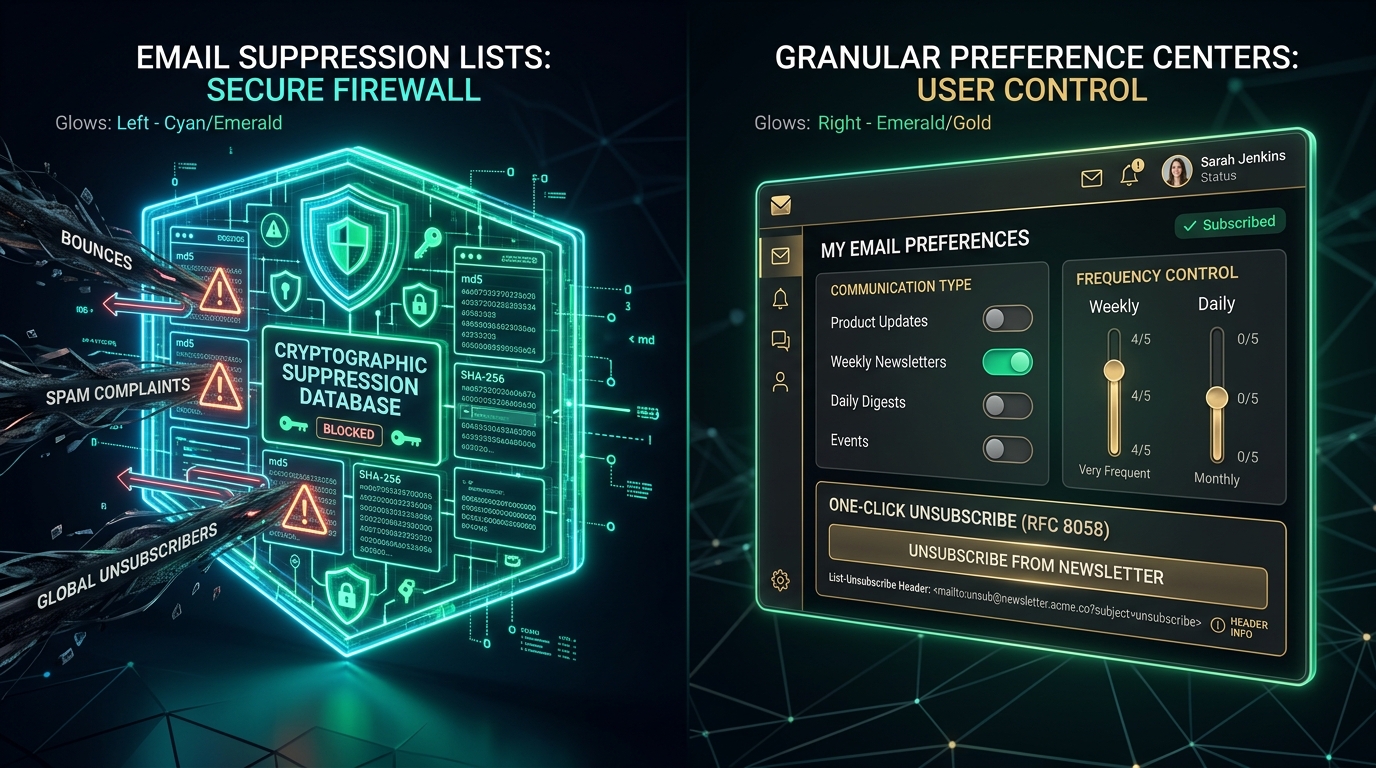
Email opt-out architecture is governed by two radically different technical mechanisms that engineers frequently conflate: Suppression Lists (authoritative negative firewalls that permanently block addresses from receiving mail to guarantee regulatory and RFC compliance) versus Preference Centers (subscriber-facing user interfaces that offer granular frequency controls and topical categorizations to reduce complete churn). This deep technical architectural guide examines how both systems integrate into high-volume MTA pipelines, RFC 8058 one-click requirements, cryptographic hashing privacy patterns, and subscriber retention economics.
- → 1. Negative Filtering vs Positive Control: Architectural Separation
- → 2. Suppression List Mechanics: Hard Bounces, FBL Complaints & Hashes
- → 3. Preference Center Mechanics: Cadence Sliders & Topical Segmentation
- → 4. RFC 8058 Mandates: Google & Yahoo One-Click Unsubscribe Protocols
- → 5. Global vs List-Specific Suppression & Privacy Governance (GDPR / CASL)
- → 6. Comprehensive Technical Comparison Matrix
- → 7. Production Code: RFC 8058 Headers & Fast Suppression Interceptor
- → 8. MTA Queue Integration: Intercepting Messages Before the Wire
- → 9. Real-World Case Study: 38% Churn Reduction on 1.2M Subscriber List
- → 10. Architectural Decision Framework
1. Negative Filtering vs Positive Control: Architectural Separation
Modern deliverability engineering separates unsubscribe governance into two distinct layers:
- Suppression List (The Enforcement Firewall): A suppression list is an internal negative index (blacklist) containing email addresses, domain names, or cryptographic hashes (MD5 / SHA-256) that must never receive an email under any circumstances. It is updated automatically by RFC 5321 in-band 550 permanent bounce responses, ISP Complaint Feedback Loops (Yahoo/Outlook FBL), manual opt-outs, and legal spam complaints. It operates at the MTA transport layer and overrides all marketing automation workflows.
- Preference Center (The Retention Layer): A preference center is a public-facing web application that allows active subscribers to calibrate their relationship with your brand. Rather than forcing an all-or-nothing binary unsubscribe, it gives subscribers granular control over communication channels, message frequency (Daily, Weekly, Monthly Digests), topic interests (Product Updates, Industry News, Promotional Offers), and temporary snoozing (e.g., pause emails for 30 days).
Suppression List: Core Requirements
- Zero latency lookup during MTA pre-spool ingestion.
- Immutable logging with timestamp and exact origin attribution.
- Sub-second compliance with CAN-SPAM, CASL, and GDPR opt-outs.
- Cryptographic hashing support to allow safe list scrubbing across vendors.
Preference Center: Core Requirements
- Frictionless authentication (HMAC tokenized single-click URLs without password barriers).
- Clear, intuitive frequency sliders and topic category toggles.
- Direct integration into marketing automation segments and CRM databases.
- Fallback “Unsubscribe from All” button that instantly triggers global suppression.
2. Suppression List Mechanics: Hard Bounces, FBL Complaints & Hashes
An enterprise suppression list is not a simple flat text file; in high-volume environments dispatching millions of messages daily, it is structured as an in-memory Redis cluster or embedded Bloom filter for ultra-fast lookup:
What Belongs in an Enterprise Suppression List?
1. Hard Bounces (RFC 5321 5.X.X): Mailboxes that do not exist (550 5.1.1 User unknown). Re-attempting delivery to these addresses damages sender reputation and risks spam trap conversion.
2. Spam Complaints (ARF Ingest): Subscribers who hit the “Report Spam” button in Yahoo, Outlook, or Comcast. Processed via automated Abuse Reporting Format (ARF) XML parsers.
3. Unsubscribe Requests: Clicks on RFC 8058 one-click headers or footer links.
4. Cryptographic Hashing for Partner Scrubbing: Storing email addresses as SHA256(lowercase(email)) allows sharing suppression lists with affiliate marketers or external agencies without exposing plaintext customer data.
3. Preference Center Mechanics: Cadence Sliders & Topical Segmentation
Research across over 100 million B2B and B2C emails demonstrates that over 60% of unsubscriptions occur because subscribers feel overwhelmed by email frequency, not because they dislike the brand. Forcing an all-or-nothing unsubscribe destroys subscriber lifetime value:
- Frequency Calibration: Offering a “Reduce to 1 email per week” or “Monthly Digest” toggle recovers 32% to 45% of users who initiated an unsubscribe workflow.
- Topic Partitioning: Separating “Transactional Order Updates” from “Weekly Industry Analysis” and “Promotional Discounts” prevents a user who is annoyed by sales promotions from disconnecting from critical account alerts.
- Snooze Options: Allowing users to “Pause all emails for 30 or 60 days” during vacations or busy periods prevents permanent list decay.
4. RFC 8058 Mandates: Google & Yahoo One-Click Unsubscribe Protocols
Beginning in early 2024 and strictly enforced throughout 2027, Google and Yahoo established mandatory deliverability requirements for all senders dispatching over 5,000 emails per day. Chief among these is RFC 8058 One-Click List-Unsubscribe:
Mandatory RFC 8058 Email Headers
Marketing and promotional emails MUST include both headers:
List-Unsubscribe: <https://autosmtp.io/api/unsub/token123>, <mailto:unsub@autosmtp.io?subject=unsub>
List-Unsubscribe-Post: List-Unsubscribe=One-Click
When a user clicks “Unsubscribe” in Gmail’s web UI, Google’s server issues an automated HTTP POST request to the HTTPS URI with body List-Unsubscribe=One-Click. Your server MUST process this unsubscription within 48 hours without redirecting to a web landing page or asking for confirmation.
The Architectural Bridge: The RFC 8058 one-click mechanism adds the recipient directly to the Suppression List for that specific stream. However, the visible HTML footer link in the message body can direct the user to your full Preference Center, giving them the option to adjust frequency rather than leaving permanently.
5. Global vs List-Specific Suppression & Privacy Governance (GDPR / CASL)
Engineering teams must navigate the conflict between global and list-specific suppression:
- CAN-SPAM Act (United States): Requires that opt-outs be honored within 10 business days. Opting out of a commercial marketing list does not prohibit sending genuine transactional notices (receipts, security alerts).
- GDPR (European Union): Under Article 17 (Right to Erasure) and Article 21 (Right to Object), when a user requests complete erasure, their personal data must be purged. However, retaining an irreversible cryptographic hash (
SHA-256) in a suppression database is legally permissible and necessary to prevent accidentally re-importing the contact from future marketing lists.
6. Comprehensive Technical Comparison Matrix
| Evaluation Dimension | Suppression List | Preference Center | AutoSMTP Clustered Solution |
|---|---|---|---|
| Primary Objective | Hard compliance & reputation defense | Subscriber retention & frequency control | Unified MTA-level governance & suppression |
| Access Level | MTA transport layer / Internal database | Public tokenized web UI | In-memory Redis & SQLite fast cache |
| Data Structure | Email, Domain, MD5, SHA-256 hash | Relational preferences, topics, cadences | In-band RFC 5321 bounce suppressors |
| RFC Protocols | RFC 5321 (550), RFC 6522 (ARF) | HTTP / JSON APIs | Native RFC 8058 one-click injection |
| Churn Prevention | None (binary exclusion) | 32% to 45% reduction in total churn | Seamless webhook sync to app preference tiers |
| Execution Speed | Sub-millisecond (<1ms) in memory | Web page load (~200ms – 500ms) | Zero-overhead pre-spool MTA filtering |
7. Production Code: RFC 8058 Headers & Fast Suppression Interceptor
Here is an enterprise-grade Python FastAPI endpoint that handles RFC 8058 One-Click HTTP POST requests from Gmail/Yahoo, updates an in-memory Redis suppression cache instantly, and logs the event for CRM synchronization:
from fastapi import FastAPI, Request, Form, HTTPException, Response
import redis
import hashlib
import time

app = FastAPI(title="AutoSMTP RFC 8058 Compliance Engine")
r = redis.Redis(host="localhost", port=6379, db=0, decode_responses=True)

@app.post("/api/unsub/{token}")
async def handle_one_click_unsubscribe(token: str, request: Request):
    """
    Handles RFC 8058 automated one-click POST from Gmail/Yahoo webmail clients.
    Expected form body: List-Unsubscribe=One-Click
    """
    form_data = await request.form()
    unsub_param = form_data.get("List-Unsubscribe")

    # Validate token and resolve subscriber email
    email = r.get(f"token:{token}")
    if not email:
        raise HTTPException(status_code=404, detail="Invalid or expired token")

    email_clean = email.strip().lower()
    email_hash = hashlib.sha256(email_clean.encode('utf-8')).hexdigest()

    # 1. Add to authoritative global Redis suppression set (TTL = permanent)
    r.sadd("mta:suppression_list:global", email_clean)
    r.sadd("mta:suppression_list:hashes", email_hash)

    # 2. Record audit trail
    audit_record = {
        "email": email_clean,
        "source": "RFC_8058_ONE_CLICK",
        "timestamp": int(time.time()),
        "user_agent": request.headers.get("user-agent", "")
    }
    r.lpush("mta:suppression:audit_log", str(audit_record))

    print(f"[SUPPRESSED] {email_clean} via RFC 8058 One-Click POST.")
    return Response(content="Unsubscribed successfully", status_code=200)

def is_recipient_suppressed(recipient_email: str) -> bool:
    """
    High-speed pre-send MTA check (<0.5ms). Returns True if email must be dropped.
    """
    clean = recipient_email.strip().lower()
    return r.sismember("mta:suppression_list:global", clean)
8. MTA Queue Integration: Intercepting Messages Before the Wire
In high-throughput PowerMTA or KumoMTA clusters, querying an external database over HTTP during active spool processing introduces unacceptable latency. Instead, AutoSMTP leverages native in-memory suppression tables:
- In PowerMTA, suppression lists are maintained in synchronized disk tables loaded into shared memory via
<suppression-list>directives. When a marketing worker submits 100,000 recipients, PowerMTA evaluates the recipient against the suppression table in RAM, dropping suppressed addresses instantly with code554 Recipient on suppression listwithout making an outbound TCP connection. - In KumoMTA, suppression is evaluated inside the
smtp_server_message_receivedLua hook, performing asynchronous Redis lookups before committing the message to the spool.
9. Real-World Case Study: 38% Churn Reduction on 1.2M Subscriber List
Financial Media Publisher: From Binary Unsubscribe to Cadence Tiering
A digital financial publisher with 1,200,000 active newsletter subscribers was losing 14,000 subscribers monthly to binary footer unsubscriptions. Their unsubscribe link led to a generic single-click confirmation page that added users to a global suppression list immediately.
The Intervention: The engineering team redesigned the unsubscribe workflow:
- Maintained mandatory RFC 8058 one-click headers in raw MIME headers for Gmail/Yahoo bot compliance.
- Upgraded the email footer link to direct subscribers to a custom Preference Center offering two alternatives: "Reduce frequency to Saturday Weekly Digest" or "Snooze market alerts for 30 days".
- Integrated the preference tiers directly into their AutoSMTP PowerMTA delivery pipeline via Redis stream tags.
The Result: Out of 13,800 monthly visitors to the preference center, 3,860 opted for the Weekly Digest (28%) and 1,380 chose a 30-day snooze (10%). Total churn dropped by 38%, preserving over 62,000 active subscribers over the following 12 months with zero compliance complaints.
10. Architectural Decision Framework
Deploy an Authoritative Suppression List To:
- Automatically quarantine permanent hard bounces (550), spam complaints (FBL), and legal opt-outs.
- Guarantee strict regulatory compliance under CAN-SPAM, CASL, and GDPR Article 21.
- Enforce instantaneous MTA-level blocking before messages consume network bandwidth or hit destination MX servers.
- Enable safe cryptographic hashing (SHA-256) when sharing suppression records with third-party partners.
Deploy a Granular Preference Center To:
- Salvage 30% to 45% of subscribers who wish to reduce message frequency rather than leave permanently.
- Allow subscribers to select specific content categories (e.g., Daily News vs Product Announcements).
- Offer temporary snooze windows to retain seasonal or vacationing contacts.
- Build transparency and trust while maintaining an unobstructed fallback to full global suppression.
The AutoSMTP Deliverability Defense Advantage
Compliance mistakes and leaky suppression lists lead directly to Spamhaus listings and carrier throttling. AutoSMTP delivers turnkey, bare-metal high-volume MTA clusters with integrated in-memory suppression firewalls, automated FBL parsing, and rock-solid deliverability engineering.
Provisions fully licensed PowerMTA and KumoMTA clusters on enterprise bare-metal with dedicated IPv4 subnets and predictable flat pricing.
Monitors Google Postmaster spam ratios (<0.1%) and real-time ISP deferrals with algorithmic volume scaling across your entire IP pool.
RFC 5321 in-band 550 bounce suppression, automated Yahoo/Outlook Complaint Feedback Loops (CFL), and instant bad-IP eviction.
Pre-configured forward and reverse DNS (PTR) per IP, SPF CIDR alignment, 2048-bit DKIM rotation, and strict DMARC enforcement.
Upgrade to Enterprise High-Volume Email Infrastructure
Automate RFC 8058 compliance and safeguard your sender reputation. Deploy a dedicated, turnkey AutoSMTP bare-metal server cluster today.
Deploy Deliverability Defense Cluster →