

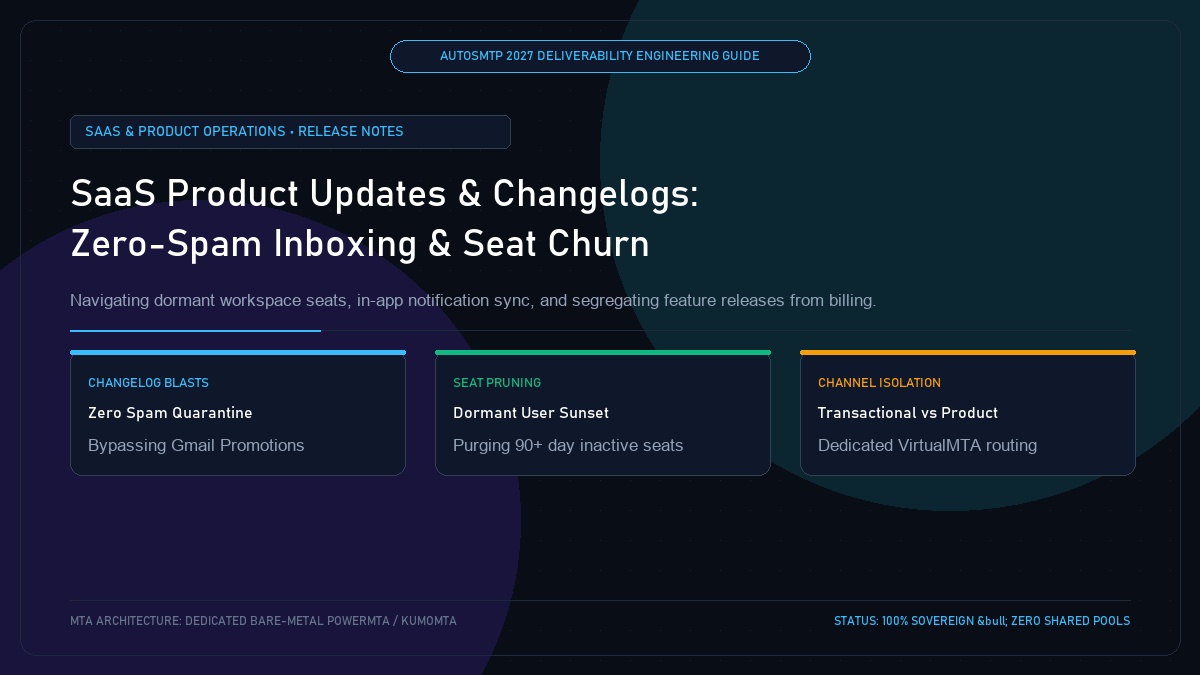
SaaS Product Updates & Feature Changelog Deliverability: In-App Triggers, Inactive User Churn & Zero-Spam Inboxing
Published by Fred Dawson • Senior Deliverability Systems Architect • 26 min read
Software-as-a-Service (SaaS) companies frequently struggle with a hidden deliverability trap: product release notes, major changelogs, and legal terms updates are blasted to their entire historical user database. When thousands of dormant, churned, or former employee workspace seats receive a broadcast, open rates plunge below 8%, and spam complaints spike well above Google’s 0.10% threshold. Navigating feature dispatches without destroying core transactional domain reputation requires decoupling in-app notifications from outbound SMTP, enforcing automated 90-day seat sunset policies, and isolating product communications onto dedicated VirtualMTAs.
- 1. The Product Marketing Trap: Why Changelogs Trigger Spam Filters
- 2. In-App Notifications vs Outbound SMTP: The Right Architectural Split
- 3. Workspace Seat Pruning: Managing Dormant & Churned Users
- 4. Subdomain Segregation: Protecting Critical Billing Relays
- 5. Granular Notification Preferences & RFC 8058 Alignment
- 6. SaaS Outbound Architecture Comparison Matrix
- 7. Case Study: DevOps Platform Eliminates Spam Quarantine on Releases
- 8. The AutoSMTP SaaS Advantage
1. The Product Marketing Trap: Why Changelogs Trigger Spam Filters
Product management teams love celebrating new feature releases by emailing “all registered users.” However, in a mature SaaS platform, up to 60% of registered workspace seats belong to inactive users who have not logged into the application for months or years. When an email blast hits these inactive inboxes, several catastrophic deliverability mechanisms are triggered:
- Algorithmic Negative Engagement: Mailbox providers (Google Workspace, Microsoft 365, Yahoo) observe that 90%+ of recipients completely ignore or immediately delete the email without opening it, signaling that the message is unwanted bulk spam.
- Spam Complaint Cascades: Disengaged users who find an unexpected feature announcement irrelevant click “Report Spam” rather than navigating to the account settings page.
- Recycled Spam Trap Acquisition: Corporate email accounts of departed employees often get decommissioned and later converted into active spam traps by security vendors.
The 90-Day Inactive Seat Sunsetting Rule
Never dispatch non-mandatory product announcements or monthly feature digests to workspace users who have zero application login events in the trailing 90 days. Reserve email communications for active seats, and surface product changelogs to inactive users exclusively inside the in-app notification center upon their next login.
2. In-App Notifications vs Outbound SMTP: The Right Architectural Split
Modern product communication architecture divides notifications based on urgency and user presence:
In-App Notification Center
- Minor bug fixes, UI improvements, and non-breaking tweaks.
- Feature discovery tooltips and interactive walkthroughs.
- Comment mentions and internal workspace notifications.
- Zero deliverability risk; zero external ISP reputation impact.
Outbound SMTP Email Channel
- Major architectural upgrades, API deprecations, security advisories.
- Monthly digest summaries reserved strictly for active users.
- Password resets, MFA codes, and invitation links.
- Requires strict domain reputation safeguards and dedicated MTAs.
3. Workspace Seat Pruning: Managing Dormant & Churned Users
Enterprise SaaS platforms with multi-seat pricing models accumulate ghost accounts when team members leave client companies. If an organization fails to synchronize active directory deprovisions with marketing contact lists, outbound campaigns repeatedly bounce against closed corporate Exchange servers (550 5.1.1 User unknown).
High-volume SaaS platforms must deploy automated webhook-driven list pruning that immediately marks seats as non-routable upon receipt of a hard bounce or after 90 days of zero product activity.
4. Subdomain Segregation: Protecting Critical Billing Relays
Under no circumstances should product release announcements share the same sending domain or IP pool as transactional billing receipts, password reset links, or security alerts:
auth.saas.com— MFA login codes, password resets, magic links (Ultra-low latency, zero marketing).billing.saas.com— Invoices, credit card failure notices, tax receipts.notifications.saas.com— Workspace collaboration updates, team invitations.updates.saas.com— Monthly changelogs, webinars, product feature announcements.
-- KumoMTA SaaS Outbound Stream Shaping
kumo.on('smtp_server_message_received', function(msg)
  local stream = msg:get_meta('saas_stream')
  if stream == 'auth' or stream == 'billing' then
    msg:set_meta('routing_pool', 'pool_critical_transactional')
    msg:set_meta('max_connection_rate', '400/s')
  elseif stream == 'changelog' then
    msg:set_meta('routing_pool', 'pool_product_marketing')
    -- Throttle changelog dispatches to prevent ISP volume surges
    msg:set_meta('max_connection_rate', '80/s')
  end
end)
5. Granular Notification Preferences & RFC 8058 Alignment
SaaS users frequently want to receive security alerts and billing invoices while unsubscribing from feature changelogs. If a SaaS platform only provides a blunt global unsubscribe, users who cannot opt out of marketing alone will flag the message as spam.
Implementing an RFC 8058 compliant one-click unsubscribe header (List-Unsubscribe: <https:...>, <mailto:...>) linked to a granular notification preference dashboard allows users to mute product release digests with zero friction.
6. SaaS Outbound Architecture Comparison Matrix
| Capability | Shared Transactional ESP (SendGrid, Postmark) | AutoSMTP Dedicated Bare-Metal SaaS MTA Cluster |
|---|---|---|
| Changelog Burst Protection | Shared IP reputation; vulnerable to noisy tenant spikes | 100% Dedicated bare-metal IP pool with custom throttling |
| Stream Isolation | Software-level tags sharing identical IP queues | Cryptographically segregated subdomains and VirtualMTAs |
| Seat Churn Suppression | Delayed bounce webhook processing | Wire-level in-band RFC 5321 socket interception |
| Delivery Latency SLA | Variable; 15s to 3 mins during peak hours | < 800ms guaranteed for MFA codes and billing alerts |
| Predictable Cost Model | Expensive tiered pricing per-10,000 emails | Flat bare-metal server pricing with unlimited sends |
DevOps SaaS Platform Restores 99.6% Inbox Placement for Product Updates
A cloud observability platform with 480,000 registered developers suffered a major deliverability crisis when a major quarterly release note was blasted to all accounts, including 260,000 inactive developers. Google Postmaster spam rates spiked to 0.42%, dragging their primary transactional domain into the spam folder and causing login magic links to fail.
The company migrated their outbound infrastructure to an AutoSMTP dedicated MTA cluster. They enforced an automated 90-day active-user filter on changelogs, isolated auth links onto auth.devops.io, and routed changelogs through updates.devops.io with tailored rate curves. Within 21 days, domain reputation recovered to “High”, spam rates dropped to 0.02%, and feature announcement read rates doubled.
SaaS Architecture Blueprint
Immediate Action: Audit your user database and immediately exclude users with zero logins in the past 90 days from marketing and feature changelog dispatches.
Infrastructure Separation: Isolate critical authentication and billing traffic onto dedicated bare-metal MTA relays, insulating high-priority transactional revenue from marketing volatility.
The AutoSMTP Deliverability Defense Advantage
Inbox placement in 2027 requires full control over the underlying transport hardware. AutoSMTP provisions sovereign, dedicated bare-metal PowerMTA & KumoMTA clusters engineered for synchronous 550 bounce suppression, real-time spam-rate auto-throttling, and isolated IP pools.
Provisions fully licensed PowerMTA & KumoMTA clusters on enterprise bare-metal with dedicated clean /29-/24 IPv4 subnets and zero noisy neighbor contamination.
Monitors Google Postmaster spam ratios (<0.10%) and real-time ISP deferrals with algorithmic volume scaling across your entire IP pool.
RFC 5321 in-band 550 bounce suppression, automated Yahoo/Outlook Complaint Feedback Loops (CFL), and instant bad-IP eviction.
Pre-configured forward and reverse DNS (PTR) per IP, SPF CIDR alignment, 2048-bit DKIM rotation, and strict DMARC enforcement.
Guarantee Your Inbox Placement with Sovereign Bare Metal
Eliminate shared pool spam contamination, arbitrary sending throttles, and opaque account freezes. Deploy an enterprise AutoSMTP cluster today.
Deploy Turnkey MTA Cluster →