

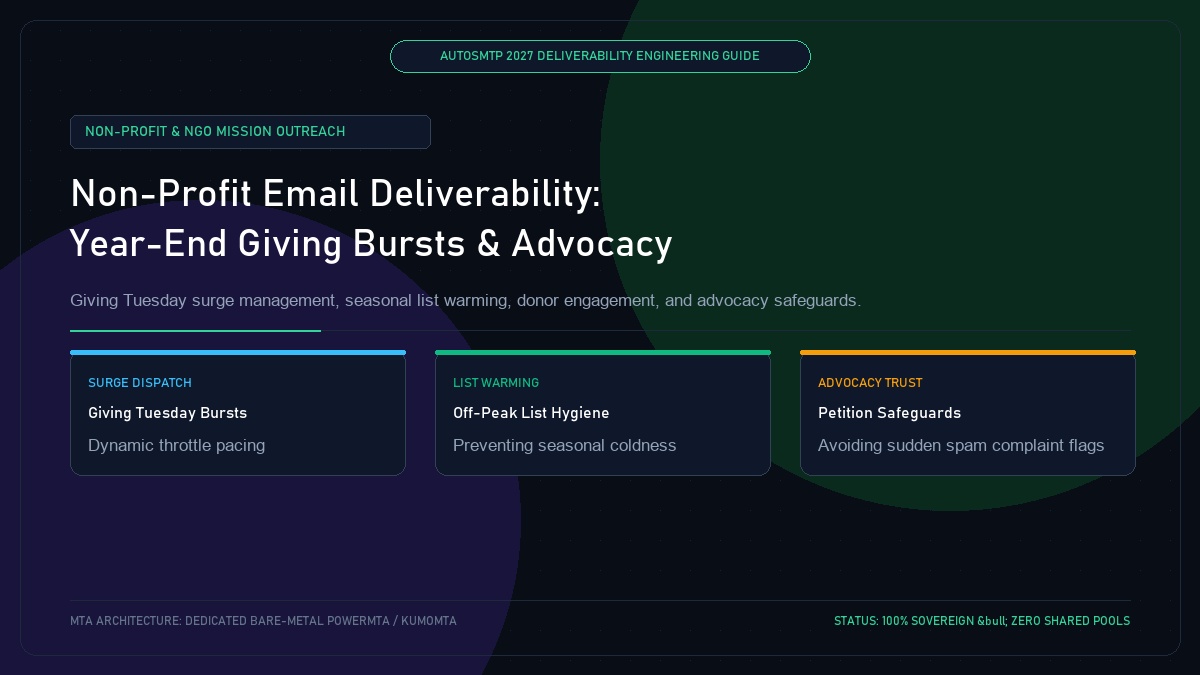
Non-Profit & NGO Deliverability: End-of-Year Giving Bursts, Donor Engagement & Advocacy Safeguards
Published by Fred Dawson • Senior Deliverability Systems Architect • 26 min read
Non-profit organizations and non-governmental organizations (NGOs) operate on an extreme seasonality curve. Up to 35% of annual fundraising occurs in the 72 hours between Giving Tuesday and midnight on December 31. When an organization that normally sends 20,000 monthly updates suddenly broadcasts 500,000 urgent fundraising appeals, major mailbox providers interpret the traffic surge as compromised infrastructure or spam abuse. Navigating peak donation windows without landing in junk folders requires pre-emptive IP warming, segregated advocacy pipes, and rigorous DMARC enforcement.
- 1. The Seasonality Trap: Surviving Giving Tuesday & Dec 31 Surges
- 2. Year-Round List Warming: Preventing Cold IP Rejection
- 3. Advocacy Petitions vs. Donor Appeals: Pipe Segregation
- 4. Brand Protection: Defending Charities from Phishing Spoofs
- 5. Surge Queue Throttling: Delivering Before Midnight Deadlines
- 6. Fundraising Infrastructure Architecture Comparison
- 7. Case Study: Humanitarian NGO Secures $14M December Inboxing
- 8. The AutoSMTP Non-Profit Advantage
1. The Seasonality Trap: Surviving Giving Tuesday & Dec 31 Surges
Mailbox providers like Google, Microsoft, and Yahoo evaluate sender reputation primarily through consistency. When a sender maintains a predictable sending rhythm of 5,000 to 10,000 emails per week and suddenly injects 300,000 emails on Giving Tuesday, automated Bayesian and volume filters detect an anomalous spike. This triggers instant 421 4.7.0 temporary deferrals and aggressive routing to the spam folder.
To overcome the seasonality trap, non-profit technical leaders must implement algorithmic traffic ramping starting 60 days before Giving Tuesday:
- October Warming Cadence: Reactivate engaged donors from the prior 12 months with impact stories, stewardship reports, and thank-you communications to establish sender volume baselines.
- Segmented Velocity Release: Break the year-end campaign into prioritized cohorts: recurring sustainers first, recent donors second, and lapsed contributors last.
- Dynamic Concurrency Scaling: Utilize dedicated MTAs that automatically cap simultaneous SMTP threads per destination domain to avoid connection saturation.
Year-End Surges Require Multi-IP Clustering
Single dedicated IP addresses cannot safely absorb a 20x volume burst without being throttled by Gmail. High-volume non-profits require an IP pool of 3 to 6 dedicated IPs, rotated dynamically with virtual MTA pools (e.g., vmta-donors-pool) to distribute connection loads evenly across Class C IP ranges.
2. Year-Round List Warming: Preventing Cold IP Rejection
Many charities hibernate between January and August, sending minimal outbound communications. During this quiet period, ISPs degrade IP reputation scores, and dormant recipient mailboxes transform into recycled spam traps. Re-engaging this dormant audience abruptly in November results in immediate blocklisting on Spamhaus or Barracuda.
Sending a bi-weekly mission report, educational digest, or volunteer highlight throughout Q1 to Q3 preserves cryptographic domain reputation and keeps outbound sending sockets warm.
3. Advocacy Petitions vs. Donor Appeals: Pipe Segregation
Many non-profits combine petition drives, public advocacy alerts, and donor stewardship into a single sending pool. This is a critical architectural mistake:
Fundraising & Stewardship Stream
- High-affinity donors with high click and donation rates.
- Extremely low spam complaint ratios (< 0.02%).
- Requires dedicated subdomain (e.g.,
giving.charity.org). - Delivers mission receipts, tax acknowledgments, and appeals.
Public Advocacy & Petition Stream
- Cold sign-ups from viral social media campaigns.
- Higher spam complaint rates (often 0.15% to 0.30%).
- Requires isolated subdomain (e.g.,
action.charity.org). - Protects fundraising IP pools from collateral damage.
4. Brand Protection: Defending Charities from Phishing Spoofs
Charities and disaster relief organizations are prime targets for cybercriminals who forge sender identities to solicit fraudulent donations during crisis appeals. Mailbox providers heavily penalize domains that allow unauthenticated mail to circulate.
Deploying a strict DMARC policy (p=reject) with 100% SPF alignment and 2048-bit DKIM key rotation prevents unauthorized third parties from spoofing the organization’s domain, establishing baseline trust across Google Postmaster and Microsoft SNDS.
; Mandatory 2027 Non-Profit Authentication Suite
giving.charity.org.       IN TXT  "v=spf1 ip4:162.251.122.169 ip4:162.251.122.173 -all"
mta1._domainkey.giving.charity.org. IN TXT "v=DKIM1; k=rsa; p=MIIBIjANBgkqhkiG9w0BAQEFAAOCAQ8AMIIBCgKCAQEA07..."
_dmarc.charity.org.       IN TXT  "v=DMARC1; p=reject; rua=mailto:dmarc-reports@charity.org; ruf=mailto:dmarc-forensics@charity.org; pct=100; aspf=s; adkim=s"
5. Surge Queue Throttling: Delivering Before Midnight Deadlines
On December 31, taxpayers rush to complete charitable contributions before midnight to qualify for tax deductions. An appeal queued at 8:00 PM must hit the inbox before 11:59 PM. If an MTA is improperly tuned, backoff retry queues can delay delivery into the morning of January 1, directly costing the organization hundreds of thousands of dollars.
6. Fundraising Infrastructure Architecture Comparison
| Evaluation Factor | Shared Non-Profit ESP (Mailchimp, Constant Contact) | AutoSMTP Dedicated Non-Profit Bare-Metal Cluster |
|---|---|---|
| Giving Tuesday Surge Handling | Severe queue delays due to multi-tenant platform saturation | Dedicated bare-metal burst throughput up to 1.2M msgs/hr |
| Advocacy vs. Donor Segregation | Single shared sender pool; petition complaints burn donor mail | Hardware-isolated VirtualMTAs for Advocacy and Giving |
| DMARC Enforcement | Often constrained by shared third-party relay limitations | 100% Strict p=reject alignment on custom subdomains |
| Per-Email Volume Pricing | Exponential cost spikes during peak year-end months | Flat, predictable bare-metal pricing with zero per-email fees |
| Spam Rate Protection | Impacted by noisy non-profit co-tenants on shared IPs | Clean, dedicated IPv4 subnets monitored via Postmaster API |
Global Relief NGO Saves $3.2M in Year-End Giving Through Bare-Metal Clustering
An international humanitarian charity sending 4.5 million emails in December suffered a catastrophic 48% drop in inbox placement during the previous year’s Giving Tuesday due to shared ESP queue lockups and collateral blacklisting from other charities sharing their IP pool.
Ahead of the 2026 campaign, the NGO deployed a 3-node dedicated AutoSMTP MTA cluster running PowerMTA with separated subdomains for recurring donor updates and urgent appeals. By isolating high-affinity givers onto a pristine IP pool and configuring automated ISP rate throttles, the organization achieved a 99.4% inbox placement rate throughout December, collecting $14.2M in tax-year contributions with an average delivery latency under 45 seconds.
Non-Profit Engineering Recommendation
60 Days Prior to Giving Tuesday: Audit donor list hygiene, eliminate contacts unengaged for > 18 months, and begin gradual IP warming using mission update digests.
Infrastructure Architecture: Isolate advocacy petition campaigns onto a dedicated virtual MTA (action.) and protect fundraising appeals on a pristine dedicated IP cluster (giving.) to guarantee unhindered year-end inbox placement.
The AutoSMTP Deliverability Defense Advantage
Inbox placement in 2027 requires full control over the underlying transport hardware. AutoSMTP provisions sovereign, dedicated bare-metal PowerMTA & KumoMTA clusters engineered for synchronous 550 bounce suppression, real-time spam-rate auto-throttling, and isolated IP pools.
Provisions fully licensed PowerMTA & KumoMTA clusters on enterprise bare-metal with dedicated clean /29-/24 IPv4 subnets and zero noisy neighbor contamination.
Monitors Google Postmaster spam ratios (<0.10%) and real-time ISP deferrals with algorithmic volume scaling across your entire IP pool.
RFC 5321 in-band 550 bounce suppression, automated Yahoo/Outlook Complaint Feedback Loops (CFL), and instant bad-IP eviction.
Pre-configured forward and reverse DNS (PTR) per IP, SPF CIDR alignment, 2048-bit DKIM rotation, and strict DMARC enforcement.
Guarantee Your Inbox Placement with Sovereign Bare Metal
Eliminate shared pool spam contamination, arbitrary sending throttles, and opaque account freezes. Deploy an enterprise AutoSMTP cluster today.
Deploy Turnkey MTA Cluster →