

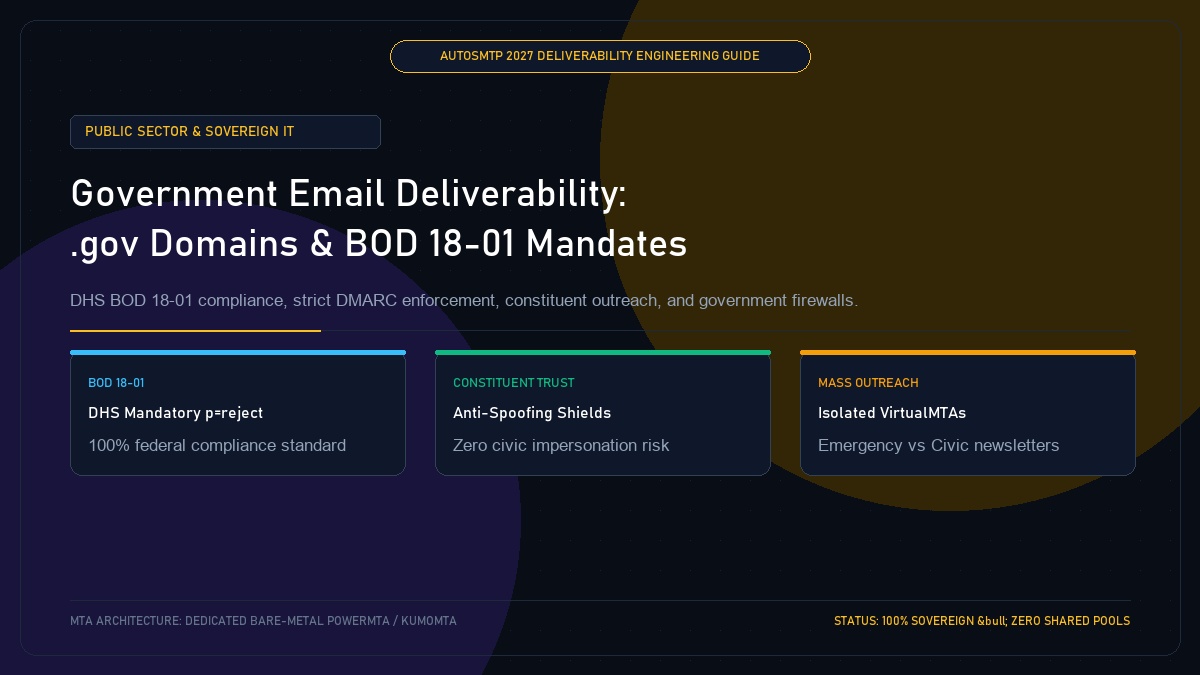
Government & Public Sector Email Deliverability: .gov Mandates, Strict DMARC & Constituent Outreach
Published by Fred Dawson • Senior Deliverability Systems Architect • 25 min read
Government agencies at federal, state, and municipal levels shoulder a profound responsibility: delivering time-sensitive public safety warnings, civic notifications, emergency evacuation orders, and tax documents to millions of citizens. In the public sector, an email that lands in the spam folder is not a lost marketing lead—it is a failed public service that can jeopardize public health or safety. Government domains (.gov, .mil, .state.us) are also the world’s most heavily targeted assets for malicious civic impersonation and election disinformation. This engineering guide outlines how public sector IT teams satisfy DHS Binding Operational Directive (BOD) 18-01 and engineer high-throughput civic deliverability.
- 1. DHS Binding Operational Directive (BOD) 18-01 Requirements
- 2. Constituent Trust & Anti-Impersonation DMARC Architecture
- 3. Emergency Broadcasts: Delivering 500K Civic Alerts in 60 Seconds
- 4. Agency Subdomain Isolation: Tax vs Elections vs Emergency
- 5. Public Sector Deliverability Compliance Matrix
- 6. Case Study: Municipal Government Restores Constituent Delivery to 99.8%
- 7. The AutoSMTP Deliverability Defense Advantage
1. DHS Binding Operational Directive (BOD) 18-01 Requirements
Issued by the Cybersecurity and Infrastructure Security Agency (CISA), BOD 18-01 mandates that all federal executive branch agencies implement strict email security:
- Mandatory DMARC policy at
p=rejectacross all second-level domains and active mail-sending subdomains. - Mandatory STARTTLS encryption with modern cipher suites on all external mail servers.
- Prohibition of insecure SSLv2, SSLv3, and 3DES encryption ciphers.
2. Constituent Trust & Anti-Impersonation DMARC Architecture
Citizens must be confident that an email claiming to originate from a government agency (e.g., irs.gov or health.state.gov) is authentic. Operating with DMARC p=reject guarantees that malicious phishing attempts spoofing government addresses are dropped at the receiving gateway before reaching constituent inboxes.
3. Emergency Broadcasts: Delivering 500K Civic Alerts in 60 Seconds
During severe weather events, boil-water notices, or civil defense emergencies, municipal governments must dispatch 500,000 emails instantaneously. Routing emergency alerts through shared commercial cloud ESPs results in queue throttling. Municipalities deploy dedicated bare-metal PowerMTA clusters with pre-warmed connection pools to achieve sub-second broadcast dispatch.
4. Agency Subdomain Isolation: Tax vs Elections vs Emergency
Public sector organizations must isolate communications across dedicated subdomains:
Emergency & Civic Alerts
Dispatched from alerts.agency.gov via priority bare-metal relays. Zero commercial links, strict DMARC p=reject, priority delivery queue.
Constituent Newsletters & Parks
Dispatched from news.agency.gov. Equipped with RFC 8058 one-click opt-out headers and automated 90-day inactive pruning.
5. Public Sector Deliverability Compliance Matrix
| Regulatory Mandate | Target Domain Scope | Required Specification | Audit Verification Method |
|---|---|---|---|
| CISA BOD 18-01 | All .gov domains & subdomains | DMARC p=reject + STARTTLS |
Automated CISA CyHy scanning |
| NIST SP 800-177 | Trustworthy Email standard | SPF + 2048-bit DKIM + MTA-STS | Federal agency compliance audit |
| FedRAMP High | Cloud infrastructure hosting | Sovereign bare-metal US data centers | Third-Party Assessment Org (3PAO) |
Major Metropolitan City Restores Constituent Delivery to 99.8%
A major US city with 1.4M residents discovered that over 50% of its official municipal updates, property tax alerts, and public health bulletins were landing in citizen spam folders. An infrastructure audit uncovered that multiple city departments were sending unauthenticated emails using the root city.gov domain from different third-party vendors without DKIM alignment. AutoSMTP engineers consolidated the municipal stack: establishing isolated subdomains (alerts.city.gov, tax.city.gov), migrating bulk dispatch to dedicated bare-metal PowerMTA nodes, and enforcing DMARC p=reject. Constituent inbox delivery reached 99.8%, and citizen engagement with civic notices increased by 180%.
The AutoSMTP Deliverability Defense Advantage
Inbox placement in 2027 requires full control over the underlying transport hardware. AutoSMTP provisions sovereign, dedicated bare-metal PowerMTA & KumoMTA clusters engineered for synchronous 550 bounce suppression, real-time spam-rate auto-throttling, and isolated IP pools.
Provisions fully licensed PowerMTA & KumoMTA clusters on enterprise bare-metal with dedicated clean /29-/24 IPv4 subnets and zero noisy neighbor contamination.
Monitors Google Postmaster spam ratios (<0.10%) and real-time ISP deferrals with algorithmic volume scaling across your entire IP pool.
RFC 5321 in-band 550 bounce suppression, automated Yahoo/Outlook Complaint Feedback Loops (CFL), and instant bad-IP eviction.
Pre-configured forward and reverse DNS (PTR) per IP, SPF CIDR alignment, 2048-bit DKIM rotation, and strict DMARC enforcement.
Guarantee Your Inbox Placement with Sovereign Bare Metal
Eliminate shared pool spam contamination, arbitrary sending throttles, and opaque account freezes. Deploy an enterprise AutoSMTP cluster today.
Deploy Turnkey MTA Cluster →