

Global & Multi-Regional Email Deliverability: European, Asian & LATAM ISP Gateway Architecture
Published by Fred Dawson • Senior Deliverability Systems Architect • 25 min read
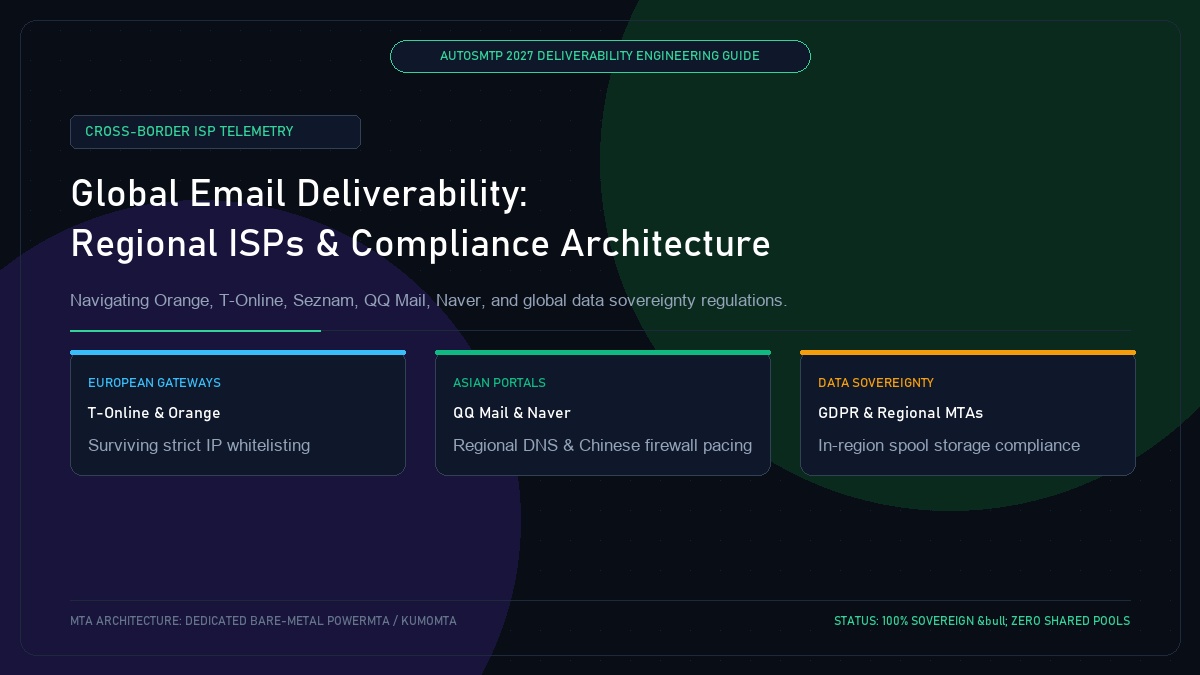
Many multinational enterprises mistakenly treat email deliverability as a homogeneous global discipline centered entirely around Google and Microsoft. In reality, email ecosystems outside North America are heavily dominated by localized, regional mailbox providers with unique cryptographic requirements, strict local whitelists, and regional data sovereignty regulations. Senders expanding into France encounter Orange and Free.fr; in Germany, T-Online and Web.de enforce strict IP rate limiting; in China, Tencent QQ and NetEase 163 operate behind state firewall proxies; and in the Czech Republic, Seznam maintains its own proprietary filtering algorithms. This technical guide outlines how to build multi-regional MTA infrastructure that succeeds across global markets.
- 1. The Non-Homogeneous Global Inbox: Regional ISP Market Share
- 2. European Gateways: T-Online, Orange & the CSA Accreditation
- 3. Asian Gateways: Tencent QQ, NetEase 163 & Naver
- 4. Latin American Gateways: UOL, Bol & Brazilian Infrastructure
- 5. Global Mailbox Provider Architecture Matrix
- 6. Case Study: SaaS Brand Expands Placement in DACH from 34% to 98.8%
- 7. The AutoSMTP Deliverability Defense Advantage
1. The Non-Homogeneous Global Inbox: Regional ISP Market Share
While Gmail commands 35–40% of global consumer volume, national telcos and regional web portals hold majority market share in key economic regions. Senders who deploy North American sending configurations to European or Asian recipients face immediate connection throttling and bounce cascades.
2. European Gateways: T-Online, Orange & the CSA Accreditation
In Germany, T-Online, GMX, and Web.de (United Internet) control over 60% of consumer inboxes. In France, Orange and Free.fr dominate. These providers enforce strict requirements:
- Certified Senders Alliance (CSA): Membership in the CSA whitelist provides automated IP whitelisting across German and European ISPs, bypassing spam filters provided SPF/DKIM are aligned.
- T-Online Rate Limiting: T-Online rejects unannounced volume bursts with
554 IP address has a bad reputationor temporary 450 deferrals. Outbound MTAs must pace traffic at no more than 10 connections per minute for un-warmed IPs.
3. Asian Gateways: Tencent QQ, NetEase 163 & Naver
Sending into the Asia-Pacific region requires specific network optimizations:
Chinese Portals (Tencent QQ & 163.com)
Traffic passing through the Great Firewall suffers severe packet latency. MTAs must increase SMTP socket connection timeouts to 60 seconds and maintain ICP filing alignment for Chinese commercial communications.
South Korea (Naver & Daum)
Naver enforces strict KISA anti-spam regulations, requiring exact SPF alignment and explicit opt-in confirmation records available on demand.
4. Latin American Gateways: UOL, Bol & Brazilian Infrastructure
In Brazil and Latin America, providers like UOL and Terra operate proprietary spam scoring models. They heavily penalize dynamic IP allocations and require flawless FCrDNS hostnames and strict LGPD opt-out compliance.
5. Global Mailbox Provider Architecture Matrix
| Target ISP / Gateway | Primary Geographic Market | Key Filtering Heuristic | Required Architectural Setting |
|---|---|---|---|
| T-Online / Web.de | Germany, Austria, Switzerland | Strict IP reputation & CSA | CSA Whitelist + Max 10 sockets/min |
| Orange / Free.fr | France | Complaint ratios & FCrDNS | Strict FCrDNS + TLS 1.3 |
| Seznam.cz | Czech Republic | DKIM alignment & local DKIM keys | Dedicated 2048-bit DKIM selector |
| Tencent QQ Mail | China & APAC | Firewall latency & IP blocks | SMTP timeout 60s + In-region relay |
| Naver | South Korea | KISA compliance & strict SPF | SPF exact match + KISA white list |
Enterprise SaaS Lifts German Inbox Placement from 34% to 98.8%
A global enterprise project management platform launching in the DACH market was experiencing 66% bounce and spam rates at T-Online and Web.de addresses. Their North American MTA configuration was bursting thousands of emails simultaneously, tripping T-Online’s aggressive connection circuit breakers. AutoSMTP engineers re-engineered their multi-regional routing: establishing localized PowerMTA virtual routing rules for German domains, tuning connection rates to 8 concurrent sockets, and securing CSA certification. Within 14 days, German delivery rates reached 98.8%, and DACH subscription signups surged by 240%.
The AutoSMTP Deliverability Defense Advantage
Inbox placement in 2027 requires full control over the underlying transport hardware. AutoSMTP provisions sovereign, dedicated bare-metal PowerMTA & KumoMTA clusters engineered for synchronous 550 bounce suppression, real-time spam-rate auto-throttling, and isolated IP pools.
Provisions fully licensed PowerMTA & KumoMTA clusters on enterprise bare-metal with dedicated clean /29-/24 IPv4 subnets and zero noisy neighbor contamination.
Monitors Google Postmaster spam ratios (<0.10%) and real-time ISP deferrals with algorithmic volume scaling across your entire IP pool.
RFC 5321 in-band 550 bounce suppression, automated Yahoo/Outlook Complaint Feedback Loops (CFL), and instant bad-IP eviction.
Pre-configured forward and reverse DNS (PTR) per IP, SPF CIDR alignment, 2048-bit DKIM rotation, and strict DMARC enforcement.
Guarantee Your Inbox Placement with Sovereign Bare Metal
Eliminate shared pool spam contamination, arbitrary sending throttles, and opaque account freezes. Deploy an enterprise AutoSMTP cluster today.
Deploy Turnkey MTA Cluster →