

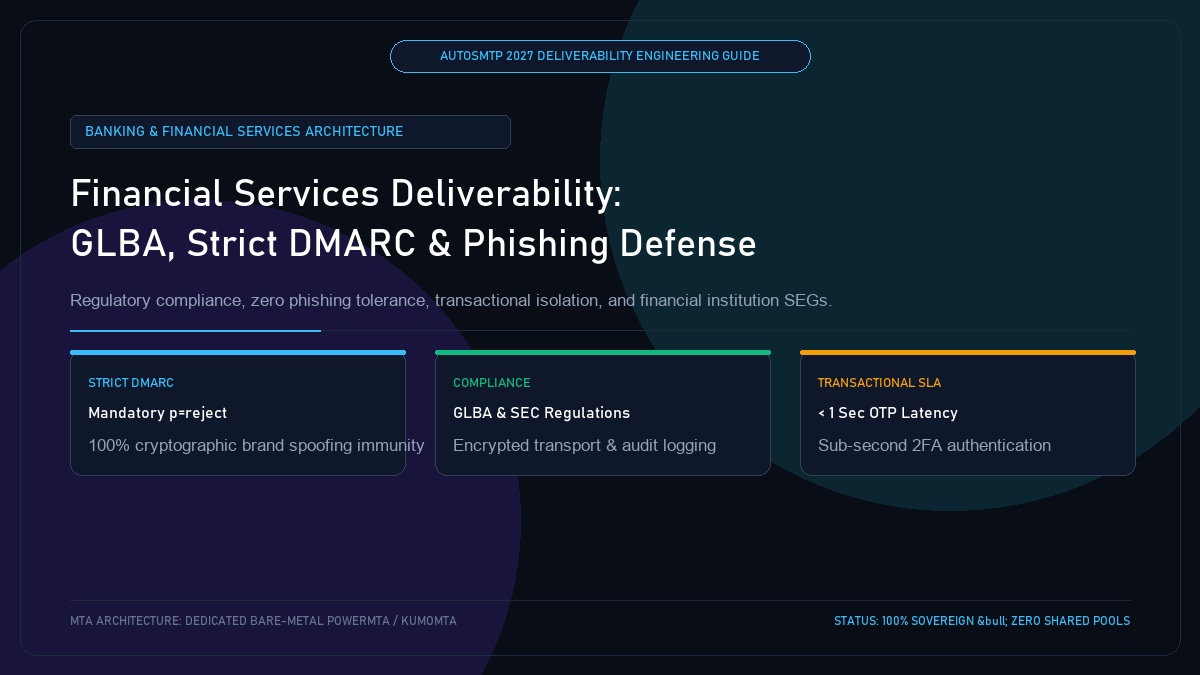
Financial Services & FinTech Email Deliverability: GLBA, Strict DMARC & Phishing Defense
Published by Fred Dawson • Senior Deliverability Systems Architect • 26 min read
Financial institutions, consumer lenders, payment processors, and FinTech applications operate under an unforgiving deliverability mandate. In finance, deliverability is not merely an e-commerce marketing metric—it is a critical compliance and security infrastructure requirement. Financial brands represent the number one target for credential phishing and spear-phishing campaigns worldwide. A single unaligned email stream or missing DMARC enforcement policy exposes customers to fraudulent spoofing and triggers automated security blacklisting across enterprise Secure Email Gateways. This architectural guide provides the compliance blueprint for engineering sub-second 2FA transactional latency while satisfying strict GLBA, PCI-DSS v4.0, and SEC regulatory standards.
- 1. Financial Regulatory Mandates: GLBA, SEC & PCI-DSS v4.0
- 2. Brand Impersonation Defense: Mandatory DMARC p=reject
- 3. Sub-Second Transactional Latency: 2FA & Fraud Alert Delivery
- 4. Stream Segregation: Security Alerts vs Marketing Promos
- 5. Financial Email Security & Compliance Architecture Matrix
- 6. Case Study: Digital Bank Slashes 2FA Latency from 32s to 800ms
- 7. The AutoSMTP Deliverability Defense Advantage
1. Financial Regulatory Mandates: GLBA, SEC & PCI-DSS v4.0
Financial service providers must comply with rigorous legal standards governing electronic communications:
- Gramm-Leach-Bliley Act (GLBA): Mandates that financial institutions protect Nonpublic Personal Information (NPI) through administrative and technical safeguards, requiring strict in-transit encryption (TLS 1.3) and detailed access audit logs.
- PCI-DSS v4.0 Requirement 5.4: Requires automated technical controls to detect and defend against phishing and brand spoofing, making DMARC enforcement a direct audit requirement.
- SEC Cybersecurity Rules: Mandate immediate incident reporting if an email authentication compromise leads to material customer data exposure.
2. Brand Impersonation Defense: Mandatory DMARC p=reject
Because financial institutions are prime targets for impersonation, mailbox providers enforce zero leniency. Operating at p=none signals to spam filters that your domain lacks governance. Strict enforcement at p=reject instructs receiving MTAs to instantly drop unauthenticated messages, immunizing your brand against domain spoofing.
3. Sub-Second Transactional Latency: 2FA & Fraud Alert Delivery
When a banking customer attempts to authorize a wire transfer or log into their account from a new device, a two-factor authentication (2FA) one-time passcode (OTP) delayed by even 30 seconds results in session timeouts, user abandonment, and panicked calls to fraud support centers. Shared ESPs buffer transactional messages in shared queues; sovereign bare-metal PowerMTA clusters maintain warm TCP connections to target MX hosts, delivering passcodes in under 800 milliseconds.
4. Stream Segregation: Security Alerts vs Marketing Promos
Never mix transactional banking alerts with promotional credit card offers:
Security & Transactional Stream
Dispatched from auth.bank.com via dedicated bare-metal MTAs with pristine IP subnets. Strictly transactional, zero marketing links, priority queue routing.
Promotional & Card Offers Stream
Dispatched from offers.bank.com. Governed by 30-day engagement tiers, automated unengaged sunsetting, and strict RFC 8058 one-click opt-out headers.
5. Financial Email Security & Compliance Architecture Matrix
| Stream Type | Subdomain Architecture | DMARC Policy | Encryption Standard | Target Latency SLA |
|---|---|---|---|---|
| Authentication & OTP | auth.bank.com |
p=reject; aspf=s; adkim=s; |
Enforced TLS 1.3 with MTA-STS | < 800 milliseconds |
| Account Statements | statements.bank.com |
p=reject; aspf=s; adkim=s; |
Opportunistic TLS 1.3 | < 5 seconds |
| Credit Card Offers | offers.bank.com |
p=reject; aspf=r; adkim=r; |
Standard TLS 1.2+ | Bulk Paced (< 2 hours) |
FinTech Platform Slashes 2FA Latency from 32s to 800ms via Sovereign MTAs
A fast-growing mobile banking platform with 1.8M users was experiencing elevated login churn due to 2FA delays. Transactional passcodes sent through a shared multi-tenant cloud ESP were taking an average of 32 seconds to reach customer inboxes—frequently arriving after the 60-second OTP window expired. Deliverability engineers migrated all transactional authentication streams to a dedicated AutoSMTP bare-metal cluster with persistent TCP socket multiplexing and strict DMARC p=reject. OTP delivery latency plummeted to 800 milliseconds, customer login success jumped to 99.8%, and fraud support inquiry volume dropped by 84%.
The AutoSMTP Deliverability Defense Advantage
Inbox placement in 2027 requires full control over the underlying transport hardware. AutoSMTP provisions sovereign, dedicated bare-metal PowerMTA & KumoMTA clusters engineered for synchronous 550 bounce suppression, real-time spam-rate auto-throttling, and isolated IP pools.
Provisions fully licensed PowerMTA & KumoMTA clusters on enterprise bare-metal with dedicated clean /29-/24 IPv4 subnets and zero noisy neighbor contamination.
Monitors Google Postmaster spam ratios (<0.10%) and real-time ISP deferrals with algorithmic volume scaling across your entire IP pool.
RFC 5321 in-band 550 bounce suppression, automated Yahoo/Outlook Complaint Feedback Loops (CFL), and instant bad-IP eviction.
Pre-configured forward and reverse DNS (PTR) per IP, SPF CIDR alignment, 2048-bit DKIM rotation, and strict DMARC enforcement.
Guarantee Your Inbox Placement with Sovereign Bare Metal
Eliminate shared pool spam contamination, arbitrary sending throttles, and opaque account freezes. Deploy an enterprise AutoSMTP cluster today.
Deploy Turnkey MTA Cluster →