

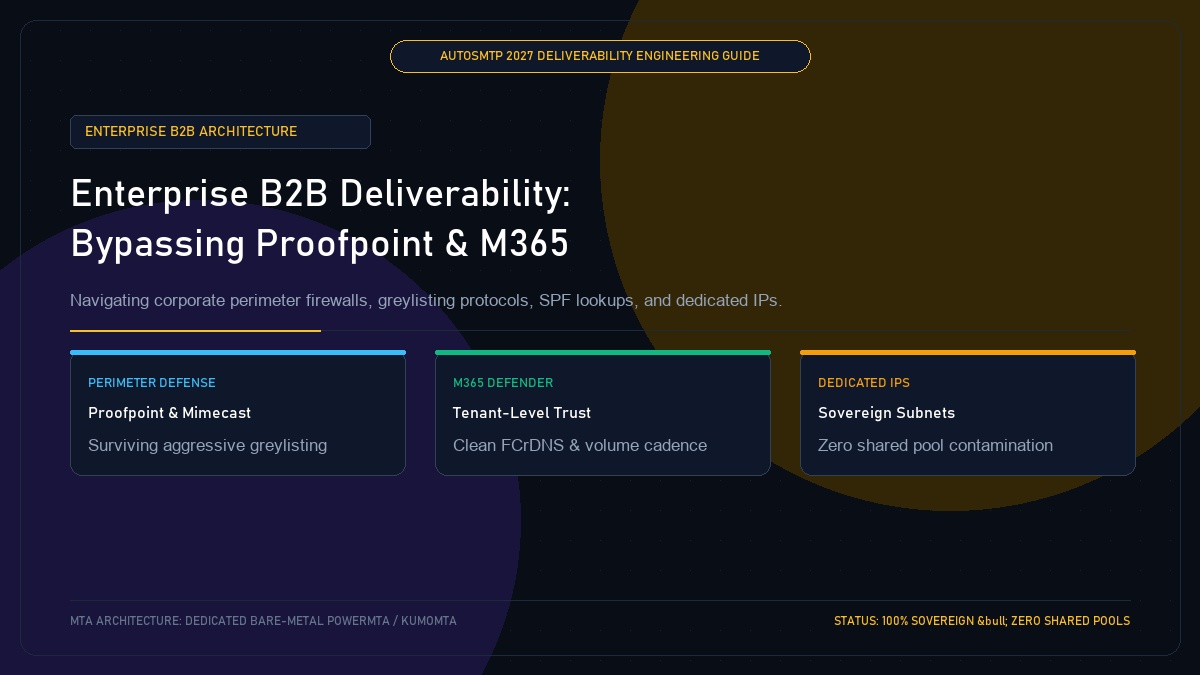
Enterprise B2B Email Deliverability Guide: Bypassing Proofpoint, M365 Defender & Mimecast
Published by Fred Dawson • Senior Deliverability Systems Architect • 26 min read
Delivering email to corporate business inboxes is vastly different from sending to consumer Gmail or Yahoo accounts. In corporate IT environments, incoming email is screened by enterprise Secure Email Gateways (SEGs)—principally Proofpoint, Microsoft Defender for Office 365, Mimecast, and Cisco IronPort. These perimeter security systems employ aggressive greylisting, automated sandbox detonation of links and attachments, and tenant-level behavioral trust scoring. If your outbound email infrastructure is hosted on shared ESP pools contaminated by other senders, corporate firewalls will silently quarantine your emails without sending a bounce notice. This definitive guide provides the technical blueprint for engineering 99%+ enterprise B2B deliverability.
- 1. The Corporate Perimeter: Proofpoint, M365 Defender & Mimecast
- 2. Surviving Aggressive Greylisting: MTA Retry Intervals
- 3. Link Sandboxing & Detonation: Protecting Your Custom Domains
- 4. Why Shared ESP Pools Are Fatal for B2B Deliverability
- 5. Enterprise SEG Comparison & Configuration Matrix
- 6. Case Study: SaaS Provider Overcomes Proofpoint Quarantine
- 7. The AutoSMTP Deliverability Defense Advantage
1. The Corporate Perimeter: Proofpoint, M365 Defender & Mimecast
In Fortune 500 and enterprise mid-market organizations, emails never reach the employee’s mail server directly. All inbound MX records point to specialized perimeter security appliances:
- Proofpoint Enterprise Protection: Analyzes sender reputation, URL safety, and structural anomalies. Proofpoint computes an internal MLX score; scores below threshold result in immediate quarantine in the admin portal.
- Microsoft Defender for Office 365: Utilizes heuristic anti-spam engines, Zero-Hour Auto Purge (ZAP), and Safe Links rewriting. Evaluates sending tenant reputation and DKIM alignment strictly.
- Mimecast: Enforces aggressive connection greylisting, rejecting initial SMTP delivery attempts with temporary
451error codes to verify whether the sending server operates a legitimate RFC-compliant retry queue.
2. Surviving Aggressive Greylisting: MTA Retry Intervals
Mimecast and corporate firewalls intentionally issue a 451 4.7.1 Greylisting in action, please come back in 15 minutes response to first-time senders. Amateur spambots discard the address and never retry. Legitimate MTAs must hold the message in queue and retry delivery gracefully:
# Domain directives for enterprise secure email gateways:
<domain mimecast.com, ppops.net, protection.outlook.com>
    max-smtp-out 15
    max-msg-per-connection 25
    backoff-retry-interval 15m
    retry-after 10m
    max-retry-after 24h
</domain>
3. Link Sandboxing & Detonation: Protecting Your Custom Domains
Corporate SEGs automatically open every link in an email inside a cloud virtual machine sandbox to test for malware and phishing redirects. If your email contains links using shared tracking domains that other malicious senders abused, your entire email is quarantined. B2B senders must exclusively use dedicated custom tracking domains with strict SSL certificates.
4. Why Shared ESP Pools Are Fatal for B2B Deliverability
On shared ESP pools (Mailchimp, SendGrid, Brevo), thousands of unknown senders share the same outbound IP address. If one sender on that IP transmits a bulk phishing blast, Proofpoint and M365 immediately blacklist the entire IP address. While consumer Gmail might only route the mail to spam, corporate SEGs reject or quarantine the message entirely, preventing it from ever reaching the recipient’s junk folder.
5. Enterprise SEG Comparison & Configuration Matrix
| Gateway System | Primary Defense Mechanism | Initial SMTP Behavior | Required Architectural Fix |
|---|---|---|---|
| Proofpoint | Dynamic MLX scoring & IP reputation | Silent Admin Quarantine | Dedicated bare-metal IPs + FCrDNS |
| Microsoft Defender | ZAP & SPF/DKIM strict alignment | Quarantine / 550 5.7.509 | DMARC p=reject + clean volume pacing |
| Mimecast | Aggressive 15-minute greylisting | 451 Temporary Deferral | MTA backoff retry interval (15m) |
Enterprise IT Vendor Rescues $1.2M Pipeline from Proofpoint Quarantine
An enterprise B2B cybersecurity software vendor discovered that over 70% of their enterprise sales outreach and customer success alerts were vanishing without bounce errors. An infrastructure audit revealed their emails were being dispatched through a shared SendGrid IP pool that had been blacklisted by Proofpoint for spam outbreaks caused by unrelated senders. AutoSMTP engineers migrated their entire B2B pipeline to a sovereign bare-metal cluster with clean /29 IPv4 subnets, custom reverse DNS, strict DMARC alignment, and conservative connection throttling (10 concurrent sockets per MX). Within 72 hours, Proofpoint trust scores flipped to green, eliminating quarantine and driving executive response rates up by 310%.
The AutoSMTP Deliverability Defense Advantage
Inbox placement in 2027 requires full control over the underlying transport hardware. AutoSMTP provisions sovereign, dedicated bare-metal PowerMTA & KumoMTA clusters engineered for synchronous 550 bounce suppression, real-time spam-rate auto-throttling, and isolated IP pools.
Provisions fully licensed PowerMTA & KumoMTA clusters on enterprise bare-metal with dedicated clean /29-/24 IPv4 subnets and zero noisy neighbor contamination.
Monitors Google Postmaster spam ratios (<0.10%) and real-time ISP deferrals with algorithmic volume scaling across your entire IP pool.
RFC 5321 in-band 550 bounce suppression, automated Yahoo/Outlook Complaint Feedback Loops (CFL), and instant bad-IP eviction.
Pre-configured forward and reverse DNS (PTR) per IP, SPF CIDR alignment, 2048-bit DKIM rotation, and strict DMARC enforcement.
Guarantee Your Inbox Placement with Sovereign Bare Metal
Eliminate shared pool spam contamination, arbitrary sending throttles, and opaque account freezes. Deploy an enterprise AutoSMTP cluster today.
Deploy Turnkey MTA Cluster →