

Pre-Flight Email Testing Checklist 2027: Authentication, Rendering & Deliverability QA
Published by Fred Dawson • Senior Deliverability Systems Architect • 25 min read
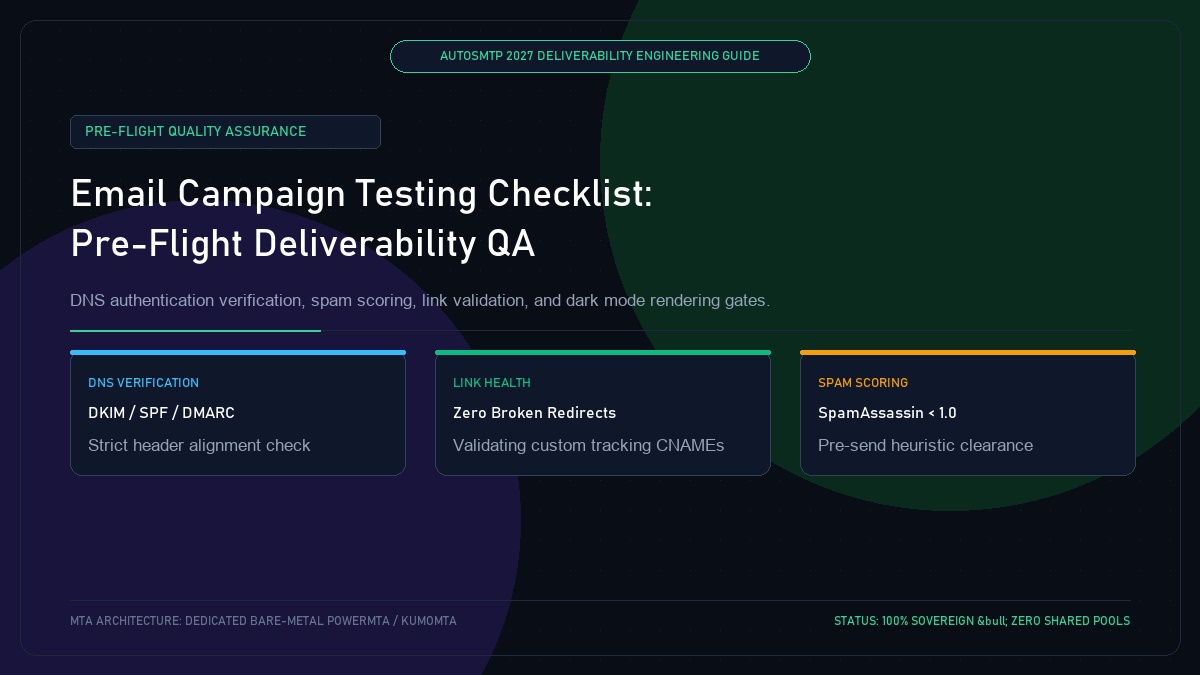
Deploying an email campaign to hundreds of thousands of subscribers without comprehensive pre-flight verification is one of the highest-risk operational actions in enterprise marketing. A single broken CNAME record on a tracking domain, an unclosed HTML tag that destroys dark mode rendering, or an unaligned DKIM signature will instantly route hundreds of thousands of emails into the spam folder—or cause total domain-level rejection. In 2027, top-tier senders implement rigorous pre-flight quality gates before any broadcast hits the MTA spool. This comprehensive guide details the 6 essential quality pillars required for enterprise-grade deliverability clearance.
- 1. Pillar 1: Cryptographic Authentication & Alignment Verification
- 2. Pillar 2: Transport Layer, FCrDNS & TLS 1.3 Readiness
- 3. Pillar 3: Link Health, Custom Tracking Domains & SSL Certificates
- 4. Pillar 4: Content Heuristics, Token Screening & SpamAssassin
- 5. Pillar 5: Multi-Client Rendering & Dark Mode Validation
- 6. Pillar 6: Seed List Testing & Inbox Placement Verification
- 7. Case Study: FinTech Prevents Blacklisting via Pre-Flight CNAME Catch
- 8. The AutoSMTP Deliverability Defense Advantage
1. Pillar 1: Cryptographic Authentication & Alignment Verification
Before launching a broadcast, verify strict cryptographic alignment across headers:
- SPF Check: The
Return-Pathdomain must resolve to a valid SPF record authorizing the sending MTA’s IP, with zero~allsoft-fails. - DKIM 2048-bit Check: The
d=domain must match the RFC 5322From:domain, signed with an active 2048-bit key. - DMARC Alignment: DMARC policy must be published at
p=quarantineorp=rejectwith validruareporting tags.
2. Pillar 2: Transport Layer, FCrDNS & TLS 1.3 Readiness
Verify that your outbound IP addresses possess Forward-Confirmed Reverse DNS (FCrDNS). A forward DNS lookup on your host name must match the PTR record of the IP address, and the server must negotiate TLS 1.2 or TLS 1.3 cipher suites seamlessly.
3. Pillar 3: Link Health, Custom Tracking Domains & SSL Certificates
Spam filters inspect all hyperlinks contained within the MIME payload. Verify:
Custom Tracking Domain (CTD) Verification
Ensure tracking links use your own brand subdomain (link.brand.com) with a valid SSL certificate. Never use shared ESP tracking domains that carry negative reputation flags.
HTTP Status Code Validation
Run an automated crawler across all links to ensure zero 404 Not Found errors, expired tracking links, or infinite redirect loops.
4. Pillar 4: Content Heuristics, Token Screening & SpamAssassin
Run your HTML template through SpamAssassin. The composite score must remain strictly below 1.0. Check for:
- Absence of blacklisted affiliate URLs or shortened links (bit.ly, tinyurl).
- Healthy 60:40 text-to-image ratio.
- Properly balanced HTML tags with no orphan closing elements.
- Mandatory RFC 8058 one-click unsubscribe headers.
5. Pillar 5: Multi-Client Rendering & Dark Mode Validation
Preview rendering across the big three client engines: WebKit (Apple Mail, iOS), Blink (Gmail Web, Android), and Word MSO (Outlook Windows). Verify that Dark Mode contrast remains above 4.5:1 and that all CTA buttons render cleanly.
6. Pillar 6: Seed List Testing & Inbox Placement Verification
Deploy a test blast to a calibrated seed list containing real mailboxes across Google Workspace, Gmail consumer, Microsoft 365, Yahoo, and iCloud. Inspect headers to confirm 100% SPF/DKIM/DMARC pass status before committing to full blast.
FinTech Platform Catches Broken CNAME SSL During Pre-Flight QA Gate
An enterprise payments platform was preparing to deploy an urgent quarterly compliance update to 450,000 corporate clients. During the automated Pre-Flight QA gate, their testing script flagged an SSL certificate expiration on their custom link-tracking subdomain (track.fintech.com). Had the campaign launched, every hyperlink in the email would have triggered a severe browser security warning (“Attackers might be trying to steal your information”), resulting in thousands of spam complaints and immediate domain-wide blacklisting. Engineers renewed the Let’s Encrypt certificate in 4 minutes, clearing the gate and achieving 100% inbox placement.
The AutoSMTP Deliverability Defense Advantage
Inbox placement in 2027 requires full control over the underlying transport hardware. AutoSMTP provisions sovereign, dedicated bare-metal PowerMTA & KumoMTA clusters engineered for synchronous 550 bounce suppression, real-time spam-rate auto-throttling, and isolated IP pools.
Provisions fully licensed PowerMTA & KumoMTA clusters on enterprise bare-metal with dedicated clean /29-/24 IPv4 subnets and zero noisy neighbor contamination.
Monitors Google Postmaster spam ratios (<0.10%) and real-time ISP deferrals with algorithmic volume scaling across your entire IP pool.
RFC 5321 in-band 550 bounce suppression, automated Yahoo/Outlook Complaint Feedback Loops (CFL), and instant bad-IP eviction.
Pre-configured forward and reverse DNS (PTR) per IP, SPF CIDR alignment, 2048-bit DKIM rotation, and strict DMARC enforcement.
Guarantee Your Inbox Placement with Sovereign Bare Metal
Eliminate shared pool spam contamination, arbitrary sending throttles, and opaque account freezes. Deploy an enterprise AutoSMTP cluster today.
Deploy Turnkey MTA Cluster →