

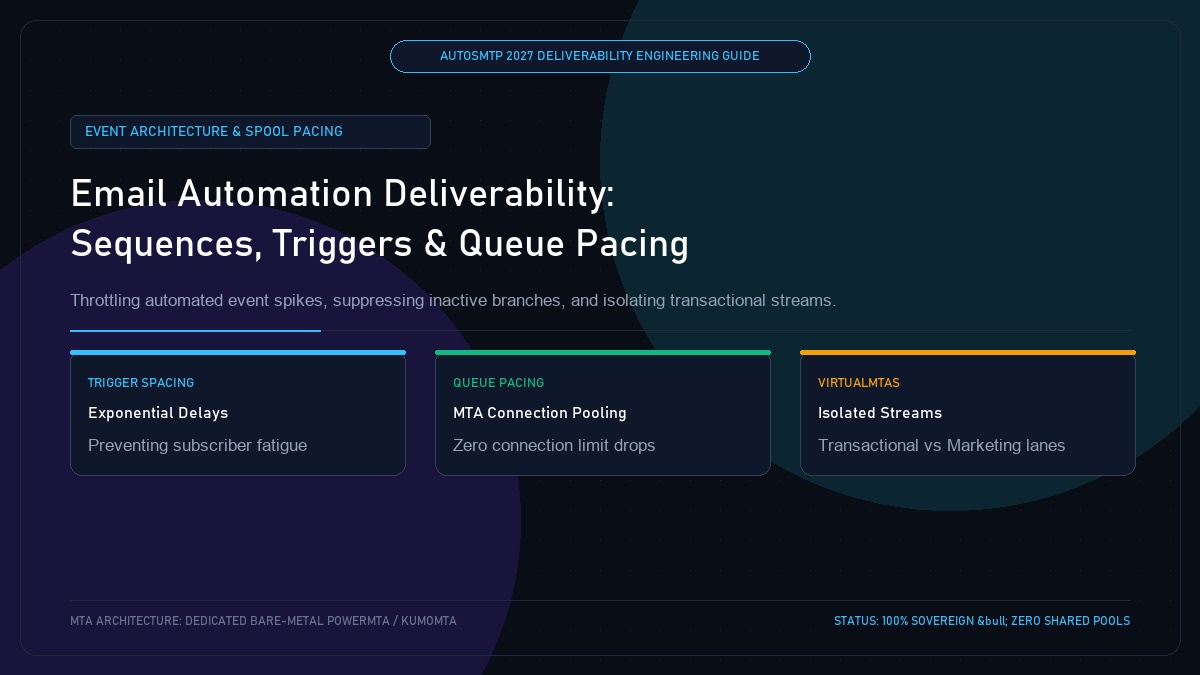
Email Automation Deliverability Architecture: Sequences, Event Triggers & Queue Throttling
Published by Fred Dawson • Senior Deliverability Systems Architect • 24 min read
Automated email sequences—welcome series, onboarding flows, abandoned cart triggers, and webinar reminders—generate over 60% of modern email marketing revenue. However, without strict architectural controls, automated workflows frequently trigger severe deliverability failures. When overlapping event triggers fire simultaneously, a single subscriber can receive four distinct marketing messages within an hour, driving spam complaints. More dangerously, mass event triggers (like flash sales) create massive outbound spool bursts that violate ISP rate limits. This guide outlines the engineering specifications for building resilient, deliverability-safe email automation engines.
- 1. The “Automation Over-Send” Crisis: Collision Mechanics
- 2. Global Frequency Capping & Circuit Breakers
- 3. Event Spool Pacing: Taming Webhook-Triggered Burst Spikes
- 4. Isolating Triggered Lifecycle Flows from Transactional Mail
- 5. Automated Sequence Pruning & Decay Branch Logic
- 6. Case Study: E-Commerce Marketplace Eliminates Gmail 421 Deferrals
- 7. The AutoSMTP Deliverability Defense Advantage
1. The “Automation Over-Send” Crisis: Collision Mechanics
In mature marketing tech stacks, multiple automated workflows run independently:
- A new subscriber joins and enters a 5-part Welcome Journey.
- Two hours later, they browse a product and trigger a Browse Abandonment flow.
- That evening, they add an item to their cart and trigger an Abandoned Cart email.
- Simultaneously, the daily promotional newsletter fires to all active contacts.
Without collision governance, this subscriber receives 4 separate emails in 12 hours. The recipient perceives this as aggressive harassment and clicks “Report Spam”. Just 3 such complaints per 1,000 subscribers pushes your domain into Google Postmaster’s danger zone (> 0.10%).
2. Global Frequency Capping & Circuit Breakers
Deliverability engineers enforce a centralized rate-limiting layer at the message dispatch engine:
Uncoordinated Multi-Flow Dispatch
Automated workflows fire independently based on user actions. Users receive overlapping promotional pitches, driving unsubscribe cascades and high spam complaint velocity.
Centralized Priority Queue (Engineered)
All outgoing marketing messages query a Redis rate-limiter: if a marketing email was sent within the past 24 hours, lower-priority triggers are suppressed or delayed until the next available window.
3. Event Spool Pacing: Taming Webhook-Triggered Burst Spikes
When an e-commerce platform triggers a “Back in Stock” notification for a trending product, 25,000 emails can enter the MTA spool within 30 seconds. Transmitting 25,000 messages to Gmail across 2 IPs in 30 seconds triggers immediate 421 4.7.0 Try again later deferrals. Modern MTAs enforce strict outbound pacing:
# Domain-level pacing for automated triggers to prevent 421 deferrals:
<domain gmail.com>
    max-smtp-out 40
    max-msg-rate 6000/h
    backoff-retry-interval 10m
</domain>

<domain yahoo.com>
    max-smtp-out 30
    max-msg-rate 4500/h
</domain>
4. Isolating Triggered Lifecycle Flows from Transactional Mail
Never blend triggered marketing sequences with operational transactional messages (password resets, order confirmations, two-factor authentication codes). Critical transactional mail must operate on sovereign IP pools and dedicated subdomains (trans.autosmtp.io) with high connection priority, while automated lifecycle flows run on marketing IP pools (notify.autosmtp.io).
5. Automated Sequence Pruning & Decay Branch Logic
If a subscriber reaches Step 3 of a 6-step nurturing sequence without opening Step 1 or Step 2, continuing to send Steps 4, 5, and 6 damages your engagement ratio. Intelligent workflows implement exit conditions: if no open or click occurs after 2 emails, the user is automatically exited from the flow and placed into a passive monthly digest cohort.
E-Commerce Marketplace Eliminates Gmail 421 Deferrals via Queue Pacing
An international fashion marketplace sending 3.5M monthly automated messages experienced severe delivery delays at Gmail during seasonal flash promotions, with over 65% of cart abandonment emails deferred for up to 6 hours due to connection burst throttling. Deliverability engineers restructured their stack: routing automated triggers to dedicated PowerMTA virtual pools, enforcing a hard 1-per-24-hour frequency cap across overlapping flows, and pacing outbound socket connections evenly. Deferrals dropped to 0.02%, cart abandonment email delivery time collapsed from 4.2 hours to 8 seconds, and flash sale revenue grew by 24%.
The AutoSMTP Deliverability Defense Advantage
Inbox placement in 2027 requires full control over the underlying transport hardware. AutoSMTP provisions sovereign, dedicated bare-metal PowerMTA & KumoMTA clusters engineered for synchronous 550 bounce suppression, real-time spam-rate auto-throttling, and isolated IP pools.
Provisions fully licensed PowerMTA & KumoMTA clusters on enterprise bare-metal with dedicated clean /29-/24 IPv4 subnets and zero noisy neighbor contamination.
Monitors Google Postmaster spam ratios (<0.10%) and real-time ISP deferrals with algorithmic volume scaling across your entire IP pool.
RFC 5321 in-band 550 bounce suppression, automated Yahoo/Outlook Complaint Feedback Loops (CFL), and instant bad-IP eviction.
Pre-configured forward and reverse DNS (PTR) per IP, SPF CIDR alignment, 2048-bit DKIM rotation, and strict DMARC enforcement.
Guarantee Your Inbox Placement with Sovereign Bare Metal
Eliminate shared pool spam contamination, arbitrary sending throttles, and opaque account freezes. Deploy an enterprise AutoSMTP cluster today.
Deploy Turnkey MTA Cluster →