

PowerMTA vs SparkPost (Bird): High-Volume Architecture, On-Prem vs Cloud API & Pricing Analysis
Published by Fred Dawson • Senior Deliverability Systems Architect • 19 min read
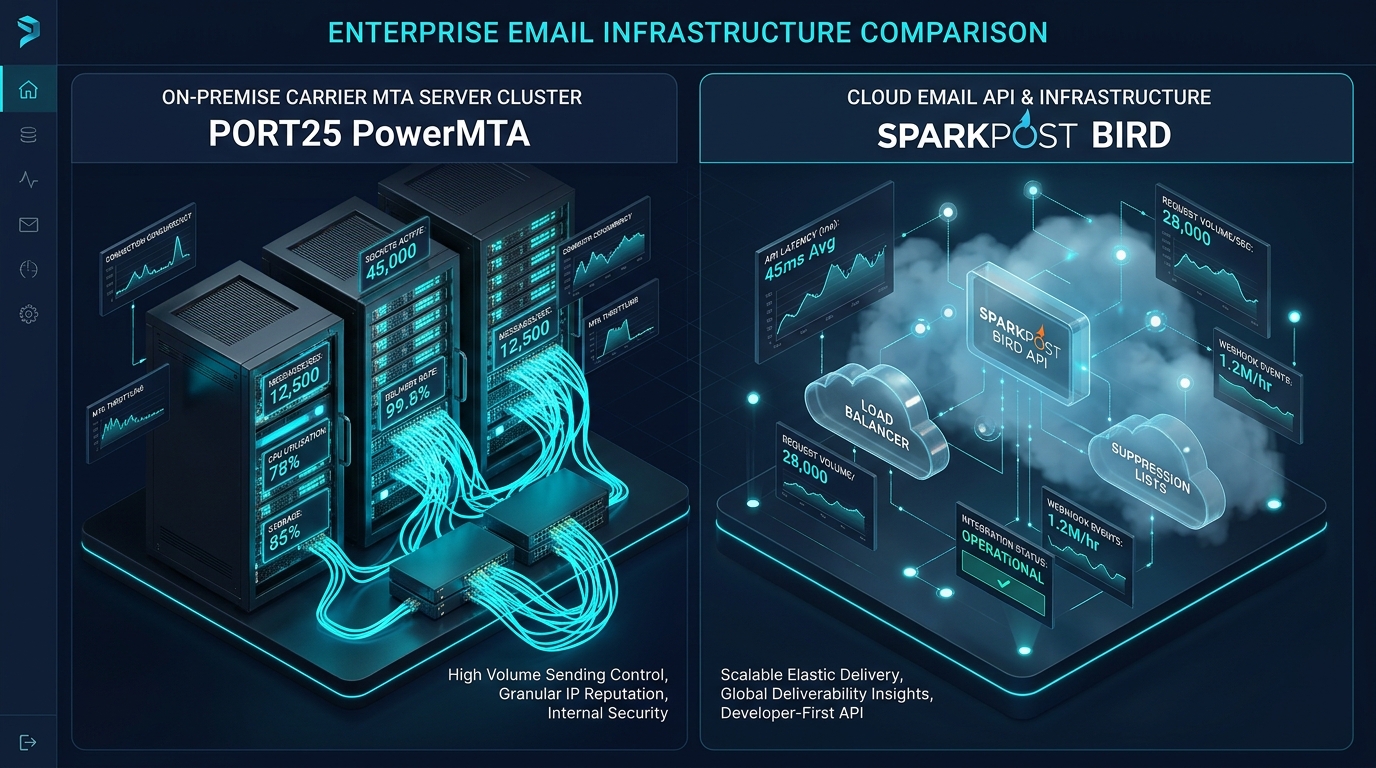
For high-volume email operations transmitting tens of millions of monthly messages, the architectural crossroads between Port25 PowerMTA and SparkPost (now owned by Bird) represents the fundamental debate between sovereign bare-metal control and managed cloud elasticity. While SparkPost evolved from the legendary enterprise Momentum MTA (Message Systems) into a developer-first cloud REST API, PowerMTA remains the undisputed gold standard for on-premises and dedicated bare-metal mail transport. Following Bird’s corporate acquisition and pricing adjustments in 2025–2026, enterprise broadcasters are re-evaluating their total cost of ownership (TCO), queue transparency, and IP warming autonomy. This benchmark dissects socket throughput, adaptive ISP throttling, financial break-even models, and operational migration paths.
- 1. Architectural Foundations: Momentum Heritage vs C++ Engine
- 2. Throughput & Concurrency: Bare-Metal Sockets vs Cloud API
- 3. Deliverability Controls: Adaptive Delivery vs Granular PMTA Directives
- 4. Total Cost of Ownership: 5M to 100M Monthly Send Economics
- 5. Strengths & Operational Trade-offs
- 6. Comprehensive Technical Comparison Matrix
- 7. Production Migration Case Study: 40M Monthly Broadcaster
- 8. The AutoSMTP Bare-Metal Cluster Advantage
1. Architectural Foundations: Momentum Heritage vs C++ Engine
To understand the operational contrast between PowerMTA and SparkPost, one must look at their foundational heritage. SparkPost was created by Message Systems to bring their enterprise Momentum C/Lua MTA platform into a multi-tenant cloud API model. While SparkPost abstracts the underlying MTA infrastructure behind REST endpoints, Webhooks, and web consoles, PowerMTA grants direct kernel-level access to the socket layer, memory spooling, and virtual network interfaces.
Sovereign Bare-Metal vs Managed Multi-Tenant Cloud
PowerMTA: Deployed as a standalone daemon on dedicated enterprise Linux hardware (CentOS, AlmaLinux, Debian). Operates an asynchronous, multi-threaded C++ engine that writes directly to an optimized on-disk spool while caching active transit queues entirely in RAM. You retain 100% legal custody of your sending IPs, SSL/TLS certificates, TLS negotiation logs, and raw recipient mail streams without intermediate cloud inspection.
SparkPost (Bird): Functions as a managed cloud service. Client applications send payloads over HTTP POST requests (/api/v1/transmissions) or standard SMTP injection into SparkPost’s cloud edge. Behind the scenes, SparkPost manages auto-scaling Momentum clusters, handles IP routing, and runs proprietary “Adaptive Delivery” machine-learning algorithms to optimize delivery rates.
2. Throughput & Concurrency: Bare-Metal Sockets vs Cloud API
Raw throughput in high-volume environments depends heavily on network hop count, serialization overhead, and connection pooling. While SparkPost can handle massive bursts thanks to cloud elasticity, each REST call incurs HTTP TLS handshake overhead, JSON payload serialization, and cloud load-balancer latency.
# ==============================================================================
# CARRIER-GRADE SOCKET CONCURRENCY & SPOOL TUNING (1M+ EMAILS / HR)
# ==============================================================================
max-msg-per-connection 100
max-smtp-out 2500
smtp-source-host 198.51.100.10 vmta10
smtp-source-host 198.51.100.11 vmta11
smtp-source-host 198.51.100.12 vmta12

<domain-macro enterprise-receivers>
    domain gmail.com
    domain googlemail.com
    domain yahoo.com
    domain aol.com
    domain outlook.com
    domain hotmail.com
</domain-macro>

<domain $enterprise-receivers>
    max-smtp-out 120
    max-msg-per-connection 50
    smtp-421-means-mx-unavailable yes
    backoff-to-normal-after 10m
    retry-after 5m
</domain>
In contrast, a single dedicated 16-core bare-metal PowerMTA server running NVMe storage easily sustains 1.2M to 1.8M messages per hour with sub-millisecond local Unix socket injection, zero API rate limiting, and zero serialization bottlenecks.
3. Deliverability Controls: Adaptive Delivery vs Granular PMTA Directives
The primary battleground between SparkPost and PowerMTA lies in how throttling and ISP reputation management are orchestrated:
PowerMTA: Granular Deterministic Rules
PowerMTA allows systems engineers to define exact mathematical rules down to the individual IP and domain level. You control connection timeouts, socket limits, MX concurrency, bounce categorization, backoff intervals, and in-flight queue prioritization. When Gmail or Yahoo changes rate limits, you adjust configuration in real-time without waiting on support tickets.
SparkPost: “Black Box” Machine Learning
SparkPost markets “Adaptive Delivery”—automated algorithms that analyze real-time ISP response codes and automatically slow down or speed up traffic. While convenient for marketing teams without deep SMTP engineering talent, it operates as a black box. If Adaptive Delivery misinterprets a temporary greylist deferral as a hard block, it may throttle legitimate transaction queues without your explicit consent.
4. Total Cost of Ownership: 5M to 100M Monthly Send Economics
The financial equation is where the differences become decisive. SparkPost charges on a utility or tiered volume model that scales directly with message volume. PowerMTA operates on flat software licensing paired with predictable bare-metal hosting costs:
| Monthly Volume | SparkPost Enterprise Cost | Dedicated PowerMTA Cluster (AutoSMTP) | Monthly Savings | Annual Savings |
|---|---|---|---|---|
| 5,000,000 | $1,850 – $2,400 / mo | $750 / mo (Dual Bare-Metal + 16 IPs) | $1,400 / mo | $16,800 / yr |
| 20,000,000 | $6,200 – $7,800 / mo | $1,250 / mo (Quad Bare-Metal + 32 IPs) | $5,750 / mo | $69,000 / yr |
| 50,000,000 | $14,500 – $18,000 / mo | $2,450 / mo (8-Node Cluster + 64 IPs) | $13,550 / mo | $162,600 / yr |
| 100,000,000+ | $26,000 – $34,000 / mo | $4,800 / mo (Enterprise Fleet + 128 IPs) | $24,000+ / mo | $288,000+ / yr |
5. Strengths & Operational Trade-offs
Where PowerMTA Wins
- Zero Account Freezes: No compliance algorithm can suspend your account or block business operations due to a spike in bounce rates.
- Massive Cost Reduction: Flat hardware and license pricing drops effective cost per thousand to under $0.05 at scale.
- Complete IP Sovereignty: You own and cultivate your dedicated IPv4 CIDR blocks with zero risk of dirty IP reassignment.
- Instant Wire Diagnostics: Immediate visibility into SMTP 421 and 550 codes via live
pmtcmdCLI and diagnostic logs.
Where SparkPost Wins
- Zero Hardware Overhead: No need to patch Linux operating systems, monitor hardware RAID arrays, or configure network bonds.
- Out-of-the-Box Signals: Comprehensive analytics dashboard with spam trap detection, engagement tracking, and bounce telemetry.
- Modern REST APIs: Instant integration into JavaScript, Python, Go, and Ruby backends with pre-built SDKs.
6. Comprehensive Technical Comparison Matrix
| Evaluation Pillar | Port25 PowerMTA | SparkPost (Bird) | Architectural Verdict |
|---|---|---|---|
| Deployment Model | Sovereign Bare-Metal / On-Prem | Multi-Tenant Cloud API | PowerMTA provides complete sovereignty |
| Throughput Ceiling | 1.5M+ msgs/hr per 16-core node | Elastic Cloud Scale (API throttled) | Tied (Local PMTA has lower latency) |
| Protocol Control | Kernel-level socket & RFC config | Abstracted REST / SMTP endpoints | PowerMTA offers unrivaled tuning |
| Reputation Risk | Zero noisy neighbors; 100% isolated | Shared infrastructure exposure | PowerMTA eliminates cross-tenant spills |
| IP Warmup Automation | Scripted Virtual MTA / AutoSMTP Engine | Automated Adaptive Delivery | SparkPost for hands-off; PMTA for precision |
| Cost Scalability | Flat predictable monthly overhead | Exponential volume-based billings | PowerMTA wins decisively past 5M/mo |
7. Production Migration Case Study: 40M Monthly Broadcaster
Migrating 40 Million Monthly Sends from SparkPost to Dedicated PowerMTA
A B2B SaaS platform delivering transaction alerts and promotional newsletters was sending 40M emails monthly via SparkPost, incurring over $12,400 per month in transmission charges. Frequent billing spikes during quarterly sales campaigns forced their engineering leadership to investigate a dedicated MTA deployment.
The Implementation: AutoSMTP deployed a redundant 4-node PowerMTA bare-metal cluster with 32 dedicated IPv4 addresses. Using automated warmup schedules and gradual traffic shifting over 28 days, delivery rates to Gmail and Microsoft 365 were sustained at 99.4% inbox placement.
The Outcome: Total monthly email infrastructure expenditure dropped from $12,400 to $1,850/mo (including hardware, IP allocation, and 24/7 deliverability monitoring)—yielding a documented annual savings of $126,600 while slashing average delivery latency from 1.8 seconds to 340 milliseconds.
Recommended Decision Roadmap
Choose SparkPost if your total sending volume remains below 3M messages per month, you lack dedicated Linux systems administrators, and you require turn-key webhooks without maintaining server hardware.
Choose PowerMTA (via AutoSMTP) if your volume exceeds 5M messages monthly, you demand predictable operational expenses, you operate mission-critical cold email or marketing streams that cannot risk third-party account suspensions, and you require sovereign control over your IP reputation.
The AutoSMTP Deliverability Defense Advantage
Inbound and outbound filtering pipelines require robust underlying transport hardware. AutoSMTP provisions sovereign, dedicated bare-metal MTA infrastructure engineered for high-throughput filtering, synchronous 550 bounce suppression, and permanent reputation control.
Provisions fully licensed PowerMTA and KumoMTA clusters on enterprise bare-metal with dedicated IPv4 subnets and predictable flat pricing.
Monitors Google Postmaster spam ratios (<0.1%) and real-time ISP deferrals with algorithmic volume scaling across your entire IP pool.
RFC 5321 in-band 550 bounce suppression, automated Yahoo/Outlook Complaint Feedback Loops (CFL), and instant bad-IP eviction.
Pre-configured forward and reverse DNS (PTR) per IP, SPF CIDR alignment, 2048-bit DKIM rotation, and strict DMARC enforcement.
Upgrade Your Email Infrastructure with Dedicated Bare Metal
Eliminate filter lag, queue serialization bottlenecks, and noisy neighbor contamination. Deploy a turnkey AutoSMTP cluster today.
Deploy Turnkey MTA Cluster →