

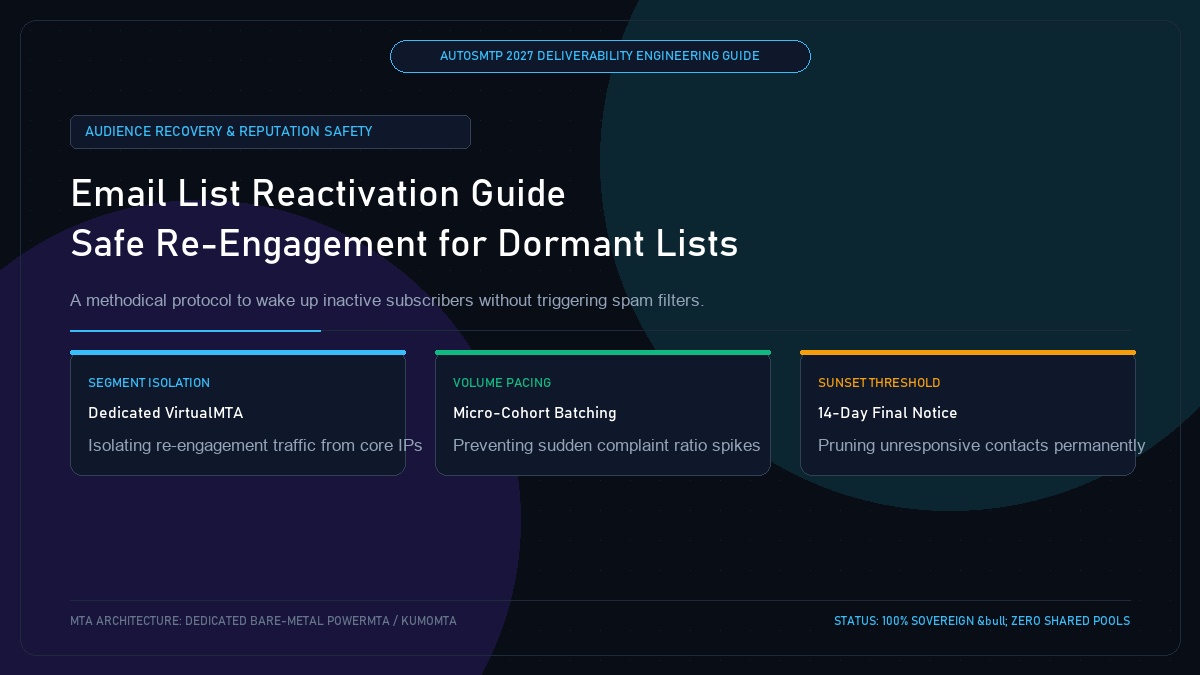
Email List Reactivation: Safe Re-engagement Strategy for Dormant and Aged Subscriber Databases
Published by Fred Dawson • Senior Deliverability Systems Architect • 22 min read
Every growing organization accumulates dormant subscribers: contacts who have not opened or clicked an email in 90 to 180 days. While marketing executives view dormant lists as untapped revenue, deliverability systems architects recognize them as a primary hazard. Blasting an aged list through your primary production IP cluster triggers spam complaints, trips recycled spam traps, and crashes Google Postmaster domain reputation. However, with the right technical isolation, micro-cohort throttling, and compelling re-opt-in copy, dormant contacts can be safely reactivated. This guide provides an operational blueprint for safe list recovery.
- 1. The Inherent Dangers of Mailing Dormant Contacts
- 2. Infrastructure Isolation: Routing via Dedicated VirtualMTAs
- 3. Segmenting Dormancy by Age: 60-Day, 90-Day, 180-Day Tiers
- 4. The Two-Step High-Intent Reactivation Sequence
- 5. Enforcing the Hard Sunset: Clean Pruning Protocol
- 6. Reactivation Cadence & Throttle Matrix
- 7. Case Study: Recovering $320K from a Dormant SaaS Database
- 8. The AutoSMTP Deliverability Defense Advantage
1. The Inherent Dangers of Mailing Dormant Contacts
Mailing contacts who have ignored your messages for months carries severe risks:
- Elevated Complaint Velocity: Subscribers who forgot they signed up are 5x more likely to click “Report Spam.”
- Recycled Spam Traps: Mailbox providers convert abandoned inboxes into spam traps after 12 months. Mailing them results in instant blocklisting.
- Negative Engagement Signals: Low open rates tell Google’s machine learning classifiers that your content is unwanted.
2. Infrastructure Isolation: Routing via Dedicated VirtualMTAs
Never send reactivation campaigns over the same IP address used for critical product notifications or active daily newsletters:
# Isolated spool for re-engagement traffic:
<virtual-mta vmta_reactivation>
    smtp-source-ip 198.51.100.42
    host-name mail.reactivate.example.com

    # Conservative throughput throttling to avoid ISP alarm
    max-msg-rate 2500/h
    max-smtp-out 10
</virtual-mta>
3. Segmenting Dormancy by Age: 60-Day, 90-Day, 180-Day Tiers
Never treat all dormant users equally. Divide contacts into distinct risk tiers:
- Tier 1 (60–90 Days Inactive): Low risk. Standard re-engagement offer; ~15% recovery rate.
- Tier 2 (91–180 Days Inactive): Moderate risk. Must run through API verification before sending.
- Tier 3 (> 180 Days Inactive): Extreme risk. High probability of abandoned traps. Send in micro-batches of < 500/day.
4. The Two-Step High-Intent Reactivation Sequence
Deploy a concise two-message workflow:
- Step 1 (Value Proposition / Permission): “Should we keep in touch?” Transparent, honest check-in with a 1-click button to confirm interest.
- Step 2 (Final Notice): “Closing your account notifications.” Sent 7 days later. Informs the user they will be removed unless they click.
5. Enforcing the Hard Sunset: Clean Pruning Protocol
If a subscriber does not engage within 14 days of the second notice, they must be permanently suppressed. Keeping disengaged contacts on active lists to preserve vanity metrics is a fatal deliverability error.
6. Reactivation Cadence & Throttle Matrix
| Dormancy Tier | Pre-Send Scrubbing | Hourly Rate Cap | Expected Recovery Rate |
|---|---|---|---|
| 60 – 90 Days | Standard Syntax Check | 5,000 msg / hour | 12% – 18% |
| 91 – 180 Days | Full Real-Time API Scrub | 2,500 msg / hour | 6% – 10% |
| > 180 Days | Double-Pass Verification + Trap Filter | 500 msg / hour | 2% – 4% |
Recovering $320,000 in ARR from a 250K Dormant SaaS Database
A B2B SaaS platform had accumulated 250,000 inactive trial users over two years. Marketing wanted to blast a 50% discount to all of them, but deliverability engineers intervened to prevent IP blacklisting. They routed the campaign through a dedicated AutoSMTP VirtualMTA, scrubbed the list through ZeroBounce (removing 34,000 invalid addresses), and executed a throttled 2-step sequence. Over 22,000 high-intent subscribers reactivated, generating $320,000 in new annual recurring revenue, while 194,000 permanently unresponsive contacts were safely purged with zero impact on primary IP reputation.
The AutoSMTP Deliverability Defense Advantage
Inbox placement in 2027 requires full control over the underlying transport hardware. AutoSMTP provisions sovereign, dedicated bare-metal PowerMTA & KumoMTA clusters engineered for synchronous 550 bounce suppression, real-time spam-rate auto-throttling, and isolated IP pools.
Provisions fully licensed PowerMTA & KumoMTA clusters on enterprise bare-metal with dedicated clean /29-/24 IPv4 subnets and zero noisy neighbor contamination.
Monitors Google Postmaster spam ratios (<0.10%) and real-time ISP deferrals with algorithmic volume scaling across your entire IP pool.
RFC 5321 in-band 550 bounce suppression, automated Yahoo/Outlook Complaint Feedback Loops (CFL), and instant bad-IP eviction.
Pre-configured forward and reverse DNS (PTR) per IP, SPF CIDR alignment, 2048-bit DKIM rotation, and strict DMARC enforcement.
Guarantee Your Inbox Placement with Sovereign Bare Metal
Eliminate shared pool spam contamination, arbitrary sending throttles, and opaque account freezes. Deploy an enterprise AutoSMTP cluster today.
Deploy Turnkey MTA Cluster →