

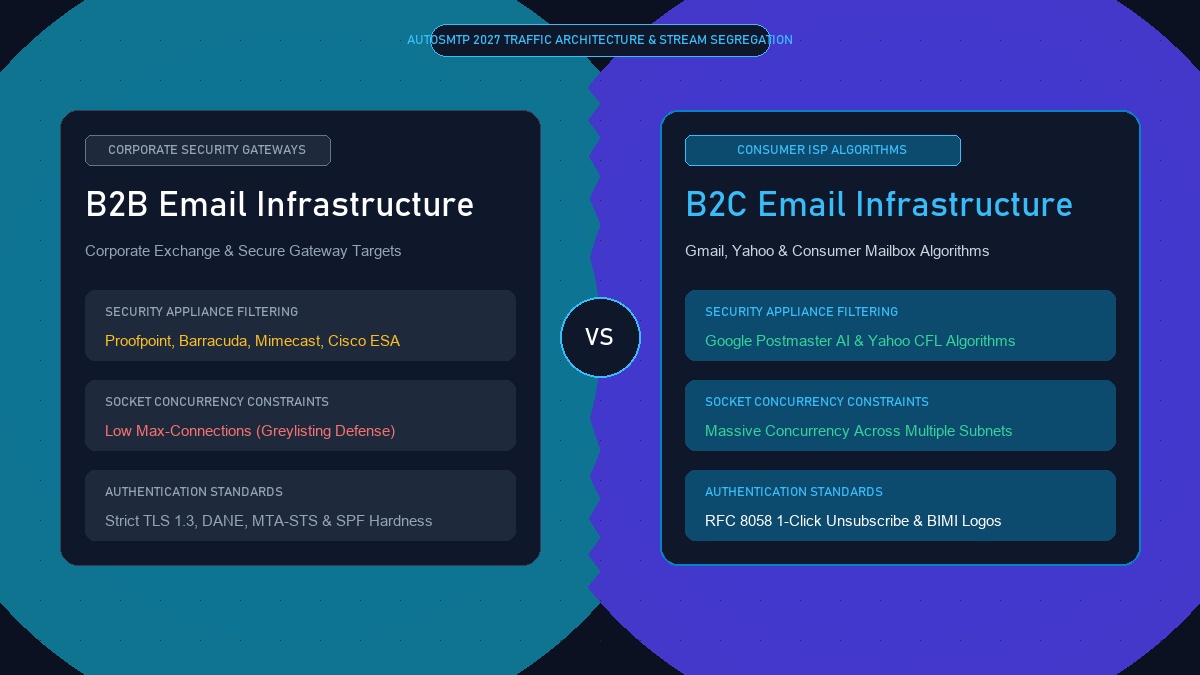
B2B vs B2C Email Infrastructure: 2027 Recipient Environments, Security Gateways, Economics & IP Topologies
While B2B and B2C email operate across the identical RFC 5321 SMTP transport protocol, they function in completely distinct threat landscapes, economic models, and mailbox environments. B2B email infrastructure delivers into corporate inboxes hosted on Microsoft 365, Google Workspace, and enterprise security perimeter gateways (Proofpoint, Mimecast, Barracuda, Cisco). These enterprise gateways aggressively pre-fetch URLs, inspect attachments, enforce strict SPF/DKIM/DMARC alignment, and reject unfamiliar sending domains.
Conversely, B2C email infrastructure delivers to massive consumer mailbox pools (Gmail, Yahoo, Apple Mail, Outlook.com) dominated by algorithmic engagement filters, Apple Mail Privacy Protection (MPP), and dedicated Promotions/Spam tab classification. In 2027, B2B generates approximately 4.3x higher revenue per send ($0.50–$2.00 vs $0.12–$0.50), justifying higher per-message infrastructure investment, dedicated IP allocations, and customized outbound MTA rate-shaping.
- 1. Same Protocol, Completely Different Worlds
- 2. Recipient Mailbox Environments Compared
- 3. Economics, Lifetime Value & ROI Math
- 4. Corporate Security Gateways vs Consumer ML
- 5. Account-Based (ABM) vs Predictive CLV
- 6. Frequency Tolerance & Sales-Handoff Gating
- 7. Measurement: Bot Prefetching vs Apple MPP
- 8. Production PowerMTA & KumoMTA Traffic Rules
- 9. Comprehensive 2027 Architectural Matrix
- 10. Enterprise Field Study: SaaS & E-Commerce
- 11. Infrastructure Decision Matrix
- 12. The AutoSMTP Dedicated Advantage
1. Same Protocol, Completely Different Worlds
At the network layer, both B2B and B2C email utilize standard TCP port 25, TLS 1.3 encryption, and DNS-based cryptographic authentication (SPF, DKIM-2048, DMARC, and BIMI). However, their operational and behavioral patterns diverge dramatically:
- The B2B Interaction Dynamic: Business professionals receive email at work desks on laptops and corporate devices. Emails are parsed methodically through inbox search, Outlook folders, and calendar integrations. Purchasing decisions involve committees, legal review, and 3-to-12-month sales cycles. A single misstep (such as being blacklisted by Proofpoint or triggering a corporate phishing alert) can compromise million-dollar enterprise contract negotiations.
- The B2C Interaction Dynamic: Consumers scan messages rapidly on mobile devices (smartphones account for 65–80% of consumer opens) during commutes, lunch breaks, and evenings. Engagement is emotional, immediate, and transactional. Success is measured by immediate checkout velocity, browse abandonment recovery, and aggregate volume economics.
B2B Infrastructure Profile
- Destination Landscape: 60%+ Microsoft 365, 25%+ Google Workspace, 15% on-prem/hybrid.
- Perimeter Defense: Multi-layer corporate security gateways (Proofpoint, Mimecast, Barracuda).
- Economic Value: High contract value ($5k–$500k+), generating $0.50–$2.00+ revenue per send.
- Primary Risk: Corporate security blacklisting, URL sandbox blocking, false-positive phishing flags.
B2C Infrastructure Profile
- Destination Landscape: 55%+ Gmail Consumer, 20%+ Apple Mail/iCloud, 15%+ Yahoo/AOL.
- Perimeter Defense: Algorithmic behavioral filters, Gmail Promotions tab classification, Spam Traps.
- Economic Value: Low transaction value ($20–$150), generating $0.12–$0.50 revenue per send.
- Primary Risk: Promotions tab relegation, subscriber complaint spikes (>0.1%), IP throttling.
2. Recipient Mailbox Environments Compared
Understanding the destination infrastructure is vital for configuring MTA connection concurrency, TLS handshakes, and timeout limits:
| Environment Attribute | B2B Corporate Inboxes | B2C Consumer Inboxes |
|---|---|---|
| Primary MX Hosts | *.mail.protection.outlook.com (Microsoft 365), aspmx.l.google.com (Google Workspace) |
gmail-smtp-in.l.google.com, mta*.am0.yahoodns.net, mx*.icloud.com |
| Security Gateways | Proofpoint Enterprise, Mimecast Secure Email, Cisco Secure Email, Barracuda ESG | Internal ML spam filtering (Google SpamNet, Yahoo SpamGuard, Apple Mail Filters) |
| Link Verification | Aggressive headless browser pre-fetching and sandboxing before user delivery | Real-time user click verification (Google Safe Browsing API, Apple Link Tracking Protection) |
| DMARC Enforcement | Strict p=reject enforcement; corporate MXs often quarantine on SPF alignment failure |
Strict 2024+ sender mandates (SPF/DKIM alignment, DMARC record mandatory for >5k sends) |
| Reading Client Breakdown | 65% Desktop (Outlook Desktop, Web Outlook, Mac Mail), 35% Mobile | 75% Mobile (iOS Mail, Gmail Android/iOS), 25% Webmail/Desktop |
| Engagement Window | Monday – Friday, 08:00 – 18:00 local business time (sharp weekend drop) | 7 days/week, 07:00 – 23:00 local time (peak evening and weekend browsing) |
3. Economics, Lifetime Value & ROI Math
The economic divergence between B2B and B2C dictates infrastructure expenditure thresholds. In B2B, a targeted cohort of 2,500 enterprise accounts represents millions in prospective annual contract value (ACV). In B2C, an e-commerce brand requires 250,000 consumer subscribers to achieve comparable gross revenue.
The Unit Economics of Deliverability
B2B Unit Economics: With an average revenue per send of $1.10 and a customer lifetime value of $25,000, losing even 2% deliverability to Proofpoint or Defender false-positive quarantine translates into hundreds of thousands of dollars in lost pipeline. Dedicated bare-metal MTAs with warm, isolated IP addresses represent an indispensable insurance policy.
B2C Unit Economics: With an average revenue per send of $0.22 and a customer lifetime value of $140, sending cost efficiency is paramount. Infrastructure must achieve extreme throughput per dollar, utilizing connection multiplexing, burst queueing, and aggressive automated retry policies to maximize gross campaign margins.
4. Corporate Security Gateways vs Consumer ML Filters
B2B senders must navigate a multi-layered gauntlet of enterprise security appliances that do not exist in consumer sending:
| Inspection Layer | Appliance / Mechanism | Operational Behavior & Failure Modes |
|---|---|---|
| Layer 1: Perimeter DNS & IP Reputation | Spamhaus SBL/CSS, Proofpoint Dynamic Reputation, Barracuda BRBL | Rejects TCP connection during initial handshake if IP lacks valid rDNS (PTR) or has dirty historical reputation. |
| Layer 2: Protocol & Auth Verification | RFC 5321 / RFC 5322 parser, OpenSSL TLS inspector, DMARC verifier | Enforces TLS 1.2+ with forward secrecy. Rejects unaligned DKIM keys or broken envelope-from / header-from combinations. |
| Layer 3: Sandboxed Link & Attachment Prefetching | Proofpoint Targeted Attack Protection (TAP), Mimecast URL Protect, Defender Safe Links | Headless security bots instantly crawl all hyperlinks in the message body. They load pages, evaluate DOM JavaScript, and test redirect chains. |
| Layer 4: AI Phishing & Linguistic Heuristics | Abnormal Security, Darktrace Antigena, Ironscales | Analyzes domain age (rejects newly registered domains <30 days old), executive name spoofing, urgent wire/payment phrasing, and credential prompts. |
5. Account-Based (ABM) vs Predictive CLV Segmentation
Segmentation philosophies in B2B and B2C are fundamentally orthogonal:
- B2B Account-Based Segmentation: The primary unit of organization is the company account, not the individual email address. Contacts within an account are categorized by committee role (Executive Decision Maker, Technical Champion, Procurement, End User). If an account is flagged as an active sales opportunity in Salesforce or HubSpot, marketing broadcast sequences must instantly yield to sales outreach.
- B2C Behavioral & Predictive Segmentation: The primary unit of organization is the individual consumer identity. Machine learning models predict next purchase dates, calculate customer lifetime value (CLV) trajectories, and assign real-time churn risk scores. Segments are dynamic and updated continuously based on web browse telemetry, cart additions, and coupon sensitivity.
6. Frequency Tolerance & Sales-Handoff Gating
Cadence mismanagement carries asymmetric penalties across both environments:
- B2B Cadence Boundaries: Sending more than 2 marketing emails per week to an enterprise contact produces rapid fatigue, domain unsubscribes, and internal IT spam reports. Crucially, when an enterprise prospect books a product demo or responds to an account executive, marketing infrastructure must execute an automated sales-handoff pause, suppressing all automated newsletters and promotional blasts for 30 to 60 days.
- B2C Cadence Boundaries: High-growth retail and DTC brands frequently send 4 to 7 emails per week during promotional cycles. Consumer audiences tolerate high frequency if the content is personalized, discount-driven, or product-focused. However, B2C infrastructure must implement strict journey frequency caps to prevent cart abandonment reminders from colliding with promotional newsletters on the same day.
7. Measurement: Bot Prefetching vs Apple MPP Distortions
Telemetry in 2027 is heavily polluted by automated client software. Operators must implement server-side filtration to maintain data accuracy:
The B2B Bot Prefetch Distortion
Corporate gateways (Proofpoint TAP, Mimecast, Microsoft Defender) open every email and click every hyperlink within 1–10 seconds of delivery to test for malicious redirects. This generates ghost clicks, artificially inflating B2B click-through rates by 200–500%.
Engineering Fix: Implement click debouncing (discard clicks occurring <5 seconds post-handshake) and analyze User-Agent strings (e.g., headless Chrome, Proofpoint crawler IPs) to isolate genuine human clicks.
The B2C Apple Mail Privacy Protection (MPP) Distortion
Apple Mail pre-loads all remote images (including tracking pixels) via proxy servers as soon as an email arrives at an iCloud or iOS-connected inbox, regardless of whether the user opens it. B2C open rates artificially surge to 60–80% across Apple segments.
Engineering Fix: Treat open rates as a directional indicator only. Shift all B2C engagement and warm-up scoring to downstream telemetry: link clicks, onsite dwell time, webhooks, and purchase conversions.
8. Production PowerMTA & KumoMTA Traffic Rules
To maximize deliverability into corporate Microsoft 365 / Google Workspace tenants without starving consumer Gmail/Yahoo queues, MTA traffic policies must be segregated by destination MX patterns:
# ==============================================================================
# AutoSMTP PowerMTA Configuration: B2B Enterprise & Security Gateway Pacing
# ==============================================================================

# Macro: Major B2B Enterprise Cloud & Security Gateways
domain-macro b2b-gateways mail.protection.outlook.com, aspmx.l.google.com,                           pphosted.com, mimecast.com, barracudanetworks.com

# Traffic Rules for Corporate Enterprise Gateways
<domain $b2b-gateways>
    # Strict TLS 1.3 requirement; refuse insecure fallback
    require-tls yes

    # Moderate connection pool to avoid triggering gateway DDoS defenses
    max-smtp-out 40
    max-msg-per-connection 25

    # Conservative connection rate to avoid Proofpoint rate-limiting
    max-connection-rate 20/m

    # Enterprise MXs prefer clean handshakes with extended timeouts
    connect-timeout 45s
    command-timeout 60s

    # Dedicated B2B Corporate Outbound IP Pool
    use-virtual-mta-pool pool-b2b-corporate
</domain>

# B2C Consumer Macro: Gmail & Yahoo
domain-macro b2c-consumer gmail.com, googlemail.com, yahoo.com, aol.com

<domain $b2c-consumer>
    # High-throughput connection reuse for massive consumer volume
    max-smtp-out 150
    max-msg-per-connection 100
    max-connection-rate 300/m
    smtp-421-backoff-period 10m

    # Dedicated B2C Outbound IP Pool
    use-virtual-mta-pool pool-b2c-consumer
</domain>-- ==============================================================================
-- AutoSMTP KumoMTA Lua Policy: Dynamic B2B vs B2C Egress Pool Selection
-- ==============================================================================
local kumo = require 'kumo'
kumo.on('get_queue_config', function(domain, tenant, campaign)
-- Identify B2B Corporate Destinations via MX pattern matching
local is_b2b = false
if domain:find('protection.outlook.com$') or
domain:find('pphosted.com$') or
domain:find('mimecast.com$') or
tenant == 'b2b-sales' then
is_b2b = true
end
if is_b2b then
return kumo.make_queue_config {
egress_pool = 'b2b-clean-ips',
max_connection_rate = '30/s',
max_deliveries_per_connection = 30,
protocol = {
smtp = {
enable_tls = 'Required',
connect_timeout = '45s',
}
}
}
else
-- High-throughput B2C Consumer Egress Policy
return kumo.make_queue_config {
egress_pool = 'b2c-bulk-ips',
max_connection_rate = '250/s',
max_deliveries_per_connection = 120,
retry_interval = '10m',
}
end
end)9. Comprehensive 2027 Architectural Comparison Matrix
| Comparison Dimension | B2B Enterprise Infrastructure | B2C Consumer Infrastructure | AutoSMTP Hybrid Best Practice |
|---|---|---|---|
| Destination Infrastructure | Microsoft 365, Google Workspace, Proofpoint, Mimecast | Gmail Consumer, Yahoo Mail, Apple Mail/iCloud, Outlook.com | Auto-detected MX routing with specialized gateway profiles |
| Revenue Per Send | $0.50 – $2.50+ (high ACV, long cycles) | $0.10 – $0.45 (transactional volume, impulse buying) | Cost-per-send optimized across separate bare-metal clusters |
| Annual List Churn | 25% – 35% (frequent employee job transitions) | 10% – 18% (abandoned consumer webmail inboxes) | Automated pre-flight bounce suppression & validation workers |
| Sending Cadence | 1 – 2 sends per week (strict business hours) | 3 – 7 sends per week (evenings & weekends included) | Recipient timezone scheduling with automated quiet-hours hold |
| Key Telemetry Distortion | Security gateway bot link prefetching (false clicks) | Apple Mail Privacy Protection proxy caches (false opens) | Click debounce filters & server-side conversion tracking |
| Authentication Sensitivity | Extreme (corporate MXs drop mail on DMARC or DKIM fail) | High (strict compliance enforced by Gmail/Yahoo 2024 mandates) | 100% strict DMARC p=reject + 2048-bit DKIM keys |
| Recommended Platform Tier | HubSpot Enterprise, Marketo, AutoSMTP PowerMTA B2B Relay | Klaviyo, MailWizz, AutoSMTP High-Throughput KumoMTA Pool | Decoupled 3-layer architecture with private bare-metal MTAs |
10. Enterprise Field Study: SaaS & E-Commerce Hybrid Split
Separating Enterprise B2B Accounts from 2.4M DTC Consumer Contacts
The Incident: A developer tools enterprise operated both an open-source consumer subscription tier (2.4M consumer developers on Gmail/Yahoo/iCloud) and an enterprise self-hosted license division ($50,000+ ACV B2B accounts). Both streams were dispatched through a single cloud ESP account sharing outbound IPs. In November, marketing blasted an end-of-year consumer discount campaign. High consumer spam complaints (0.14%) triggered a reputation downgrade across the shared IPs. Within 48 hours, Microsoft Defender and Proofpoint began quarantining all outbound enterprise renewal reminders and sales follow-ups. Enterprise pipeline stalled, threatening $420,000 in fourth-quarter renewals.
The AutoSMTP Remediation: The engineering team executed an immediate infrastructure segregation strategy:
- B2B Enterprise Stream: Migrated to a private AutoSMTP PowerMTA node configured with 2 dedicated, pristine IPv4 addresses, bound exclusively to
corp.company.com. Connection concurrency into Microsoft 365 and Proofpoint was capped at 30 outbound connections. - B2C Consumer Stream: Routed through a high-throughput 6-IP KumoMTA cluster operating on
news.company.comwith automated ISP feedback loop (FBL) ingestion and List-Unsubscribe headers. - Telemetry Sanitization: Deployed a link-click debounce worker in Redis to filter out Mimecast/Proofpoint scanner clicks from sales telemetry.
The Results: B2B corporate inbox placement returned to 99.8% on Microsoft 365 within 72 hours. Enterprise renewal reminders delivered instantly, closing 100% of at-risk contracts. Consumer marketing throughput tripled to 450,000 emails/hour with zero spillover risk into the B2B enterprise domain.
11. Infrastructure Decision Matrix: Pure vs Mixed Operations
Scenario A: Pure B2B Organization (< 100,000 monthly sends)
Focus on reputation purity and authentication rigor rather than high-throughput sending. Utilize dedicated corporate IPs with strict DMARC, maintain a maximum sending cadence of 1–2 emails per week, and integrate CRM sales handoffs to pause marketing broadcasts during active opportunities.
Scenario B: Pure B2C / DTC E-Commerce (> 500,000 monthly sends)
Prioritize throughput efficiency, mobile-first design, and behavioral lifecycle automation (cart abandonment, replenishment, winback). Utilize dedicated IP pools with automated warm-up gas pedals, monitor Google Postmaster reputation daily, and optimize for connection reuse on Gmail and Yahoo.
Scenario C: Hybrid B2B & B2C Operations (The Segregation Mandate)
Never allow B2C marketing campaigns to share IP addresses or subdomains with B2B corporate sales communications. Establish two distinct sending tiers: a pristine B2B corporate IP pool with conservative rate limits for enterprise gateways, and a scalable high-throughput B2C pool for consumer volume.
4-Step Protocol for Enterprise B2B Infrastructure Hardening
- Enforce Strict Cryptographic Auth: Deploy 2048-bit DKIM keys, publish an explicit SPF record without DNS lookup chaining (≤10 lookups), and enforce DMARC at
p=reject. - Isolate Corporate Outbound IPs: Allocate dedicated IPv4 addresses with pristine historical records and matching forward/reverse DNS records (PTR).
- Pace Connections for Enterprise Gateways: Configure your MTA to limit connection bursts into Proofpoint and Microsoft 365 to avoid triggering perimeter volumetric defenses.
- Sanitize Engagement Telemetry: Filter out headless security bot clicks to ensure sales representatives receive accurate prospect engagement intelligence.
The AutoSMTP Dedicated Enterprise Cluster
Eliminate reputation contamination and conquer corporate security gateways with AutoSMTP’s fully managed, dedicated bare-metal email infrastructure.
Provisions fully licensed PowerMTA and KumoMTA clusters on enterprise bare-metal with dedicated hardware and flat, predictable pricing.
Monitors Google Postmaster spam ratios (<0.1%) and real-time deferrals across clean IPv4 subnets for safe, automated ramp-up.
RFC 5321 in-band 550 bounce suppression and automated Yahoo/Outlook CFL ingest keep your reputation completely pristine.
Pre-configured rDNS/PTR, SPF, 2048-bit DKIM, strict DMARC, and BIMI integration ready for immediate high-volume sending.
Ready for Dedicated B2B & B2C Infrastructure?
Deploy enterprise PowerMTA and KumoMTA clusters engineered for deterministic deliverability and complete stream isolation.
Deploy Your Dedicated Cluster →