

Transactional vs Marketing Email Infrastructure: 2027 Stream Separation, Priority Queues & Dedicated IP Pools
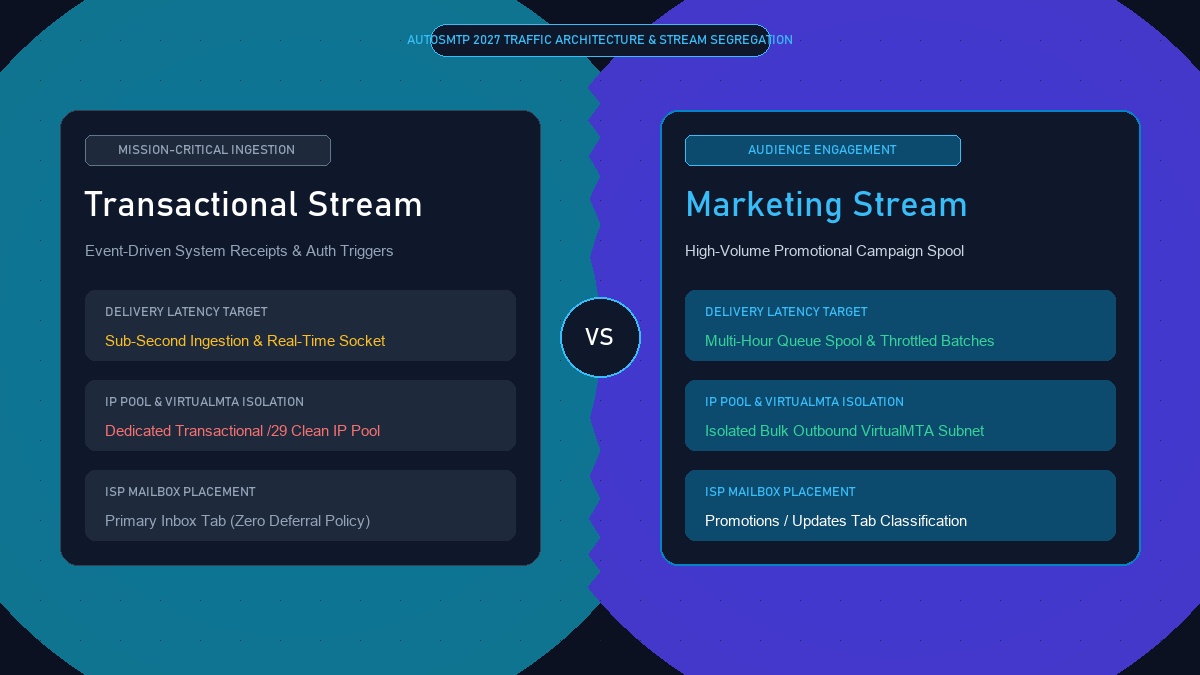
Executive Summary: Mixing transactional and marketing email on a single sending pipeline is one of the most hazardous architectural anti-patterns in modern software engineering. While both streams transmit MIME-encoded messages over SMTP, their operational requirements are diametrically opposed: transactional emails (password resets, 2FA codes, purchase receipts, fraud alerts) require sub-second latency, 99.99% primary inbox placement, and zero queue contention; marketing emails (newsletters, promotional broadcasts, re-engagement drip campaigns) generate bursty high-volume disk spools, higher complaint rates, and are expected to land in the Promotions or Updates tab. When an organization runs both streams through the same IP pool or MTA queue, holiday promotional blasts inevitably cause head-of-line blocking that delays urgent authentication tokens for hours, while marketing spam complaints drag critical billing receipts into the spam folder. This guide details stream separation across DNS subdomains, VirtualMTA priority pools, and independent bare-metal clusters.
- 1. The Fundamental Architectural Divide: SLA, Intent & Legal Status
- 2. The Head-of-Line Blocking Trap: Why Password Resets Get Delayed
- 3. Reputation Contamination: How Marketing Spikes Burn Transactional IPs
- 4. Mailbox Provider Classification: Primary Inbox vs Promotions Tab
- 5. The Three Pillars of Stream Separation: Subdomains, IPs & Queues
- 6. Production MTA Configuration: PowerMTA & KumoMTA Priority Queues
- 7. Volume Thresholds: When Single-Stream Becomes Fatal
- 8. Production Case Study: FinTech App Eliminating Black Friday OTP Outages
- 9. Architectural Evaluation Matrix: Mixed vs Segregated Infrastructure
- 10. Strategic Implementation Framework & Deployment Roadmap
1. The Fundamental Architectural Divide: SLA, Intent & Legal Status
To construct reliable email delivery, engineering teams must recognize that transactional and marketing emails represent entirely distinct digital communication categories:
Trigger Mechanism: Triggered synchronously by a specific user action (account registration, password reset, checkout payment, security alert).
Latency Expectation: < 2 seconds. A user waiting for a two-factor login code will abandon checkout or submit repeated password requests if delivery exceeds 30 seconds.
Engagement Profile: 60%–85% open rates, <0.01% spam complaints. Legally exempt from unsubscribe requirements under CAN-SPAM and GDPR.
Trigger Mechanism: Initiated asynchronously by the business (promotional newsletters, seasonal sale announcements, re-engagement drip sequences).
Latency Expectation: Minutes to hours. Delivery can be batched and throttled over an extended window without degrading user experience.
Engagement Profile: 15%–30% open rates, 0.05%–0.20% spam complaints. Strictly requires functional 1-click unsubscribe headers (RFC 8058).
2. The Head-of-Line Blocking Trap: Why Password Resets Get Delayed
The most common operational failure in unified email infrastructure is head-of-line queue blocking. When a marketing team initiates a seasonal campaign blast of 350,000 promotional emails through a shared MTA daemon, those messages enter the disk queue immediately.
If an active customer attempts to log in two minutes later and requests a one-time verification password (OTP), that critical transactional message is placed at the end of the outbound spool queue behind hundreds of thousands of marketing messages. Because mailbox providers like Gmail and Microsoft 365 enforce rate limits (e.g., maximum 40 concurrent connections per IP), the MTA requires 45 to 90 minutes to drain the queue. The customer’s OTP expires before it ever leaves the server.
priority 10) or routed through a completely separate bare-metal MTA instance.
3. Reputation Contamination: How Marketing Spikes Burn Transactional IPs
Mailbox providers evaluate sender reputation based on real-time recipient feedback. If an aggressive marketing broadcast results in a temporary spike in spam complaints crossing Google’s strict 0.10% threshold (1 complaint per 1,000 emails), Google’s automated spam filters react immediately by applying rate limits (421 4.7.28 deferrals) and routing outbound traffic from that IP and domain into the Spam folder.
If your transactional order confirmations and password resets share the same IP pool and domain, they are penalized identically. A single poorly targeted marketing newsletter can prevent thousands of customers from receiving login links, order receipts, and shipping notifications.
4. Mailbox Provider Classification: Primary Inbox vs Promotions Tab
Modern mailbox providers employ machine-learning algorithms to categorize inbound messages into distinct inbox tabs (Gmail Primary vs Promotions vs Updates; Outlook Focused vs Other). These algorithms analyze sending domain history, recipient interaction ratios, and header metadata:
- When an IP or domain sends exclusively high-engagement transactional messages with 70%+ open rates and zero unsubscribes, the provider’s classifier learns to route 100% of its traffic directly to the Primary Inbox.
- When promotional newsletters are mixed onto that same identifier, the machine-learning classifier tags the domain as commercial marketing, pushing all subsequent messages—including account security alerts—into the Promotions tab or Junk folder.
5. The Three Pillars of Stream Separation: Subdomains, IPs & Queues
Complete stream isolation requires implementing three structural boundaries:
- Domain-Level Isolation: Never send marketing from the root apex domain. Delegate autonomous subdomains:
auth.branddomain.comfor transactional OTPs and password resets.billing.branddomain.comfor invoices and receipt PDFs.news.branddomain.comfor promotional campaigns and newsletters.
- IP-Level Isolation: Assign distinct IPv4 subnets. Transactional messages originate from a dedicated /29 clean IP pool, while marketing dispatches from a separate pool configured with dynamic gas-pedal throttling.
- MTA Queue Isolation: Separate spool directories and priority allocation rules to ensure transactional messages bypass bulk queues with zero wait time.
6. Production MTA Configuration: PowerMTA & KumoMTA Priority Queues
Below is the enterprise PowerMTA configuration deployed by AutoSMTP to enforce 100% stream separation and eliminate head-of-line contention:
7. Volume Thresholds: When Single-Stream Becomes Fatal
When is it safe to maintain a single stream, and when does separation become mandatory? The operational decision curve follows distinct volume tiers:
- Under 10,000 Emails / Month: A single dedicated stream is acceptable if lists are strictly opted-in and marketing sends are infrequent (e.g., bi-weekly).
- 10,000 to 50,000 Emails / Month: Domain separation (subdomain delegation) is mandatory. Transactional must be moved to a distinct subdomain (e.g.,
notify.brand.com). - Over 50,000 Emails / Month: Full physical separation (dedicated transactional IP + dedicated marketing IP pool + separate queue prioritization) is essential to prevent business-critical delivery failures.
8. Production Case Study: FinTech App Eliminating Black Friday OTP Outages
How an E-Commerce Payment Gateway Eliminated a 38-Minute OTP Delay During Peak Holiday Sales
Background: A European online checkout provider processing payments for 800+ merchants used a single cloud email relay for both its monthly merchant marketing newsletters and real-time 3D-Secure one-time authentication codes (OTPs). During the Black Friday promotional rush, the marketing team scheduled a campaign blast of 620,000 merchant emails at 09:00 AM. Immediately, customer OTP verification codes were queued behind the marketing blast. Customers attempting to complete purchases suffered delays of 25 to 38 minutes, resulting in an estimated €180,000 in abandoned shopping carts within the first two hours.
The Solution: The company deployed AutoSMTP Dedicated Infrastructure, establishing strict physical stream separation:
1. Transactional 3D-Secure OTPs were assigned to a dedicated bare-metal PowerMTA node bound to auth.securepay.io on an isolated /29 clean IPv4 subnet, operating with priority 10 in-memory queuing.
2. Marketing campaigns were migrated to a secondary cluster on promotions.securepay.io managed via MailWizz.
3. Independent Google Postmaster and Microsoft SNDS dashboards were configured for each stream.
Results:
- Latency Slashed to 480ms: Transactional OTP delivery times dropped from 38 minutes to an average of 480 milliseconds worldwide.
- Zero Head-of-Line Blocking: Marketing blasts of 1M+ emails no longer had any measurable effect on authentication throughput.
- Inbox Placement: Transactional Primary Inbox placement reached 99.8% across Gmail, Outlook, and Apple Mail.
9. Architectural Evaluation Matrix: Mixed vs Segregated Infrastructure
| Evaluation Dimension | Mixed Stream Architecture | Segregated Stream Architecture | Operational Consequence |
|---|---|---|---|
| Queue Contention | Severe head-of-line blocking | Zero contention (independent queues) | OTPs deliver instantly even during mass blasts |
| Reputation Blast Radius | Shared (marketing flags burn auth) | 100% Air-gapped isolation | Marketing spam spikes cannot harm receipts |
| Mailbox Tab Classification | Confused (auth lands in Promo tab) | Strict separation (Primary vs Promo) | High user open rates for critical alerts |
| Diagnostic Forensics | Blended metrics hide failure points | Granular per-stream socket logs | Microsecond root-cause troubleshooting |
| Compliance Governance | Accidental unsubscribe of auth mail | Strict exemption alignment | Zero risk of suppressing password resets |
10. Strategic Implementation Framework & Deployment Roadmap
Immediate Implementation Steps:
- Audit all outbound email triggers in your application codebase.
- Create dedicated DNS subdomains for transactional (
auth.,notify.) vs marketing (news.). - Configure separate 2048-bit DKIM keys and SPF records for each subdomain.
- Set up separate Google Postmaster properties to track stream reputation independently.
AutoSMTP Stream Architecture:
- Turnkey bare-metal clusters pre-configured with segregated VirtualMTA pools.
- Priority 10 queue bypass for mission-critical transactional APIs.
- Clean, dedicated /29 IPv4 subnets assigned separately to each stream.
- Real-time RFC 5321 in-band bounce suppression and socket latency monitoring.
Stop paying monthly contact penalties to SaaS marketing platforms. AutoSMTP delivers turnkey, fully managed dedicated bare-metal email clusters engineered for sovereign control, maximum throughput, and uncompromised inbox placement.
Provisions fully licensed PowerMTA/KumoMTA clusters on enterprise bare metal with flat, predictable pricing regardless of database contact size.
Monitors Google Postmaster spam ratios (<0.1%) and real-time deferrals across clean IPv4 subnets, ramping delivery automatically.
RFC 5321 in-band 550 bounce suppression + automated Yahoo/Outlook CFL ingest directly into suppression registries.
Pre-configured rDNS/PTR, SPF, 2048-bit DKIM, strict DMARC, and BIMI integration verified prior to cluster handoff.
Ready for Sovereign Dedicated Email Infrastructure?
Deploy enterprise bare-metal MTAs with segregated IP pools, priority queues, and flat-rate pricing. Protect your transactional delivery forever.
Explore Dedicated SMTP Clusters & Pricing →