

Dedicated Domain vs Subdomain for Email: 2027 Reputation Isolation, Cold Outreach & Warmup Trade-Offs
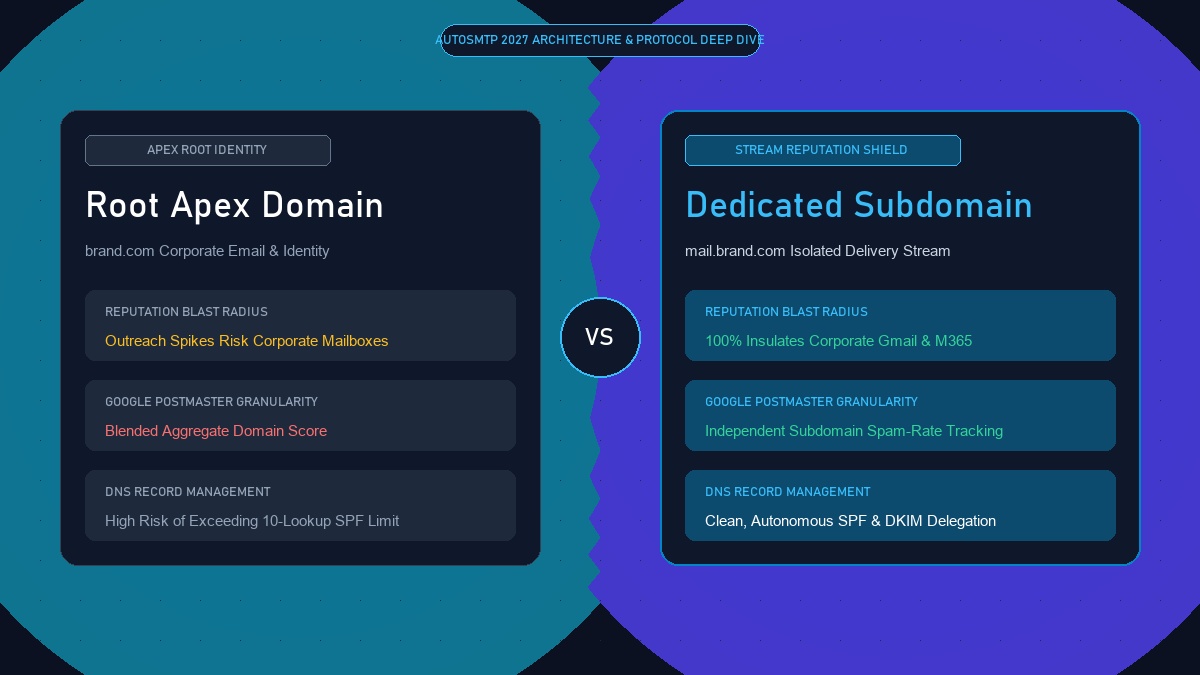
Executive Summary: Deciding whether to send email from your primary apex root domain (brand.com), a dedicated subdomain (mail.brand.com), or an entirely separate dedicated root domain (getbrand.com) is one of the most consequential architectural choices in email infrastructure engineering. While sending from subdomains allows your marketing campaigns to inherit established domain authority from the apex (accelerating warmup to 7–14 days), high spam complaint spikes on a subdomain can bleed upward and degrade primary corporate Google Workspace or Microsoft 365 1:1 email deliverability. Conversely, launching cold outbound prospecting or high-volume acquisition campaigns on separate dedicated root domains provides a 100% cryptographic firewall protecting core business communications, albeit requiring a full 30-to-45-day cold warmup. This guide outlines the 3-tier domain taxonomy, Google Postmaster reputation mechanics, and multi-domain cluster routing.
- 1. The Two Strategic Paradigms: Subdomain Segregation vs Sovereign Root Domains
- 2. Subdomain Mechanics: How Google & Microsoft Handle Parent Inheritance
- 3. Separate Root Domains: The 100% Air-Gapped Reputation Firewall
- 4. Brand-Proximate Naming Architecture & 301 Web Redirects
- 5. The 3-Tier Enterprise Domain Taxonomy: Corporate, Marketing & Outreach
- 6. Warmup & Recovery Timelines: Subdomain Velocity vs Root Burn Risk
- 7. DNS Architecture: Eliminating the RFC 7208 10-Lookup SPF Limit
- 8. Production Case Study: SaaS Startup Saving Corporate Inboxes from Spam Tab
- 9. Multi-Domain VirtualMTA Pool Routing in PowerMTA & KumoMTA
- 10. Strategic Decision Framework & Configuration Matrix
1. The Two Strategic Paradigms: Subdomain Segregation vs Sovereign Root Domains
In high-volume email operations, mixing all message streams onto a single apex domain (brand.com) is an architectural failure. When marketing broadcasts, password resets, and cold sales outreach share the same root identifier, a single spam complaint spike triggered by an aggressive marketing blast damages the deliverability of CEO-to-investor emails and customer password resets.
To eliminate this vulnerability, modern senders choose between two proven architectural approaches:
- Subdomain Segregation (
mail.brand.com,notify.brand.com): Creating hierarchical DNS branches off the corporate root domain. Subdomains inherit organizational trust while maintaining separate cryptographic authentication. - Sovereign Root Domains (
getbrand.com,brandhq.io): Purchasing brand-proximate cousin domains completely detached from the primary DNS zone. This creates an impermeable, air-gapped barrier protecting corporate operations from high-risk marketing activities.
2. Subdomain Mechanics: How Google & Microsoft Handle Parent Inheritance
Major mailbox providers process subdomain reputation through a hierarchical relationship model:
- Parent Inheritance: If
brand.comhas maintained a spotless 5-year sending history on Google Workspace, a newly provisioned subdomain (em.brand.com) inherits a positive baseline reputation from day one. Instead of spending 30 days warming up at 500 emails/day, the subdomain can safely scale to 25,000+ emails/day within 10 to 14 days. - The Upward Bleed Risk: However, parent inheritance is a double-edged sword. Google Postmaster Tools explicitly states that while it evaluates subdomains independently, consistently negative subdomain reputation (spam rates >0.30%) aggregates upward and degrades the parent domain’s overall reputation. If an affiliate partner or unscrubbed newsletter list burns
em.brand.com, internal corporate emails fromalice@brand.commay begin landing in Gmail Spam folders.
3. Separate Root Domains: The 100% Air-Gapped Reputation Firewall
For outbound B2B prospecting, cold email lead generation, high-frequency affiliate promotions, or testing new unverified acquisition channels, separate dedicated root domains are non-negotiable. By provisioning independent domains (e.g., meetbrand.com, trybrand.com), the blast radius is strictly confined to the disposable asset:
- If
trybrand.comtriggers a Spamhaus DBL listing or high spam complaints, the primary apexbrand.comsuffers zero reputational impact. - Corporate Google Workspace and Microsoft 365 executive communications remain completely insulated and operational.
- The tradeoff is warmup inertia: because the dedicated root domain has zero historical DNS equity, it must undergo a rigorous, 30-to-45-day cold gas-pedal warmup before dispatching significant volume.
4. Brand-Proximate Naming Architecture & 301 Web Redirects
When selecting separate root domains, brand consistency and recipient trust are paramount. Employ logical, brand-proximate naming patterns that reassure recipients:
Action Prefixes: get[brand].com, try[brand].com, use[brand].com
Entity Suffixes: [brand]hq.com, [brand]app.com, [brand]mail.com
Mandatory HTTP 301 Redirect: The root apex and www of every cousin domain must execute a clean 301 permanent redirect to https://brand.com. Recipients who type the domain into a browser must immediately land on the authentic brand homepage.
Hyphen Overuse: get-brand-today-direct.com (triggers automated anti-phishing heuristic flags).
Low-Reputation TLDs: Avoid .xyz, .top, .click, or .live for commercial outreach; stick strictly to .com, .io, .co, or established regional ccTLDs (.co.uk, .de).
Misspelled Typosquatting: Subtle misspellings trigger immediate brand infringement and blocklist flags.
5. The 3-Tier Enterprise Domain Taxonomy: Corporate, Marketing & Outreach
To achieve enterprise-grade deliverability and zero operational risk, AutoSMTP deploys the following 3-tier domain architecture:
| Tier Level | Domain Structure | Typical Domain Example | Hosting & MTA Infrastructure | Target Traffic Stream |
|---|---|---|---|---|
| Tier 1: Corporate Apex | Primary Apex Domain | brand.com |
Google Workspace / Microsoft 365 | 1:1 Human corporate email, investor relations, internal ops |
| Tier 2: Dedicated Subdomains | Subdomains off Apex | notify.brand.comnews.brand.com |
AutoSMTP Bare-Metal PowerMTA / KumoMTA | Opted-in customer billing, password resets, product newsletters |
| Tier 3: Cousin Root Domains | Separate Root Domains | getbrand.combrandhq.io |
AutoSMTP Multi-IP Bare-Metal Cluster | B2B cold outbound prospecting, partner acquisition, cold lead gen |
6. Warmup & Recovery Timelines: Subdomain Velocity vs Root Burn Risk
The operational velocity of subdomains versus dedicated root domains differs fundamentally:
- Subdomain Warmup (Fast): Begins with inherited trust from the apex. A subdomain can ramp from 1,000 to 50,000 emails/day in 10 to 14 days, provided the parent domain maintains high Google Postmaster reputation.
- Dedicated Root Warmup (Deliberate): Begins with zero trust. ISP spam filters observe the domain closely, requiring a strict 30-to-45-day gas-pedal warmup ramping across dedicated IPv4 subnets.
- Recovery Timeline: If a subdomain experiences an algorithmic dip, pausing sends for 7 days while sending high-engagement transactional mail usually restores reputation. If a dedicated cousin domain suffers an outright Spamhaus DBL listing or severe complaint wave, burning and replacing the domain is often faster than waiting 90+ days for recovery.
7. DNS Architecture: Eliminating the RFC 7208 10-Lookup SPF Limit
A major technical benefit of routing automated mail through subdomains is the elimination of SPF record bloat. Under RFC 7208, an SPF record cannot exceed 10 DNS lookups. When marketing teams cram Salesforce, HubSpot, Zendesk, Google Workspace, and AutoSMTP into the apex brand.com SPF record, it frequently breaks, throwing PermError and failing DMARC.
By delegating subdomains, each stream receives its own autonomous, clean SPF and DKIM namespace:
8. Production Case Study: SaaS Startup Saving Corporate Inboxes from Spam Tab
How an AI B2B Platform Rescued Founder Communications by Separating Outreach Domains
Background: A fast-growing AI software startup was conducting outbound sales outreach directly from their primary apex domain (aibrand.io) using sales automation tools. After an SDR team blasted a poorly targeted list of 40,000 prospects, Gmail and Outlook flagged aibrand.io with a “Bad” domain reputation in Google Postmaster Tools. Immediately, the CEO’s 1:1 fundraising emails to venture capital firms and critical customer support replies began landing directly in Spam folders.
The Solution: In late 2026, AutoSMTP re-architected their entire email topology into a strict 3-tier structure:
1. Outbound sales prospecting was immediately stripped from the apex domain and transitioned to three brand-proximate dedicated root domains (getaibrand.com, tryaibrand.io, aibrandhq.com), each provisioned on dedicated IPv4 addresses and warmed over 35 days.
2. Product notifications were mapped to notify.aibrand.io on a dedicated PowerMTA cluster.
3. The apex domain aibrand.io was reserved strictly for 1:1 corporate communications, with all blast traffic permanently barred.
Results:
- Reputation Restoration: Within 14 days of halting blast traffic on the apex, Google Postmaster upgraded
aibrand.ioback to “High” reputation, restoring 100% primary inbox delivery for executive emails. - Outreach Resilience: Cold outbound pipeline generated over $320,000 in qualified enterprise pipeline across the dedicated cousin domains with zero risk to corporate operations.
- Autonomous DNS Governance: Streamlined SPF and DKIM records across all subdomains without exceeding RFC limits.
9. Multi-Domain VirtualMTA Pool Routing in PowerMTA & KumoMTA
An enterprise AutoSMTP bare-metal cluster seamlessly manages multiple dedicated domains and subdomains by binding them to dedicated VirtualMTAs with isolated source IPs and automated DKIM signatures:
10. Strategic Decision Framework & Configuration Matrix
Deploy a Subdomain (mail.brand.com) When:
- Sending to opted-in subscribers, verified customers, or active app users.
- Delivering transactional receipts, password resets, and onboarding flows.
- You want fast warmup (7–14 days) by leveraging your apex domain’s established reputation.
- You maintain low bounce rates (<1%) and strict spam complaint control (<0.05%).
Deploy a Separate Root Domain (getbrand.com) When:
- Conducting cold B2B sales prospecting or outbound acquisition campaigns.
- Testing unverified or newly acquired marketing lists with higher bounce risk.
- You require a 100% air-gapped firewall protecting corporate Google/M365 inboxes.
- You are willing to invest 30–45 days in a disciplined, dedicated warmup protocol.
Stop paying monthly contact penalties to SaaS marketing platforms. AutoSMTP delivers turnkey, fully managed dedicated bare-metal email clusters engineered for sovereign control, maximum throughput, and uncompromised inbox placement.
Provisions fully licensed PowerMTA/KumoMTA clusters on enterprise bare metal with flat, predictable pricing regardless of database contact size.
Monitors Google Postmaster spam ratios (<0.1%) and real-time deferrals across clean IPv4 subnets, ramping delivery automatically.
RFC 5321 in-band 550 bounce suppression + automated Yahoo/Outlook CFL ingest directly into suppression registries.
Pre-configured rDNS/PTR, SPF, 2048-bit DKIM, strict DMARC, and BIMI integration verified prior to cluster handoff.
Ready for Sovereign Dedicated Email Infrastructure?
Deploy enterprise bare-metal MTAs with dedicated IPs, automated IP warming, and flat-rate pricing. Protect your domain reputation and eliminate SaaS restrictions forever.
Explore Dedicated SMTP Clusters & Pricing →