

Proxmox Mail Gateway vs Barracuda: 2027 Open-Source Enterprise Cluster vs Commercial Appliance
Published by Fred Dawson • Senior Deliverability Systems Architect • 18 min read
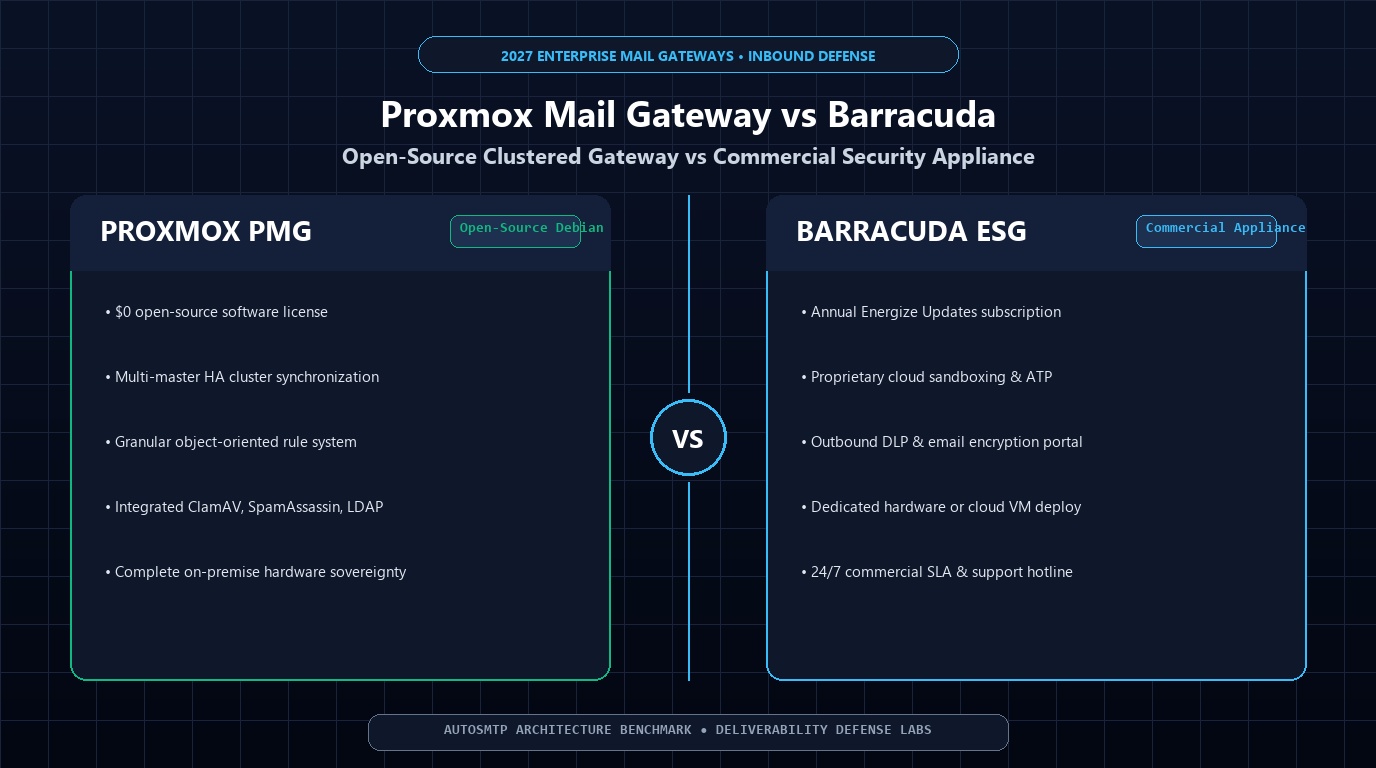
Deploying an enterprise mail security gateway before email reaches downstream mailboxes (Microsoft 365, Google Workspace, or on-premise Exchange) requires choosing between open-source clustering and commercial turnkey hardware. Proxmox Mail Gateway (PMG) provides a Debian-based, 100% open-source multi-master active-active clustered security proxy with granular object-oriented rules and $0 per-mailbox software licensing. Conversely, Barracuda Email Security Gateway (ESG) offers proprietary cloud sandboxing, outbound DLP compliance filters, and automated Energize Updates backed by 24/7 commercial hardware support.
1. Gateway Architecture & Multi-Master Clustering
The operational resilience of an MX gateway is paramount; if the gateway goes down, incoming mail queues globally stall and sender MTAs defer.
Proxmox Mail Gateway: Uses an innovative active-active multi-master cluster architecture. Nodes synchronize configuration, rule sets, Greylisting state, and spam quarantine metadata over SSH tunnels utilizing a distributed PostgreSQL database backend. If any node in the cluster fails, other MX records absorb traffic seamlessly with zero configuration drift. Operators can spin up new nodes in minutes on any x86-64 hardware or virtual machine.
Barracuda ESG: Typically deployed as physical 1U/2U rackmount appliances or pre-built cloud virtual machines (AWS/Azure). Barracuda supports clustered configurations (Linked Appliances), but configuration synchronization is hierarchical (Primary/Replica) and requires identical appliance firmware revisions and active Energize Updates subscriptions on all units.
2. Object-Oriented Rules vs Appliance Heuristics
PMG features an exceptionally powerful object-oriented rule system divided into five distinct categories: FROM (Who), TO (What), WHEN (Time), WHAT (Content/Attachement), and ACTION (Accept, Quarantine, Reject, Notify). Rules can be combined logically with boolean operators, allowing granular routing policies per domain, user group, or IP CIDR block.
Barracuda relies on proprietary multi-layered threat intelligence: IP reputation analysis, intent analysis (scanning URLs in message bodies), and cloud-based sandboxing (Advanced Threat Protection). While Barracuda excels at zero-hour malware detection out-of-the-box, fine-tuning edge-case rules or inspecting the underlying filtering mechanics is restricted by proprietary firmware.
3. Outbound DLP, Archiving & Encryption Portals
Barracuda Enterprise Compliance Strengths
Barracuda includes built-in Data Loss Prevention (DLP) dictionaries scanning outbound messages for Social Security Numbers, credit card formats (PCI-DSS), and medical records (HIPAA). When triggered, emails are automatically redirected to Barracuda’s secure cloud encryption portal where recipients authenticate via one-time tokens.
Proxmox Mail Gateway Custom Workarounds
PMG focuses primarily on antispam, antivirus (ClamAV), and message routing. Outbound DLP requires writing custom regex content filters or integrating external milters. PMG does not include a native end-user web encryption portal, requiring third-party tools (like Ciphermail) for automated S/MIME or PGP workflows.
4. Total Cost of Ownership (TCO) & Licensing Economics
The financial disparity between PMG and Barracuda is dramatic at scale:
- Proxmox Mail Gateway: 100% open-source software (AGPL v3). You can protect unlimited domains, unlimited inboxes, and process unmetered traffic for $0. Optional enterprise repository access and commercial support subscriptions cost only €155 to €380/year per server socket.
- Barracuda ESG: Hardware appliances range from $2,500 to $12,000+ upfront, paired with annual Energize Updates and Instant Replacement fees ranging from $1,200 to $4,500/year. Cloud-hosted models bill per-user or metered bandwidth tiers.
5. Proxmox vs Barracuda Technical Matrix
| Evaluation Pillar | Proxmox Mail Gateway (Debian) | Barracuda Email Security Gateway | Deployment Verdict |
|---|---|---|---|
| Software Licensing | Open-source ($0); optional support €155/yr | Proprietary ($2,500 – $12,000+ appliance + subs) | PMG: Massive cost advantage at high volume |
| Clustering Topology | Multi-master active-active sync via PostgreSQL | Primary/Secondary linked appliances | PMG: Frictionless scaling across bare metal/VMs |
| Antivirus & Antispam Engine | ClamAV + SpamAssassin + Custom Rule Objects | Proprietary heuristics + Cloud Sandboxing (ATP) | Barracuda: Superior zero-hour malware sandbox |
| Outbound DLP & Encryption | Manual regex rules; no native portal | Built-in HIPAA/PCI dictionaries & web portal | Barracuda: Turnkey enterprise compliance |
| Hardware Sovereignty | 100% on-premise bare-metal or private cloud VM | Proprietary hardware appliance or AWS/Azure VM | PMG: Total data residency and GDPR control |
Healthcare Network: Saving $42,000 Over 3 Years with Proxmox Clusters
A healthcare system with 35 subsidiary clinics was facing a $48,000 hardware refresh and license renewal quote for their aging Barracuda 600 appliances. By deploying a 3-node Proxmox Mail Gateway cluster across redundant bare-metal servers with enterprise Proxmox subscriptions (€930/yr total), they achieved full active-active failover, integrated LDAP synchronization across Active Directory, and eliminated recurring per-user licensing taxes, saving over $42,000 across a 36-month cycle.
The AutoSMTP Deliverability Defense Advantage
Inbound and outbound filtering pipelines require robust underlying transport hardware. AutoSMTP provisions sovereign, dedicated bare-metal MTA infrastructure engineered for high-throughput filtering, synchronous 550 bounce suppression, and permanent reputation control.
Provisions fully licensed PowerMTA and KumoMTA clusters on enterprise bare-metal with dedicated IPv4 subnets and predictable flat pricing.
Monitors Google Postmaster spam ratios (<0.1%) and real-time ISP deferrals with algorithmic volume scaling across your entire IP pool.
RFC 5321 in-band 550 bounce suppression, automated Yahoo/Outlook Complaint Feedback Loops (CFL), and instant bad-IP eviction.
Pre-configured forward and reverse DNS (PTR) per IP, SPF CIDR alignment, 2048-bit DKIM rotation, and strict DMARC enforcement.
Upgrade Your Email Infrastructure with Dedicated Bare Metal
Eliminate filter lag, queue serialization bottlenecks, and noisy neighbor contamination. Deploy a turnkey AutoSMTP cluster today.
Deploy Turnkey MTA Cluster →