

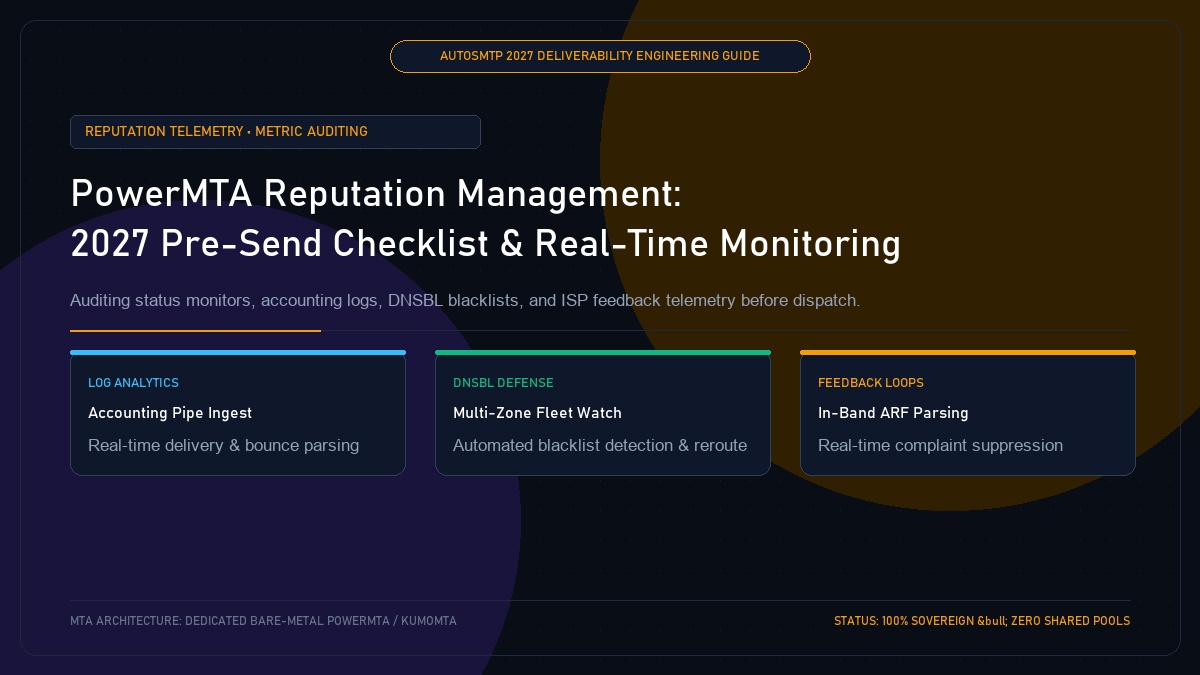
PowerMTA Sender Reputation Management: 2027 Pre-Send Checklist & Real-Time Telemetry
Published by Fred Dawson • Senior Deliverability Systems Architect • 25 min read
In enterprise email infrastructure, sender reputation is not a static score that you check once a month; it is a live, dynamic biological system responding continuously to every socket connection, deferral, and bounce. When managing a fleet of dedicated PowerMTA nodes, deliverability success depends on establishing end-to-end telemetry: parsing raw accounting logs (acct-*.csv), monitoring live queue states via the HTTP status API, watching DNSBL registries, and enforcing pre-send hygiene gates. This definitive guide details the operational monitoring framework and the 10-point checklist required to safeguard enterprise sender reputation in 2027.
- 1. The Modern Deliverability Formula: IP Reputation vs Domain Reputation
- 2. PowerMTA Real-Time Monitoring: Web Monitor & HTTP Status Telemetry
- 3. Accounting Log Deep Dive: Parsing acct-*.csv for Early Warning Signals
- 4. Multi-Zone DNSBL Blacklist Interception & Automated Failover Pools
- 5. The 10-Point Pre-Send Deliverability Audit Checklist
- 6. Telemetry Architecture Matrix: Monitoring Layers & Protocols
- 7. Case Study: B2B Enterprise Restores Microsoft SNDS Green Status
- 8. The AutoSMTP Strategic Advantage
1. The Modern Deliverability Formula: IP Reputation vs Domain Reputation
Deliverability engineers in 2027 must manage two interconnected reputation vectors:
- IP Reputation (Connection Layer): Mailbox providers judge the connecting IPv4 address on TCP handshake volume, connection frequency, TLS version, rDNS/PTR alignment, and sudden volume spikes. Poor IP reputation manifests as connection drops, 421 deferrals, and DNSBL listings.
- Domain Reputation (Authentication & Content Layer): Governed by your RFC 5322
From:domain, DKIM signing domain (d=), SPF Return-Path alignment, and recipient engagement (opens, clicks, spam complaints, unsubscribes). Domain reputation follows you even if you switch IP addresses or hosting providers.
2. PowerMTA Real-Time Monitoring: Web Monitor & HTTP Status Telemetry
PowerMTA includes a high-performance built-in web monitor and administrative HTTP interface that provides instantaneous metrics into queue health and delivery status:
# PowerMTA Web Monitor Configuration
http-mgmt-port 8080
http-access 127.0.0.1 admin
http-access 10.0.0.0/8 admin

# Administrative API Status Query (CLI or Curl)
curl -s http://localhost:8080/status | grep "Total queued:"

# Command Line Status Inspection
pmta show top queues
pmta show status
3. Accounting Log Deep Dive: Parsing acct-*.csv for Early Warning Signals
PowerMTA’s accounting file system generates structured CSV logs capturing the precise wire outcome of every message transaction. Implementing an automated log-ingestion pipeline enables immediate threat detection:
<acct-file /var/log/pmta/acct-%Y-%m-%d.csv>
    move-to /var/log/pmta/archive/
    move-interval 1h
    records d,b,rb,t
    record-fields d type,timeLogged,orig,rcpt,orcpt,dsnAction,dsnStatus,dsnDiag,vmta
    record-fields b type,timeLogged,orig,rcpt,orcpt,dsnAction,dsnStatus,dsnDiag,vmta
</acct-file>
4. Multi-Zone DNSBL Blacklist Interception & Automated Failover Pools
A sudden listing on Spamhaus ZEN, Barracuda, or Invaluement can halt deliveries across 60% of enterprise recipient domains within minutes. Automated telemetry must query DNSBL registries continuously every 15 minutes:
- Automated Pool Failover: When a dedicated IP is detected on a critical DNSBL, the orchestration engine reconfigures PowerMTA’s
<virtual-mta-pool>to remove the listed IP, routing subsequent traffic through warm standby reserve IPs while automated delisting occurs. - Root Cause Isolation: The accounting log is automatically queried for the preceding 2 hours to identify the specific campaign, tenant, or data segment that triggered the spam trap.
5. The 10-Point Pre-Send Deliverability Audit Checklist
The 10-Point Pre-Send Deliverability Audit Checklist
1. Reverse DNS (PTR): Validated that every outbound IP’s PTR record resolves to a fully qualified domain matching forward A records.
2. Cryptographic Alignment: SPF CIDR blocks valid, 2048-bit DKIM selector verified, DMARC p=reject or p=quarantine enforced.
3. Google Postmaster Baseline: Verified that spam complaint rate over the preceding 7 days is strictly below 0.10%.
4. Microsoft SNDS & JMRP: Confirmed clean IP status (green filter status, < 0.3% complaint rate) in Microsoft SNDS.
5. DNSBL Fleet Check: Verified 0 listings across Spamhaus, Barracuda, Spamcop, and Invaluement.
6. Pre-Send List Verification: Ensured newly acquired or unmailed segments have passed real-time socket verification.
7. List-Unsubscribe Header: Confirmed RFC 8058 one-click unsubscribe headers (List-Unsubscribe and List-Unsubscribe-Post) are active.
8. Throttle Directives: Checked that max-msg-rate and concurrency ceilings match current warming phase limits.
9. Spool & RAM Capacity: Verified that disk spool utilization is under 15% and system memory has sufficient headroom.
10. Automated Backoff Active: Confirmed backoff-retry-interval and dynamic downshifting policies are enabled.
6. Telemetry Architecture Matrix: Monitoring Layers & Protocols
| Monitoring Layer | Telemetry Source | Polling Frequency | Critical Action Threshold |
|---|---|---|---|
| Queue Latency | PowerMTA HTTP Status API | Every 60 seconds | Queue depth > 25,000 or age > 30 min |
| Hard Bounces | Accounting Pipe (acct-*.csv) |
Continuous streaming | Hard bounce rate > 1.5% in 15-min window |
| ISP Deferrals (421s) | PowerMTA DSN Diagnostics | Continuous streaming | > 5% deferral ratio triggers auto-backoff |
| DNSBL Registries | Direct UDP DNS queries (34 zones) | Every 15 minutes | Any listing triggers automatic vMTA pool eviction |
| Google Postmaster | Google Postmaster Tools API | Daily automated pull | Spam rate > 0.10% halts marketing blasts |
Enterprise B2B Recovers Outlook Inboxing After Automated DNSBL Triage
A B2B marketing organization operating a 6-node PowerMTA cluster suffered a sudden drop in Outlook inbox placement (from 98% to 12%) after an SDR sequence hit a dormant honeypot. Microsoft SNDS transitioned their primary IP to Red status within 6 hours.
The firm deployed AutoSMTP’s automated telemetry daemon. The script parsed the accounting logs, isolated the rogue SDR campaign, evicted the flagged IP from pool-production, and reassigned sending traffic to pre-warmed reserve IPs. Simultaneously, automated delisting appeals were submitted. Microsoft SNDS returned to Green within 48 hours, with zero disruption to regular corporate transactional mail.
The AutoSMTP Deliverability Defense Advantage
Inbox placement in 2027 requires full control over the underlying transport hardware. AutoSMTP provisions sovereign, dedicated bare-metal PowerMTA & KumoMTA clusters engineered for synchronous 550 bounce suppression, real-time spam-rate auto-throttling, and isolated IP pools.
Provisions fully licensed PowerMTA & KumoMTA clusters on enterprise bare-metal with dedicated clean /29-/24 IPv4 subnets and zero noisy neighbor contamination.
Monitors Google Postmaster spam ratios (<0.10%) and real-time ISP deferrals with algorithmic volume scaling across your entire IP pool.
RFC 5321 in-band 550 bounce suppression, automated Yahoo/Outlook Complaint Feedback Loops (CFL), and instant bad-IP eviction.
Pre-configured forward and reverse DNS (PTR) per IP, SPF CIDR alignment, 2048-bit DKIM rotation, and strict DMARC enforcement.
Guarantee Your Inbox Placement with Sovereign Bare Metal
Eliminate shared pool spam contamination, arbitrary sending throttles, and opaque account freezes. Deploy an enterprise AutoSMTP cluster today.
Deploy Turnkey MTA Cluster →