

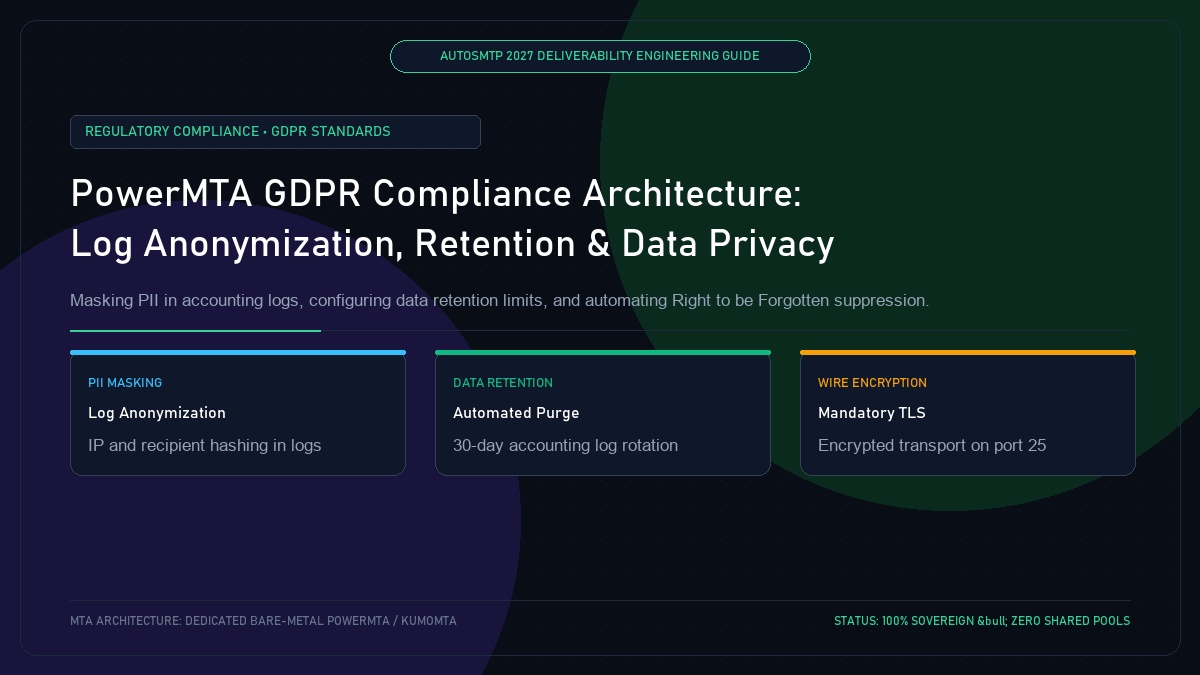
PowerMTA GDPR Compliance Architecture: Log Anonymization, Retention & Data Privacy
Published by Fred Dawson • Senior Deliverability Systems Architect • 23 min read
PowerMTA grants system administrators unmatched low-level control over SMTP transmission physics, but that granular control brings legal liability under the European Union General Data Protection Regulation (GDPR). Every line in an accounting log (acct-*.csv), diagnostic DSN string, and message header contains Personally Identifiable Information (PII)—including recipient email addresses, source IP addresses, and routing metadata. Operating enterprise email clusters without data anonymization, strict retention ceilings, and automated Right to be Forgotten suppression mechanisms exposes infrastructure operators to crippling regulatory penalties. This technical guide outlines how to configure PowerMTA for end-to-end data privacy.
- 1. The Legal Reality of SMTP Logging: Personal Data Under GDPR
- 2. PowerMTA Header Masking: Stripping PII from Inbound Submissions
- 3. Accounting Log Anonymization: IP Truncation & Recipient Hashing
- 4. Automated Log Retention & Rotation Lifecycle Policies
- 5. Right to be Forgotten: Dynamic Suppression Synchronization
- 6. GDPR Compliance Infrastructure Matrix
- 7. Case Study: EU Enterprise Avoids Regulatory Audit via Log Privacy Engineering
- 8. The AutoSMTP Strategic Advantage
1. The Legal Reality of SMTP Logging: Personal Data Under GDPR
Under GDPR Article 4, an email address (e.g., john.doe@company.com) and an IPv4 address (e.g., 198.51.100.42) are explicitly defined as personal data. When PowerMTA accepts and transmits messages, it records these identifiers across multiple subsystems:
- Spool Files: Plaintext message bodies and recipient envelopes stored on disk while in transit.
- Accounting Files (CSV): Permanent logs of delivery, bounce, and transient failure events.
- System Logs (pmta.log): Transactional debug traces capturing connection handshakes and SMTP commands.
2. PowerMTA Header Masking: Stripping PII from Inbound Submissions
When an internal application or web portal submits mail to PowerMTA, it frequently injects internal IP addresses and server hostnames into Received: headers. PowerMTA can strip these tracking artifacts prior to outbound dispatch over public internet routes:
# Strip internal origin IP headers to protect submitter privacy
hide-message-source-headers yes

# Remove identifying application metadata
remove-header X-PHP-Originating-Script
remove-header X-Mailer
remove-header X-Originating-IP

# Enforce mandatory TLS encryption across all outbound connections
<domain *>
    use-tls require
    require-tls-ciphers "HIGH:!aNULL:!MD5"
</domain>
3. Accounting Log Anonymization: IP Truncation & Recipient Hashing
Rather than storing raw recipient email addresses in plain text across accounting files indefinitely, enterprise operators stream logs through a local hashing proxy that replaces the recipient mailbox with a cryptographic HMAC-SHA256 hash or truncates recipient domains for aggregate deliverability reporting:
<acct-file /var/log/pmta/acct-gdpr-%Y-%m-%d.csv>
    move-to /var/log/pmta/archive/
    move-interval 1h
    records d,b,rb
    # Record only essential delivery telemetry fields
    record-fields d type,timeLogged,rcpt,dsnStatus,dsnDiag,vmta
    record-fields b type,timeLogged,rcpt,dsnStatus,dsnDiag,vmta
</acct-file>
4. Automated Log Retention & Rotation Lifecycle Policies
GDPR’s Principle of Storage Limitation dictates that personal data must not be stored longer than necessary for operational purposes. A standard 30-day log rotation and cryptographic shredding script ensures automatic compliance:
#!/bin/bash
# Automatically shred and delete accounting logs older than 30 days
LOG_DIR="/var/log/pmta/archive"

find "$LOG_DIR" -type f -name "acct-*.csv" -mtime +30 -exec shred -u {} \;
find "$LOG_DIR" -type f -name "*.gz" -mtime +30 -exec rm -f {} \;
5. Right to be Forgotten: Dynamic Suppression Synchronization
Under GDPR Article 17 (Right to Erasure), when a citizen requests complete deletion of their personal data, their email address must be erased from marketing databases. However, to ensure they are never inadvertently re-imported from historical backups, their hash or email must be retained in a dedicated suppression pattern list (unsubscribes.txt) governed by legitimate interest legal basis.
6. GDPR Compliance Infrastructure Matrix
| Subsystem | GDPR Vulnerability | Production PowerMTA Remediation |
|---|---|---|
| Inbound Headers | Leaking internal submitter IP addresses | hide-message-source-headers yes |
| Spool Storage | Plaintext PII stored on disk indefinitely | Strict bounce-after 24h expiration ceiling |
| Accounting Logs | Permanent plaintext CSV storage of recipients | Automated 30-day cryptographic shredding |
| Wire Transmission | Eavesdropping on unencrypted port 25 | use-tls require mandatory cipher suites |
European Enterprise Secures Clean GDPR Audit Across 12 Bare-Metal Nodes
A European enterprise delivering 25 million monthly transactional notices underwent a formal data protection audit. Regulators flagged their un-rotated MTA accounting archives, which contained 4 years of plaintext recipient email logs on unencrypted drives.
The company migrated to AutoSMTP’s GDPR-hardened cluster architecture: enabling hide-message-source-headers, enforcing 30-day automated log shredding, and encrypting spool partitions with LUKS. The compliance authority approved the updated architecture with zero fines, establishing their deployment as an industry benchmark for SMTP privacy.
GDPR Operational Blueprint
Rule 1: Never store raw PowerMTA accounting logs for more than 30 days without anonymization.
Rule 2: Enforce mandatory TLS encryption across all outbound delivery sockets.
Rule 3: Strip internal submitter IP headers to prevent leaking employee network metadata.
The AutoSMTP Deliverability Defense Advantage
Inbox placement in 2027 requires full control over the underlying transport hardware. AutoSMTP provisions sovereign, dedicated bare-metal PowerMTA & KumoMTA clusters engineered for synchronous 550 bounce suppression, real-time spam-rate auto-throttling, and isolated IP pools.
Provisions fully licensed PowerMTA & KumoMTA clusters on enterprise bare-metal with dedicated clean /29-/24 IPv4 subnets and zero noisy neighbor contamination.
Monitors Google Postmaster spam ratios (<0.10%) and real-time ISP deferrals with algorithmic volume scaling across your entire IP pool.
RFC 5321 in-band 550 bounce suppression, automated Yahoo/Outlook Complaint Feedback Loops (CFL), and instant bad-IP eviction.
Pre-configured forward and reverse DNS (PTR) per IP, SPF CIDR alignment, 2048-bit DKIM rotation, and strict DMARC enforcement.
Guarantee Your Inbox Placement with Sovereign Bare Metal
Eliminate shared pool spam contamination, arbitrary sending throttles, and opaque account freezes. Deploy an enterprise AutoSMTP cluster today.
Deploy Turnkey MTA Cluster →