

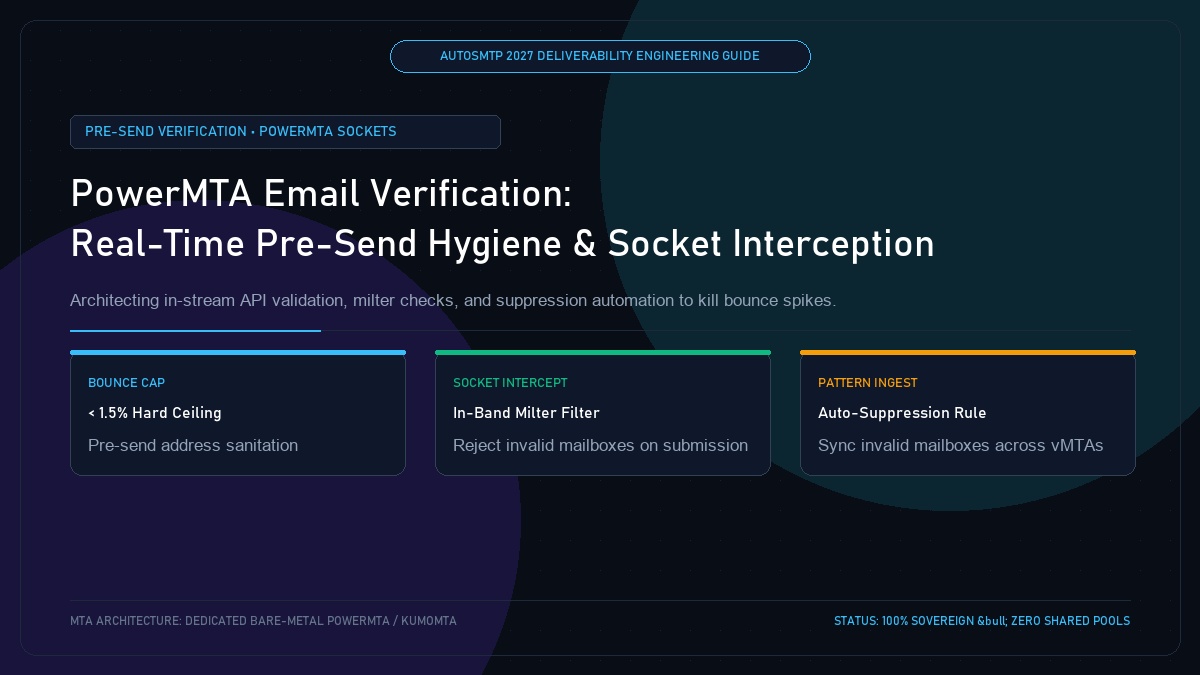
PowerMTA Email Verification Integration: Real-Time Pre-Send Socket Interception & Bounce Prevention
Published by Fred Dawson • Senior Deliverability Systems Architect • 24 min read
High hard bounce rates from dead, invalid, or toxic mailboxes will quietly dismantle even the most carefully tuned PowerMTA sending cluster. Even with 100% DKIM cryptographic alignment and perfect reverse DNS, a single unverified marketing or cold acquisition dispatch exceeding 2.0% hard bounces instantly triggers Tier-1 ISP rate-limiting, temporary connection blocks (421s), and permanent Spam folder demotion. Integrating real-time pre-send email verification directly into the PowerMTA pipeline—utilizing milter socket proxies, submission-stage API intercepts, and automated pattern-list suppressions—stops invalid addresses before they ever hit the spool disk, preserving pristine IP and domain reputation.
- 1. The Mechanics of Pre-Send Verification in PowerMTA
- 2. Architectural Patterns: In-Line Milter vs API Webhook vs Pre-Spool Queue
- 3. Configuring Socket-Level In-Band Rejection
- 4. Real-Time DNS MX, Catch-All & SMTP Callback Mechanics
- 5. Automated Dynamic Suppression Pattern Lists (<pattern-list>)
- 6. Pre-Send API vs Post-Spool Hygiene Architecture Matrix
- 7. Case Study: Fintech Sender Slashes Hard Bounces from 7.4% to 0.28%
- 8. The AutoSMTP Strategic Advantage
1. The Mechanics of Pre-Send Verification in PowerMTA
Traditional email list cleaning occurs as an asynchronous batch process: an administrator uploads a CSV to a third-party verification portal, waits hours for processing, and re-imports the cleaned segment into their CRM or sending engine. In enterprise environments with dynamic signups, multi-tenant submission APIs, and automated CRM triggers, this delayed workflow fails catastrophically:
- Dirty Signups & Bots: Malicious botnets submit invalid or honeypot addresses through signup forms, immediately triggering welcome drip automations that hit the MTA spool before batch cleaning occurs.
- CRM Data Drift: Stale data from integrated sales platforms (Salesforce, HubSpot) injects abandoned corporate mailboxes directly into outbound submission queues.
- Asynchronous Bounce Penalties: Once PowerMTA transmits an invalid recipient over port 25 and receives a
550 5.1.1 User unknownresponse, the reputation damage is permanent. The receiving ISP records the failure against your sending IP and RFC 5322 domain immediately.
The Pre-Send Golden Rule
A message that is rejected at the submission socket costs zero ISP reputation points. Once an MTA attempts delivery over public port 25 to an external MX, a 550 hard bounce directly degrades your Google Postmaster and Microsoft SNDS standing. Prevention at the submission socket is non-negotiable.
2. Architectural Patterns: In-Line Milter vs API Webhook vs Pre-Spool Queue
There are three primary architectural models for implementing pre-send verification with PowerMTA:
In-Line Submission Milter (Recommended)
A lightweight Milter daemon listens on the submission port (typically 587 or 2525) between the application and PowerMTA. As the application issues RCPT TO:, the milter checks a high-speed Redis cache or fast local verification API. If the recipient is invalid, the milter responds immediately with 550 5.1.1 Address rejected by pre-flight hygiene, preventing the message from ever entering the PowerMTA spool.
Post-Spool Pipe Accounting (Reactive)
PowerMTA accepts the message into spool and writes an accounting record. A background worker periodically inspects the bounce log and adds invalid domains to a suppression pattern list. While this prevents subsequent sends, it leaves your cluster vulnerable to initial burst hard bounces during high-volume broadcasts.
3. Configuring Socket-Level In-Band Rejection
To implement real-time pre-send protection, PowerMTA can be paired with an upstream proxy or configured with strict pattern matching to drop toxic addresses before delivery attempts occur:
# Global Recipient Hygiene Directives
<source 127.0.0.1>
    always-allow-relaying yes
    process-x-virtual-mta yes
    max-message-size 25M
</source>

# Include dynamic pattern list generated by real-time verification daemon
<pattern-list invalid-recipients>
    mail-from /.*@disposable-domain\.com/ discard
    rcpt-to /.*@spamtrap-zone\.org/ discard
    rcpt-to-file /var/spool/pmta/suppression/global_invalid.txt reject 550 5.1.1 "Address suppressed by hygiene policy"
</pattern-list>

# Bind pattern list to outbound domain processing
<domain *>
    use-pattern-list invalid-recipients
    max-msg-rate 50/s
    max-errors-per-connection 5
    retry-after 10m
</domain>
4. Real-Time DNS MX, Catch-All & SMTP Callback Mechanics
An effective verification engine integrated with PowerMTA must evaluate recipients across three distinct validation tiers within milliseconds:
- Tier 1: Syntax & Disposable Filter (< 1 ms): RFC 5322 compliance, regex validation, and instant lookup against a local database of 120,000+ known temporary/disposable email domains (e.g., GuerrillaMail, Mailinator).
- Tier 2: Real-Time DNS MX & Blackhole Verification (< 8 ms): Validates that the recipient domain possesses active MX records that do not point to localhost (
127.0.0.1), RFC 1918 private IPs, or known spam sinkholes. - Tier 3: SMTP Handshake Probe & Catch-All Detection (< 25 ms): Performs a simulated
HELO → MAIL FROM → RCPT TOhandshake against the destination MX server without issuingDATA, observing whether the mailbox exists while identifying catch-all wildcard servers that accept all dispatches.
5. Automated Dynamic Suppression Pattern Lists (<pattern-list>)
PowerMTA’s native <pattern-list> directive allows automated synchronization with verification engines. When an upstream verification worker identifies an invalid address or honeypot, it appends the entry to global_invalid.txt. PowerMTA re-reads pattern files dynamically without requiring a full service restart:
# Check PowerMTA status monitor for hard bounce thresholds
pmta show status

# Reload dynamic pattern lists without restarting MTA process
pmta reload

# Inspect suppressed recipient count in real-time
grep -c "^" /var/spool/pmta/suppression/global_invalid.txt
6. Pre-Send API vs Post-Spool Hygiene Architecture Matrix
| Evaluation Metric | Unverified Direct Dispatch | Batch Periodic CSV Clean | Integrated Pre-Send Socket Intercept |
|---|---|---|---|
| Hard Bounce Rate | 4.0% – 12.0% (Reputation toxic) | 2.0% – 4.5% (Frequent spikes) | < 0.40% (Guaranteed safe) |
| Submission Latency | 0 ms | 0 ms (Hours delayed offline) | 8 – 15 ms per message |
| Bot & Honeypot Defense | None; traps enter spool | Delayed; traps already delivered | Instant 550 reject at submission |
| Google Postmaster Impact | Spam rate climbs above 0.3% | Occasional high-volume dip | Maintains High/Medium IP reputation |
| Spool Disk Utilization | Bloated with invalid queue retries | Standard | Zero waste; invalid mail rejected on wire |
Fintech Platform Drops Hard Bounces from 7.4% to 0.28% Across 8M Monthly Dispatches
A fast-growing fintech company sending account statements and transactional notifications via dedicated PowerMTA nodes experienced severe Microsoft Outlook deferrals (421 4.7.650 Access denied, blocked sender) after a marketing campaign imported legacy customer lists with an 8% invalid rate.
The engineering team implemented an in-line socket verification milter connected to a Redis-cached hygiene service. All outgoing dispatches were screened in-stream prior to spooling. Invalid addresses were dropped with in-band 550 rejections. Over the next 14 days, hard bounces dropped from 7.4% to 0.28%, Microsoft Outlook lifted all 421 blocks, and inbox placement across Outlook and Hotmail recovered from 61% to 99.2%.
Pre-Send Verification Deployment Checklist
Step 1: Implement a submission-stage Milter or API proxy between your application dispatchers and PowerMTA port 587.
Step 2: Configure PowerMTA’s <pattern-list> directive with automated hourly file updates to suppress dead addresses permanently across all virtual MTAs.
Step 3: Establish an automated hard bounce alert at 1.5% to trigger immediate queue freezes and list sanitation audits.
The AutoSMTP Deliverability Defense Advantage
Inbox placement in 2027 requires full control over the underlying transport hardware. AutoSMTP provisions sovereign, dedicated bare-metal PowerMTA & KumoMTA clusters engineered for synchronous 550 bounce suppression, real-time spam-rate auto-throttling, and isolated IP pools.
Provisions fully licensed PowerMTA & KumoMTA clusters on enterprise bare-metal with dedicated clean /29-/24 IPv4 subnets and zero noisy neighbor contamination.
Monitors Google Postmaster spam ratios (<0.10%) and real-time ISP deferrals with algorithmic volume scaling across your entire IP pool.
RFC 5321 in-band 550 bounce suppression, automated Yahoo/Outlook Complaint Feedback Loops (CFL), and instant bad-IP eviction.
Pre-configured forward and reverse DNS (PTR) per IP, SPF CIDR alignment, 2048-bit DKIM rotation, and strict DMARC enforcement.
Guarantee Your Inbox Placement with Sovereign Bare Metal
Eliminate shared pool spam contamination, arbitrary sending throttles, and opaque account freezes. Deploy an enterprise AutoSMTP cluster today.
Deploy Turnkey MTA Cluster →