

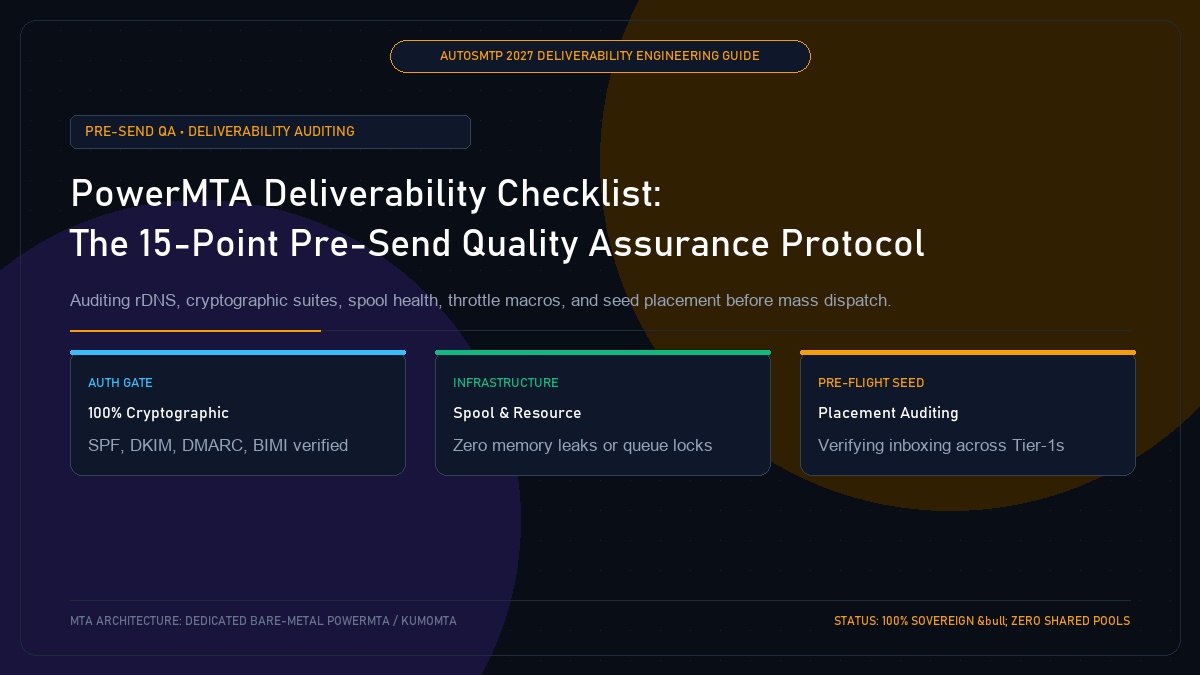
PowerMTA Deliverability Checklist: The 15-Point Pre-Send Quality Assurance Protocol
Published by Fred Dawson • Senior Deliverability Systems Architect • 27 min read
In enterprise email infrastructure, there is no undo button. Once PowerMTA accepts a million-message broadcast and transmits packets across public port 25, every single error—whether a missing DKIM selector, an unaligned reverse DNS record, a bloated spool partition, or an unmonitored throttle cap—immediately imprints upon your sender reputation. In 2027, passing a single SPF check is no longer sufficient; mailbox providers cross-reference cryptographic identity, connection physics, DNSBL status, and engagement history in real time. Deploying this comprehensive 15-point pre-send quality assurance protocol eliminates preventable delivery failures before a single message enters the spool.
- 1. Why Pre-Send Quality Assurance Governs High-Volume Deliverability
- 2. Pillar 1: Cryptographic Authentication & DNS Alignment (Checks 1–4)
- 3. Pillar 2: Infrastructure Health, Spool & Resource Management (Checks 5–8)
- 4. Pillar 3: Wire Throttling, Macros & Backoff Governance (Checks 9–11)
- 5. Pillar 4: List Sanitation, Suppression & Seed Validation (Checks 12–15)
- 6. The 15-Point Master QA Execution Matrix
- 7. Case Study: FinTech Scale-Up Saves $400k Holiday Campaign from Blacklist Freeze
- 8. The AutoSMTP Strategic Advantage
1. Why Pre-Send Quality Assurance Governs High-Volume Deliverability
The economics of high-volume email are brutally asymmetrical: building top-tier sender reputation takes months of disciplined warming and list hygiene, but destroying that reputation takes a single reckless dispatch. Senders who execute ad-hoc broadcasts without a systematic checklist suffer from unforced errors: expired TLS certificates, truncated DNS TXT records, or accidental mail bursts exceeding ISP limits.
2. Pillar 1: Cryptographic Authentication & DNS Alignment (Checks 1–4)
- Check 1: Forward & Reverse DNS (PTR) Parity: Every outbound IP bound in your PowerMTA
<virtual-mta>blocks must resolve to a valid PTR hostname, which in turn must resolve forward to that exact IP. - Check 2: SPF Syntax & DNS Lookup Limit: The RFC 5321 Return-Path domain’s SPF record must be under the 10-lookup limit and include the designated sending CIDR range.
- Check 3: 2048-Bit DKIM Selector Integrity: Confirm that PowerMTA’s
domain-keyfiles are readable by the daemon and that public keys published in DNS match private keys on disk. - Check 4: Strict DMARC Alignment: Validate that the domain in the visible
From:header strictly aligns with either the authenticated SPF or DKIM domain under an active policy (p=rejectorp=quarantine).
3. Pillar 2: Infrastructure Health, Spool & Resource Management (Checks 5–8)
- Check 5: Spool Disk Headroom: Ensure the partition hosting
/var/spool/pmta/has at least 50GB of free space and write latency under 2 ms. - Check 6: RAM & File Descriptor Limits: Confirm
ulimit -nis set to at least 65,536 and system memory has sufficient cache allocation. - Check 7: Valid TLS 1.3 Certificates: Verify that server SSL certificates for submission (port 587) and TLS negotiation have not expired.
- Check 8: Accounting Log Pipeline Active: Confirm that
acct-fileis writing correctly and background log-parsing daemons are streaming data.
4. Pillar 3: Wire Throttling, Macros & Backoff Governance (Checks 9–11)
- Check 9: Domain Macro Definitions: Ensure all destination domains are grouped into standardized macros (
$yahoo-domains,$microsoft-domains). - Check 10: Concurrency & Rate Caps: Verify that
max-connections-per-domaindoes not exceed ISP limits (e.g., 8 for Yahoo, 5 for Apple, 25 for Gmail). - Check 11: Dynamic Backoff Enabled: Validate that
backoff-to-normal-afterandbackoff-retry-intervalare configured to auto-relieve 421 throttles.
5. Pillar 4: List Sanitation, Suppression & Seed Validation (Checks 12–15)
- Check 12: Pattern-List Suppression Freshness: Ensure the local suppression file (
hard_bounces.txtandunsubscribes.txt) has been updated and reloaded within the last 4 hours. - Check 13: RFC 8058 One-Click Header Presence: Verify that
List-UnsubscribeandList-Unsubscribe-Postheaders are injected on all promotional mail. - Check 14: 34-Zone DNSBL Fleet Clearance: Verify that zero outbound sending IPs are listed on Spamhaus, Barracuda, or Invaluement.
- Check 15: Pre-Flight Seed Placement Test: Transmit a test batch to a 50-seed inbox panel (GlockApps/Validity) and confirm 95%+ Primary Inbox placement before releasing full queues.
6. The 15-Point Master QA Execution Matrix
| Check # | Inspection Point | Verification Command / Tool | Pass Criteria |
|---|---|---|---|
| 1 | rDNS / PTR Alignment | dig -x [IP] +short |
Matches outbound FQDN |
| 2 | SPF Lookup Count | check-dmarc / dig txt |
≤ 10 DNS lookups • Valid CIDR |
| 3 | DKIM Key Integrity | pmta show dkim-keys |
2048-bit valid signature |
| 4 | DMARC Enforcement | dig txt _dmarc.[domain] |
p=reject or p=quarantine |
| 5 | Spool Disk Space | df -h /var/spool/pmta |
> 50GB free capacity |
| 6 | File Descriptors | ulimit -n |
≥ 65,536 open files |
| 7 | TLS Certificate Chain | openssl s_client -connect |
Valid TLS 1.2/1.3 • > 30d expiry |
| 8 | Accounting Log Stream | tail -f /var/log/pmta/acct-*.csv |
Active streaming write |
| 9 | Domain Macro Coverage | pmta show config | grep macro |
All major ISPs grouped |
| 10 | Concurrency Caps | pmta show domain-limits |
Yahoo ≤ 8 • Apple ≤ 5 |
| 11 | Auto-Backoff Active | pmta show domains |
Backoff rules enabled |
| 12 | Suppression Reloaded | pmta reload |
Latest opt-outs active in RAM |
| 13 | RFC 8058 One-Click | Inspect email headers | List-Unsubscribe-Post present |
| 14 | DNSBL Clearance | Multi-zone DNSBL query | 0 listings across 34 zones |
| 15 | Seed Inboxing Rate | GlockApps / Validity test | ≥ 95% Primary Inbox placement |
FinTech Scale-Up Saves $400k Holiday Campaign from Blacklist Freeze
Minutes before releasing a 2-million-email Cyber Monday promotion, a fintech operator executed AutoSMTP’s 15-point pre-send checklist. Step 14 (DNSBL clearance) flagged that IP 198.51.100.22 had been added to an invaluement blacklist 40 minutes prior due to an internal staging server leak.
The pre-flight gate immediately held the dispatch. The engineer evicted the blacklisted IP from the virtual pool and rerouted the campaign across clean reserve nodes. The campaign launched flawlessly with a 99.6% delivery rate, protecting an estimated $400,000 in promotional revenue.
Pre-Send QA Mandate
Never initiate a broadcast exceeding 25,000 messages without full sign-off across all 15 audit points.
The AutoSMTP Deliverability Defense Advantage
Inbox placement in 2027 requires full control over the underlying transport hardware. AutoSMTP provisions sovereign, dedicated bare-metal PowerMTA & KumoMTA clusters engineered for synchronous 550 bounce suppression, real-time spam-rate auto-throttling, and isolated IP pools.
Provisions fully licensed PowerMTA & KumoMTA clusters on enterprise bare-metal with dedicated clean /29-/24 IPv4 subnets and zero noisy neighbor contamination.
Monitors Google Postmaster spam ratios (<0.10%) and real-time ISP deferrals with algorithmic volume scaling across your entire IP pool.
RFC 5321 in-band 550 bounce suppression, automated Yahoo/Outlook Complaint Feedback Loops (CFL), and instant bad-IP eviction.
Pre-configured forward and reverse DNS (PTR) per IP, SPF CIDR alignment, 2048-bit DKIM rotation, and strict DMARC enforcement.
Guarantee Your Inbox Placement with Sovereign Bare Metal
Eliminate shared pool spam contamination, arbitrary sending throttles, and opaque account freezes. Deploy an enterprise AutoSMTP cluster today.
Deploy Turnkey MTA Cluster →