

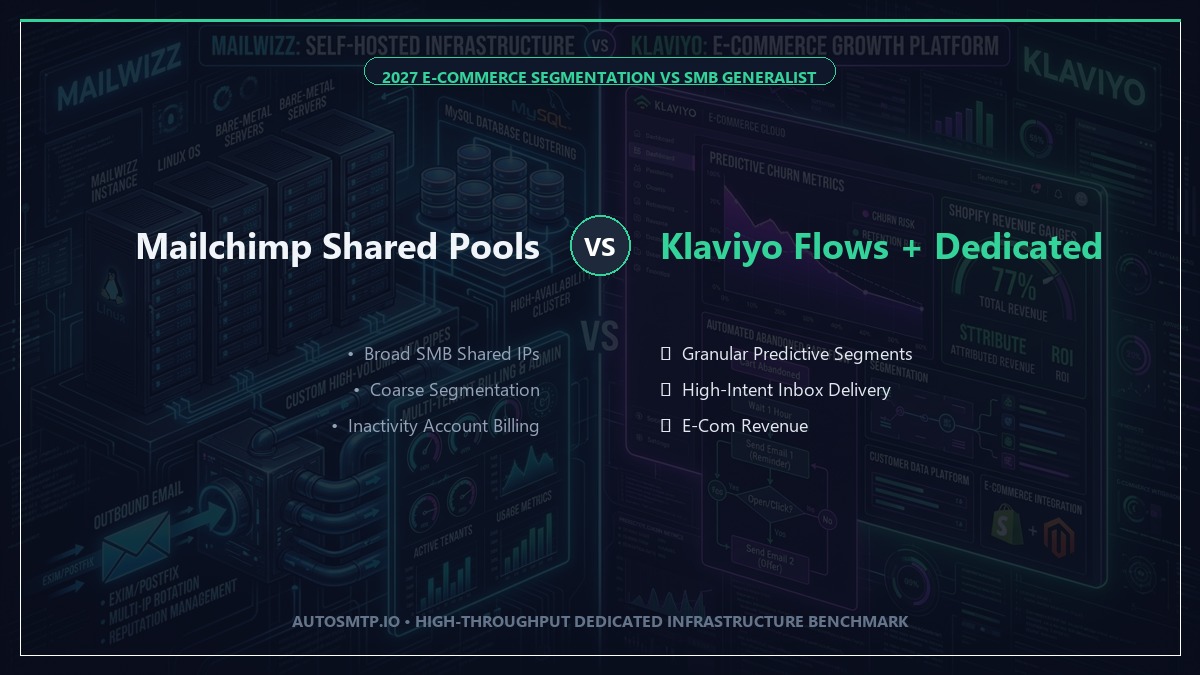
Klaviyo vs Mailchimp Deliverability: 2027 E-Commerce Behavioral Segmentation vs Generic SMB Shared IP Pools
Published by Fred Dawson • Senior Deliverability Systems Architect • 19 min read
For over a decade, Mailchimp was the universal starting point for email marketing. However, as e-commerce businesses scale, they inevitably face a critical deliverability and revenue bottleneck: Mailchimp’s sprawling shared IP pools, populated by millions of low-volume hobbyists, non-profits, and unverified SMBs, generate collective reputation drag that lands emails in the Gmail Promotions or Spam tab. In contrast, Klaviyo built its entire delivery infrastructure around deep behavioral segmentation, real-time e-commerce purchase telemetry, and strict sender governance that protects high-performing brands. This technical audit dissects the deliverability mechanics, inbox placement differentials, billing policies on dormant contacts, and bare-metal scaling alternatives of Klaviyo versus Mailchimp in 2027.
- 1. Shared IP Pool Governance: Quality Tiering vs The Mass SMB Dilemma
- 2. Predictive Behavioral Segmentation: The Key to 2027 Inbox Placement
- 3. The Unsubscribed Contact Trap: Auditing Mailchimp’s Billing Policy
- 4. Outgrowing SaaS: When to Transition to Dedicated AutoSMTP MTAs
- 5. Klaviyo vs Mailchimp Deliverability Matrix
- 6. The AutoSMTP Deliverability Defense Advantage
1. Shared IP Pool Governance: Quality Tiering vs The Mass SMB Dilemma
The single greatest operational difference impacting deliverability between Klaviyo and Mailchimp is shared IP architecture:
- Mailchimp’s Freemium Noise Dilemma: Mailchimp services millions of accounts worldwide, ranging from small local clubs to sporadic holiday senders. Because shared IP reputation is collective, legitimate commercial senders on Mailchimp frequently share sending relays with unvetted free-tier accounts. Sudden spikes in spam complaints from neighboring senders degrade shared IP reputation at Google and Yahoo, resulting in widespread deferrals (421/451 throttling) and promotional tab landing.
- Klaviyo’s Dynamic Deliverability Tiering: Klaviyo evaluates customer sending metrics algorithmically. Brands demonstrating high open rates (>25%), low bounce rates (<1%), and near-zero spam complaints (<0.02%) are automatically routed through high-trust, elite shared IP clusters. Low-engagement senders are quarantined onto separate subnets to prevent collateral damage.
2. Predictive Behavioral Segmentation: The Key to 2027 Inbox Placement
In modern spam filtering, mailbox algorithms evaluate the engagement ratio of each campaign broadcast:
Why Blasting Unsegmented Lists Triggers Spam Folder Demotions
When an email marketer sends a broadcast to 100,000 subscribers and only 8% open the message, Gmail’s machine-learning filters flag the send as low-value commercial bulk, demoting future campaigns to the Spam or Junk folder.
Klaviyo provides native predictive analytics: Expected Next Order Date, Customer Lifetime Value (LTV), and Churn Risk. Marketers can easily create dynamic segments (e.g., “Placed an order in last 90 days OR opened an email in last 14 days”). By sending exclusively to high-intent subscribers, campaigns achieve 35%+ open rates, signaling high reputation to receiving ISPs and ensuring primary inbox placement.
3. The Unsubscribed Contact Trap: Auditing Mailchimp’s Billing Policy
Mailchimp’s controversial pricing model charges customers for contacts regardless of deliverable status:
Mailchimp Billing Policy
- Charges for unsubscribed and non-marketable contacts stored in your audience unless permanently deleted.
- Deleting contacts erases historical purchase attribution and interaction data.
- A list of 150,000 contacts with 50,000 unsubscribes still bills at the 150,000 tier ($1,200+/month).
Klaviyo Billing Policy
- Bills exclusively on active, marketable profiles.
- Unsubscribed contacts are automatically suppressed and incur zero billing fees.
- Full customer lifetime value and historical event data remain preserved indefinitely for analytics.
4. Outgrowing SaaS: When to Transition to Dedicated AutoSMTP MTAs
While Klaviyo is superior to Mailchimp for e-commerce, both platforms become financially punitive when subscriber lists exceed 200,000 contacts ($1,800/mo to $3,500+/mo). Enterprise DTC brands outgrow this by establishing a sovereign delivery tier:
# TIER 1: HIGH-VALUE FLOW TRIGGERS (Retained in Klaviyo)
Abandoned Cart / Back in Stock / Post-Purchase ──> Klaviyo Flow Engine
(Capped at 25,000 active VIP profiles = $250/mo SaaS bill)

# TIER 2: HIGH-VOLUME MASS BROADCASTS (AutoSMTP Clustered MTAs)
Weekly Product Drops & Holiday Blasts (500K+ Contacts) ──> Dedicated AutoSMTP Bare Metal
                                                          ├── Dedicated /29 IPv4 Subnet
                                                          ├── Unmetered Throughput
                                                          └── Flat $350/mo (Zero Contact Penalties)
5. Klaviyo vs Mailchimp Deliverability Matrix
| Pillar / Capability | Klaviyo E-Commerce ESP | Mailchimp Marketing Cloud | Deliverability Impact |
|---|---|---|---|
| Shared IP Pool Quality | Dynamically tiered by sender engagement | Broad shared pools with millions of SMBs | Klaviyo: Superior inbox reputation isolation |
| Segmentation Engine | Real-time event & predictive LTV filters | Static tags & basic campaign history | Klaviyo: Drives 30%+ open rates for high domain trust |
| Contact Billing Basis | Active marketable profiles only | All contacts (including unsubscribes) | Klaviyo: Eliminates dormant contact penalties |
| E-Com Integration Speed | Sub-second direct webhooks (Shopify/Woo) | Batched sync intervals | Klaviyo: Crucial for immediate checkout recovery |
| Cost at 150K Contacts | $1,500 – $1,800/month | $1,200 – $1,450/month | Both become expensive at high enterprise volume |
Increasing Black Friday Attributed Revenue by 42% Moving from Mailchimp to Klaviyo
A direct-to-consumer consumer electronics brand with 180,000 subscribers experienced declining open rates (averaging 11.2%) on Mailchimp. Investigation revealed their promotional broadcasts were sharing IP pools with spammy affiliate senders, landing their holiday sale announcements in the Gmail Spam folder.
The Transition: The brand migrated their catalog and purchase history into Klaviyo, segmenting their audience into 30-day, 60-day, and 90-day purchase intent cohorts. Open rates surged from 11.2% to 29.8%, primary inbox placement improved to 98.4%, and Black Friday promotional revenue climbed by 42% over the prior year.
The AutoSMTP Deliverability Defense Advantage
Inbound and outbound filtering pipelines require robust underlying transport hardware. AutoSMTP provisions sovereign, dedicated bare-metal MTA infrastructure engineered for high-throughput filtering, synchronous 550 bounce suppression, and permanent reputation control.
Provisions fully licensed PowerMTA and KumoMTA clusters on enterprise bare-metal with dedicated IPv4 subnets and predictable flat pricing.
Monitors Google Postmaster spam ratios (<0.1%) and real-time ISP deferrals with algorithmic volume scaling across your entire IP pool.
RFC 5321 in-band 550 bounce suppression, automated Yahoo/Outlook Complaint Feedback Loops (CFL), and instant bad-IP eviction.
Pre-configured forward and reverse DNS (PTR) per IP, SPF CIDR alignment, 2048-bit DKIM rotation, and strict DMARC enforcement.
Upgrade Your Email Infrastructure with Dedicated Bare Metal
Eliminate filter lag, queue serialization bottlenecks, and noisy neighbor contamination. Deploy a turnkey AutoSMTP cluster today.
Deploy Turnkey MTA Cluster →