

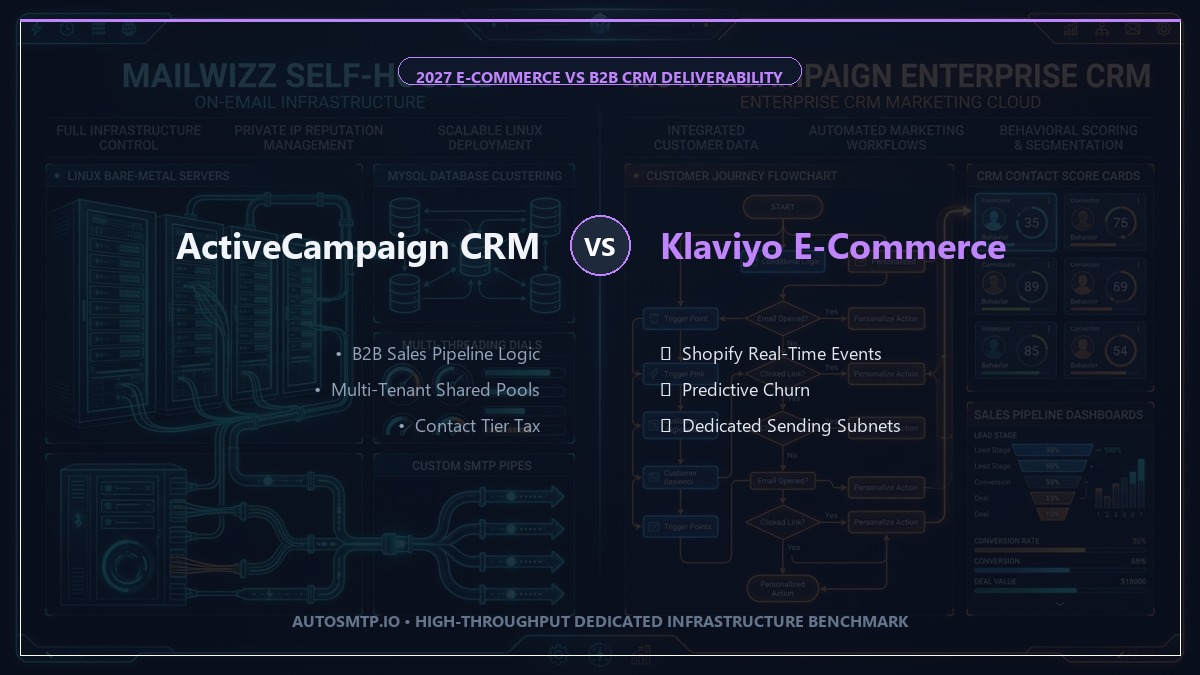
Klaviyo vs ActiveCampaign: 2027 E-Commerce Flow Deliverability vs Omnichannel B2B CRM Routing
Published by Fred Dawson • Senior Deliverability Systems Architect • 19 min read
When selecting a premium cloud marketing automation platform, high-growth businesses frequently weigh Klaviyo against ActiveCampaign. While both provide sophisticated automation builders and segmentation engines, their underlying email delivery topologies and ISP reputation profiles were engineered for diametrically opposed recipient environments. Klaviyo was purpose-built for direct-to-consumer (DTC) e-commerce, optimizing real-time event webhooks (abandoned checkout, browse abandonment) for consumer webmail providers (Gmail, Yahoo, iCloud). ActiveCampaign was architected around multi-channel B2B CRM funnels, deal stages, and corporate security gateways (Microsoft 365, Proofpoint, Mimecast). This technical benchmark dissects the deliverability mechanics, shared IP pool segregation, dedicated IP thresholds, and high-volume economic ceilings of both platforms in 2027.
- 1. Destination ISP Topologies: Consumer Webmail vs Corporate Gateways
- 2. Real-Time Trigger Latency: Shopify Event Sockets vs CRM Deal Webhooks
- 3. Shared IP Pool Segregation & Dedicated IP Requirements
- 4. The Hybrid Enterprise Architecture: Decoupling Mass Broadcasts
- 5. Klaviyo vs ActiveCampaign Deliverability Matrix
- 6. The AutoSMTP Deliverability Defense Advantage
1. Destination ISP Topologies: Consumer Webmail vs Corporate Gateways
The core deliverability divide between Klaviyo and ActiveCampaign stems from the mailbox environments they navigate:
- Klaviyo’s Consumer Deliverability Engine: Over 85% of emails sent through Klaviyo terminate at consumer webmail providers (Gmail, Yahoo, Apple Mail). These ISPs evaluate sender reputation based on engagement signals: open rates, click-through velocity, scroll depth, and marking as important. Klaviyo’s deliverability algorithms are tuned for high-frequency promotional bursts and rapid flash-sale traffic shaping.
- ActiveCampaign’s B2B Enterprise Engine: ActiveCampaign traffic is heavily skewed toward business email domains hosted on Microsoft 365, Google Workspace, and protected by Secure Email Gateways (SEGs) like Proofpoint, Mimecast, and Barracuda. These gateways inspect domain age, SPF/DKIM cryptographic headers, Bayesian content heuristics, and DNS consistency rather than consumer engagement metrics.
2. Real-Time Trigger Latency: Shopify Event Sockets vs CRM Deal Webhooks
How quickly an automated message lands in the inbox directly impacts revenue conversion:
Abandoned Cart Ingest Latency
In e-commerce, an abandoned checkout email delivered within 15 minutes converts at 3x the rate of an email delivered after 60 minutes. Klaviyo maintains direct API sockets with Shopify, BigCommerce, and WooCommerce, injecting event triggers directly into high-priority transactional spools within sub-seconds.
ActiveCampaign’s event engine processes triggers through a broader CRM workflow queue (evaluating contact tags, deal stages, and custom field logic). During peak campaign windows, automation execution can experience queue latency of 10 to 30 minutes, diminishing the urgency of time-sensitive promotional triggers.
3. Shared IP Pool Segregation & Dedicated IP Requirements
How both platforms manage their shared sending infrastructure dictates delivery stability for non-enterprise senders:
Klaviyo Deliverability Governance
- Employs dynamic algorithmic tiering; accounts with open rates >30% and complaint rates <0.02% are routed to elite shared IP pools.
- Low-engagement senders are quarantined onto secondary IPs to protect premium brands.
- Enforces strict opt-in verification and automated sunsetting of unengaged profiles.
ActiveCampaign Shared Pool Risks
- Shared IP pools combine e-commerce stores, affiliate promoters, and B2B cold sales teams.
- B2B cold lead uploads frequently cause bounce spikes and spam trap hits on shared relays.
- Dedicated IPs are restricted to expensive Enterprise plans (often requiring $1,000+/mo commitments).
4. The Hybrid Enterprise Architecture: Decoupling Mass Broadcasts
Both Klaviyo and ActiveCampaign impose steep, compounding contact tier taxes as audience size scales past 100,000 subscribers ($1,500/mo to $3,500+/mo). Forward-thinking enterprise brands resolve this by deploying a Hybrid Decoupled Architecture:
# TIER 1: HIGH-INTENT EVENT TRIGGERS (Klaviyo / ActiveCampaign)
Abandoned Cart / Welcome Series ──> Native ESP Sockets ──> High-Engagement Inboxes
(Only active 30-day VIP contacts retained in SaaS database to keep tiers low)

# TIER 2: MASS AUDIENCE BROADCASTS & NEWSLETTERS (AutoSMTP Bare Metal)
500,000+ Full Contact Database ──> MailWizz Frontend ──> AutoSMTP Dedicated /29 MTAs
                                                          ├── PowerMTA NVMe Spool
                                                          ├── 250,000+ msg/hr burst
                                                          └── Flat $350/mo (Zero Contact Tax)
5. Klaviyo vs ActiveCampaign Deliverability Matrix
| Pillar / Capability | Klaviyo E-Commerce ESP | ActiveCampaign B2B CRM | Deliverability Focus |
|---|---|---|---|
| Primary Audience | DTC E-Commerce consumers (Gmail/Yahoo) | B2B buyers & enterprise accounts (M365) | Klaviyo: Consumer inbox; ActiveCampaign: B2B |
| Shared Pool Hygiene | Automated dynamic reputation tiering | Broad shared pools with varied senders | Klaviyo: Superior shared pool isolation |
| Event Ingest Speed | Sub-second Shopify/e-com webhooks | Queue-delayed CRM workflow triggers | Klaviyo: Crucial for immediate checkout recovery |
| Dedicated IP Threshold | Available at ~100k+ sends or $50/mo add-on | Enterprise plan requirement ($1,000+/mo) | Klaviyo: More accessible dedicated IP path |
| Cost at 200K Contacts | $1,850 – $2,300/month | $1,400 – $1,900/month | Both impose steep compounding database fees |
Slashing $24,000/Year in SaaS Taxes with a Decoupled AutoSMTP Bulk Engine
A DTC fashion brand with 420,000 subscribers was spending over $2,600/month on Klaviyo. Over 65% of their monthly bill was driven simply by storing older, infrequent buyers who received only weekly product drop newsletters.
The Strategy: The brand downsized their active Klaviyo profile tier to 50,000 high-intent 30-day active contacts (abandoned cart, browse recovery, VIP flows), reducing their Klaviyo invoice to $400/month. The remaining 370,000 subscribers were migrated to an AutoSMTP Dedicated Bare-Metal Server for weekly broadcasts at a flat $399/month. Total annual software savings exceeded $21,600 with zero drop in promotional sales revenue.
The AutoSMTP Deliverability Defense Advantage
Inbound and outbound filtering pipelines require robust underlying transport hardware. AutoSMTP provisions sovereign, dedicated bare-metal MTA infrastructure engineered for high-throughput filtering, synchronous 550 bounce suppression, and permanent reputation control.
Provisions fully licensed PowerMTA and KumoMTA clusters on enterprise bare-metal with dedicated IPv4 subnets and predictable flat pricing.
Monitors Google Postmaster spam ratios (<0.1%) and real-time ISP deferrals with algorithmic volume scaling across your entire IP pool.
RFC 5321 in-band 550 bounce suppression, automated Yahoo/Outlook Complaint Feedback Loops (CFL), and instant bad-IP eviction.
Pre-configured forward and reverse DNS (PTR) per IP, SPF CIDR alignment, 2048-bit DKIM rotation, and strict DMARC enforcement.
Upgrade Your Email Infrastructure with Dedicated Bare Metal
Eliminate filter lag, queue serialization bottlenecks, and noisy neighbor contamination. Deploy a turnkey AutoSMTP cluster today.
Deploy Turnkey MTA Cluster →