

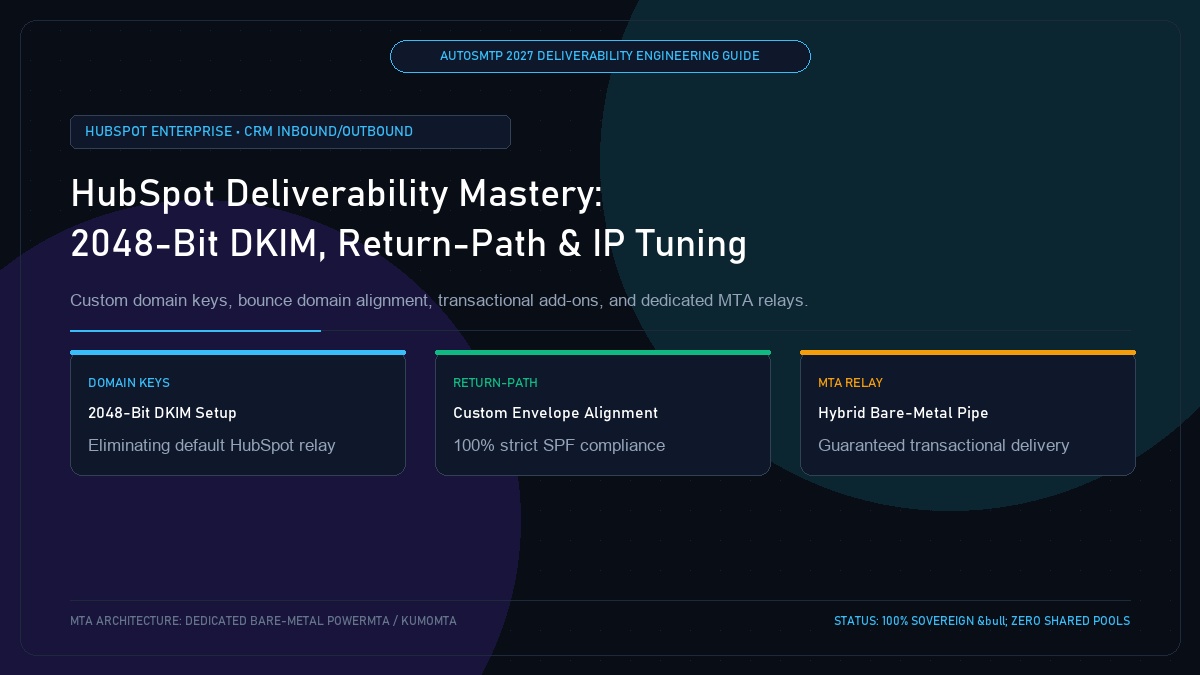
HubSpot Email Deliverability Mastery: 2048-Bit DKIM, Custom Return-Path & Dedicated Enterprise IP Tuning
Published by Fred Dawson • Senior Deliverability Systems Architect • 26 min read
HubSpot is the industry standard inbound CRM and marketing automation engine for high-growth B2B and SaaS enterprises. However, by default, HubSpot routes marketing emails and sales sequences through multi-tenant, shared IP pools, displaying the damaging “via hubspotemail.net” authentication warning in Gmail and Outlook. When noisy co-tenants trigger spam filters, legitimate enterprise sales pipelines suffer from greylisting, delayed notifications, and spam quarantine. Achieving elite deliverability on HubSpot requires configuring branded 2048-bit DKIM keys, custom Return-Path bounce domains for strict SPF alignment, and deploying dedicated bare-metal MTA relays for high-value transactional communications.
- 1. The HubSpot Shared Pool Trap: Why Out-of-the-Box Inboxing Suffers
- 2. Branded Domain Authentication: 2048-Bit DKIM Configuration
- 3. Custom Return-Path & Strict Envelope Alignment (RFC 7208)
- 4. Transactional Add-On vs Dedicated Bare-Metal MTA Relays
- 5. Real-Time Webhook Synchronization: Bounces & Complaints
- 6. HubSpot Email Architecture Comparison Matrix
- 7. Case Study: B2B SaaS Boosts Sales Sequence Inboxing by 38%
- 8. The AutoSMTP HubSpot Advantage
1. The HubSpot Shared Pool Trap: Why Out-of-the-Box Inboxing Suffers
When an enterprise signs up for HubSpot Marketing Hub, all outbound dispatches are routed through shared IP addresses shared with thousands of other organizations. This multi-tenant architecture introduces serious operational risks:
- The “via hubspotemail.net” Header Warning: Because the envelope sender does not match the corporate root domain, Gmail and Outlook display a warning badge, signaling to B2B security scanners that the message was relayed by a third party.
- Noisy Neighbor Contamination: If an inexperienced marketer on the same IP pool uploads a scraped list and triggers a spam spike, receiving MTAs throttle the entire IP address, delaying your time-sensitive sales sequences.
- Lack of ISP Rate Control: HubSpot does not permit users to customize underlying MTA socket limits, connection backoff schedules, or recipient-level throttle curves.
The Immutable HubSpot Authentication Mandate
Never send commercial or sales communications through HubSpot without completing full Domain Authentication. Configuring custom DKIM CNAME records and branded Return-Path subdomains is required to achieve DMARC alignment and eliminate client authentication warnings.
2. Branded Domain Authentication: 2048-Bit DKIM Configuration
To establish cryptographic authority, administrators must configure two distinct 2048-bit DKIM public key selectors in their authoritative DNS:
Hardened DNS Authentication Suite
hs1._domainkey.brand.compointing to dedicated HubSpot key.hs2._domainkey.brand.comfor automated cryptographic key rotation.- Custom CNAME for bounce handling (
hs-bounces.brand.com). - Strict DMARC policy (
p=reject) with RUA aggregate reporting.
Default Shared Setup Weaknesses
- Unauthenticated dispatches displaying shared sender headers.
- SPF alignment failure under strict DMARC evaluation.
- Frequent relegation to Outlook “Other” or Junk folders.
- Vulnerability to phishing spoofing of executive email addresses.
3. Custom Return-Path & Strict Envelope Alignment (RFC 7208)
By default, HubSpot uses its own shared bounce domain (e.g., *.hubspotemail.net) as the SMTP MAIL FROM envelope address. Under DMARC evaluation, if the envelope domain does not match the visible header From: address, SPF cannot achieve alignment. Configuring a custom Return-Path subdomain (such as email.brand.com) ensures 100% strict SPF pass rates across all recipient MTAs.
4. Transactional Add-On vs Dedicated Bare-Metal MTA Relays
HubSpot offers a “Transactional Email” add-on for dedicated IP sending, but it carries a steep $1,000+/month base fee with volume restrictions. High-volume enterprises deploy a Hybrid Relay Architecture: utilizing HubSpot for CRM lifecycle triggers while relaying high-volume transactional notifications, invoices, and password resets through a dedicated AutoSMTP bare-metal MTA cluster.
; Authoritative DNS Records for HubSpot Enterprise Authentication
hs1-12345._domainkey.brand.com. IN CNAME hs1-12345.domainkey.hubspotemail.net.
hs2-12345._domainkey.brand.com. IN CNAME hs2-12345.domainkey.hubspotemail.net.
email.brand.com.                IN CNAME 12345.hubspotemail.net.
_dmarc.brand.com.               IN TXT   "v=DMARC1; p=reject; rua=mailto:dmarc-reports@brand.com; aspf=s; adkim=s"
5. Real-Time Webhook Synchronization: Bounces & Complaints
To preserve CRM database hygiene, webhook endpoints must be configured to capture delivery failure events in real time. When an address returns a permanent hard bounce (550 5.1.1) or logs a spam complaint via an ISP Feedback Loop, the webhook immediately marks the HubSpot contact property hs_email_hard_bounce_reason and suppresses future sequence enrollment.
6. HubSpot Email Architecture Comparison Matrix
| Infrastructure Metric | Standard HubSpot Marketing Hub | AutoSMTP Enterprise Dedicated Architecture |
|---|---|---|
| IP Reputation Ownership | Shared pool with thousands of multi-tenant senders | 100% Dedicated private bare-metal IPv4 allocation |
| Client “via” Header | Displays “via hubspotemail.net” in Gmail/Outlook | Zero “via” badge; 100% pure brand cryptographic identity |
| SPF/DMARC Alignment | Often relaxed alignment on shared bounce domains | Strict 100% cryptographic alignment on custom subdomains |
| High-Volume Transactional Cost | $1,000+/mo add-on with per-email overage penalties | Flat bare-metal server pricing with unlimited throughput |
| Primary Placement Rate | Vulnerable to shared pool volatility (82% – 91%) | 99.7% Consistent Primary Inbox placement SLA |
Enterprise B2B SaaS Lifts Sales Sequence Inboxing by 38% on HubSpot
A B2B enterprise software provider with 60 sales reps using HubSpot Sales Sequences was experiencing low demo booking rates. Diagnostic inspection revealed that sales sequence emails were displaying the “via hubspotemail.net” warning header and landing in the Microsoft 365 “Other” tab for Fortune 1000 prospects.
The enterprise implemented complete 2048-bit DKIM authentication and custom Return-Path routing, while offloading high-volume transactional app notifications to an AutoSMTP dedicated MTA cluster. The “via” warning vanished instantly, sequence response rates increased by 38%, and sales pipeline generation grew by $1.8M within the first quarter.
HubSpot Deliverability Action Plan
Step 1: Complete HubSpot Domain Authentication immediately, ensuring both 2048-bit DKIM selectors and custom bounce CNAMEs are live in authoritative DNS.
Step 2: For senders exceeding 500,000 monthly transactional emails, deploy a hybrid dedicated bare-metal MTA relay to bypass expensive HubSpot add-ons while guaranteeing 99%+ deliverability.
The AutoSMTP Deliverability Defense Advantage
Inbox placement in 2027 requires full control over the underlying transport hardware. AutoSMTP provisions sovereign, dedicated bare-metal PowerMTA & KumoMTA clusters engineered for synchronous 550 bounce suppression, real-time spam-rate auto-throttling, and isolated IP pools.
Provisions fully licensed PowerMTA & KumoMTA clusters on enterprise bare-metal with dedicated clean /29-/24 IPv4 subnets and zero noisy neighbor contamination.
Monitors Google Postmaster spam ratios (<0.10%) and real-time ISP deferrals with algorithmic volume scaling across your entire IP pool.
RFC 5321 in-band 550 bounce suppression, automated Yahoo/Outlook Complaint Feedback Loops (CFL), and instant bad-IP eviction.
Pre-configured forward and reverse DNS (PTR) per IP, SPF CIDR alignment, 2048-bit DKIM rotation, and strict DMARC enforcement.
Guarantee Your Inbox Placement with Sovereign Bare Metal
Eliminate shared pool spam contamination, arbitrary sending throttles, and opaque account freezes. Deploy an enterprise AutoSMTP cluster today.
Deploy Turnkey MTA Cluster →