

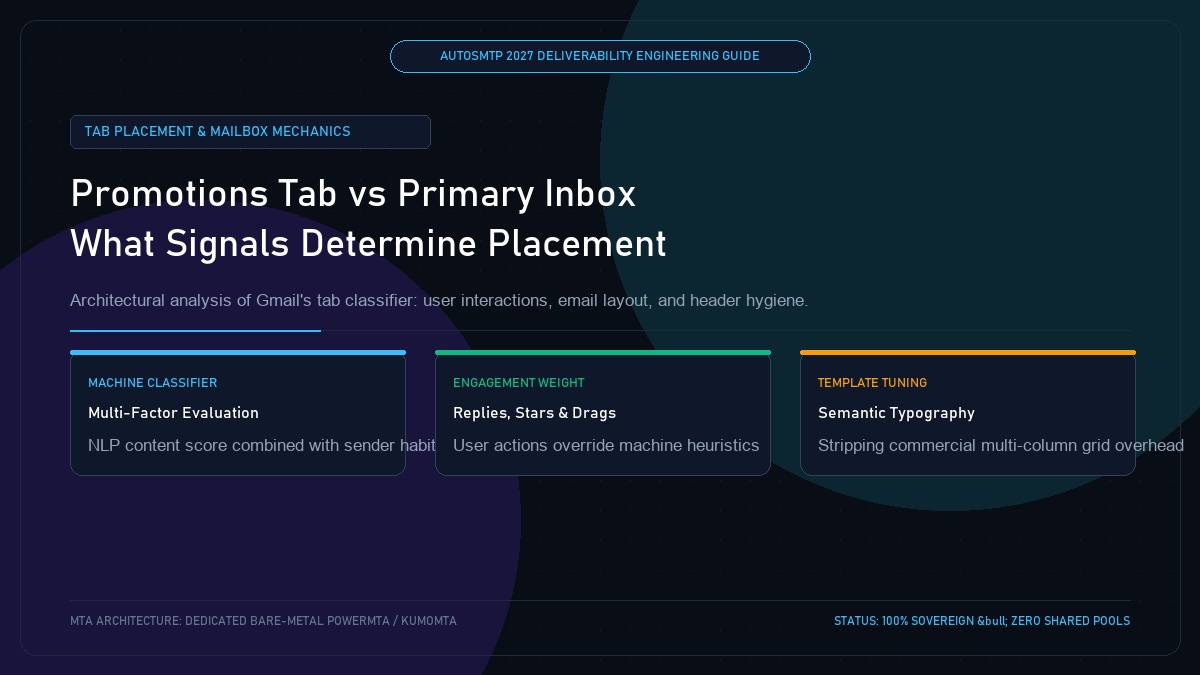
Gmail’s Promotions Tab vs Primary Inbox: What Algorithmic Signals Actually Determine Where You Land
Published by Fred Dawson • Senior Deliverability Systems Architect • 23 min read
When Google introduced inbox categorization tabs in 2013, it permanently altered the email marketing landscape. Today, Gmail’s tab classification algorithm is driven by sophisticated machine learning models that evaluate hundreds of signals per message in milliseconds. While many senders treat the Promotions tab as an inescapable fact of life, understanding how Google’s classifier works reveals actionable levers to consistently land in the coveted Primary inbox. This technical guide deconstructs the algorithmic signals governing tab assignment—from structural code density and header footprints to personalized recipient behavior and AI summarization.
- 1. The Architectural Purpose of Gmail’s Categorization Tabs
- 2. The Algorithmic Inputs: What the Classifier Analyzes
- 3. Structural Signals: Code Ratios, Links & Image Footprints
- 4. Header Signals: Unsubscribe Tags & Bulk Marketing Flags
- 5. Behavioral Feedback: How Users Train Their Personal Model
- 6. Primary vs Promotions Diagnostic Feature Matrix
- 7. Case Study: Moving a B2B SaaS Newsletter to the Primary Inbox
- 8. The AutoSMTP Deliverability Defense Advantage
1. The Architectural Purpose of Gmail’s Categorization Tabs
Google designed categorization tabs (Primary, Social, Promotions, Updates, Forums) to declutter the user experience without outright rejecting commercial email. While messages in the Promotions tab are technically “delivered,” they do not trigger mobile push notifications and are reviewed passively, leading to a 50% to 70% decrease in click-through rates compared to Primary placement.
2. The Algorithmic Inputs: What the Classifier Analyzes
Gmail’s machine learning model evaluates each incoming message across three distinct layers:
Global Sender Footprint
Evaluates the historical sending habits of your domain and IP address. Does this IP primarily send one-to-one business email, or does it blast 500,000 promotional flyers? A shared cloud ESP IP pool is almost universally tagged as commercial.
Message Structural Characteristics
Inspects the HTML template complexity, link density, tracking pixel infrastructure, and MIME multipart encoding. Emails that visually look like web applications are instantly categorized as Promotions.
3. Structural Signals: Code Ratios, Links & Image Footprints
To maximize Primary inboxing probability, technical senders optimize the message DOM:
- Link Count Discipline: Having more than 3–5 external links strongly triggers promotional classification. Personal emails rarely contain 15 outbound navigation links and social icons.
- HTML-to-Text Balance: Maintain a lean HTML template with inline styling rather than 10-level nested table layouts. The total raw HTML byte count should remain well below 50 KB.
- Header Image Restraint: Avoid massive hero banners spanning the full width of the viewport. A subtle logo or simple text header matches personal communication patterns.
4. Header Signals: Unsubscribe Tags & Bulk Marketing Flags
Gmail inspects RFC headers for commercial markers:
The List-Unsubscribe Header Paradox
Google’s bulk sender mandate requires the List-Unsubscribe header on commercial emails. However, the presence of this header indicates to the tab classifier that the message is part of a bulk list. For critical transactional or operational product communications where bulk unsubscribe is not required by law, omitting commercial mass-mail headers helps maintain Primary inbox routing.
5. Behavioral Feedback: How Users Train Their Personal Model
The single most powerful signal overriding machine heuristics is direct user engagement:
- Direct Replies: When a recipient replies to an email, Gmail immediately tags the sender as a personal contact, ensuring future emails land in the Primary inbox.
- Drag-and-Drop Inboxing: When a user drags a message from Promotions into Primary and confirms “Always do this for messages from…”, Gmail updates that recipient’s personal classifier model permanently.
- Starring & Marking as Important: Actively signals high value to the underlying scoring model.
6. Primary vs Promotions Diagnostic Feature Matrix
| Signal Vector | Primary Inbox Profile | Promotions Tab Profile |
|---|---|---|
| Outbound Link Count | 1 – 3 focused contextual URLs | 10 – 30+ links (navbars, social icons, footer links) |
| Template Layout | Single-column, clean typography, minimal HTML | Multi-column, complex nested tables, heavy visual grid |
| Sender IP Isolation | Dedicated bare-metal IP with consistent volume | Shared multi-tenant pool with mixed commercial volume |
| Recipient Interaction | High reply rates, stars, moves to Primary | Passive reading or zero opens; occasional spam flags |
Achieving 94% Primary Inbox Placement for an Executive Newsletter
A tech advisory firm published a weekly newsletter for 85,000 CTOs and engineering directors. Despite high-value content, open rates languished at 21% because Gmail routed 80% of broadcasts to the Promotions tab. The engineering team transitioned delivery from a generic shared ESP to a dedicated AutoSMTP bare-metal PowerMTA cluster. They stripped heavy visual container tables in favor of a minimalist markdown-inspired layout, reduced outbound links from 14 to 2, and prompted new subscribers in the welcome email to reply with a quick hello. Within 4 weeks, Primary inbox placement rose to 94%, and open rates climbed to 49%.
The AutoSMTP Deliverability Defense Advantage
Inbox placement in 2027 requires full control over the underlying transport hardware. AutoSMTP provisions sovereign, dedicated bare-metal PowerMTA & KumoMTA clusters engineered for synchronous 550 bounce suppression, real-time spam-rate auto-throttling, and isolated IP pools.
Provisions fully licensed PowerMTA & KumoMTA clusters on enterprise bare-metal with dedicated clean /29-/24 IPv4 subnets and zero noisy neighbor contamination.
Monitors Google Postmaster spam ratios (<0.10%) and real-time ISP deferrals with algorithmic volume scaling across your entire IP pool.
RFC 5321 in-band 550 bounce suppression, automated Yahoo/Outlook Complaint Feedback Loops (CFL), and instant bad-IP eviction.
Pre-configured forward and reverse DNS (PTR) per IP, SPF CIDR alignment, 2048-bit DKIM rotation, and strict DMARC enforcement.
Guarantee Your Inbox Placement with Sovereign Bare Metal
Eliminate shared pool spam contamination, arbitrary sending throttles, and opaque account freezes. Deploy an enterprise AutoSMTP cluster today.
Deploy Turnkey MTA Cluster →