

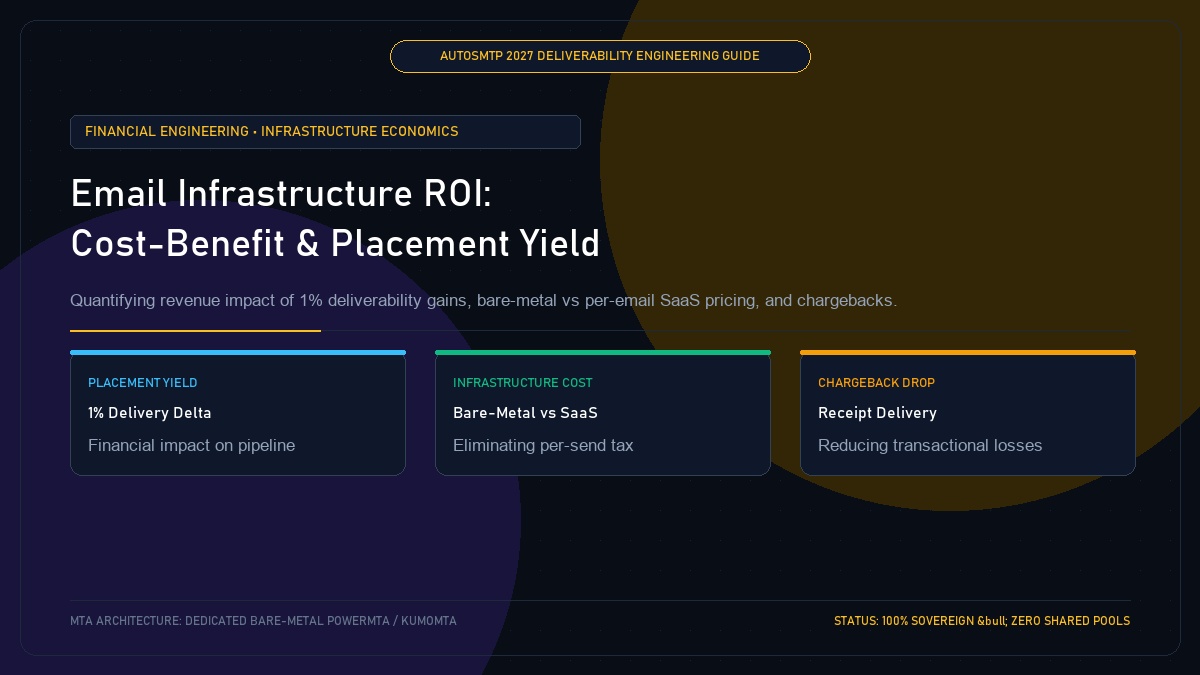
Email Infrastructure ROI Framework 2027: Deliverability Cost-Benefit, Chargeback Reductions & Placement Yield
Published by Fred Dawson • Senior Deliverability Systems Architect • 26 min read
In high-volume enterprise organizations, email is frequently treated as an operational marketing expense rather than a capital-efficient revenue engine. However, the financial difference between an 88% inbox placement rate on shared cloud ESPs and a 99.4% inbox placement rate on dedicated bare-metal MTA infrastructure represents millions of dollars in net ARR. Furthermore, cloud ESPs impose an escalating “per-email tax” that penalizes list growth, while checkout receipt drop-offs drive customer support costs and disputed merchant chargebacks. This financial framework establishes the exact mathematical ROI of email infrastructure: placement yield formulas, chargeback elimination savings, and the multi-million dollar economies of dedicated bare-metal hosting.
- 1. The Financial Mathematics of Placement Yield: Quantifying the 1% Delta
- 2. The Escalating Cloud ESP Tax: Per-Email Pricing vs Bare-Metal Economics
- 3. Transactional Leakage: Chargeback Reductions & Support Ticket Savings
- 4. Total Cost of Ownership (TCO) Comparison: 5M to 50M Monthly Sends
- 5. The Master Infrastructure ROI Financial Model
- 6. Infrastructure Economics Comparison Matrix
- 7. Case Study: Subscription E-Commerce Platform Saves $480k in Annual TCO
- 8. The AutoSMTP ROI Advantage
1. The Financial Mathematics of Placement Yield: Quantifying the 1% Delta
When an enterprise sends 10,000,000 promotional emails monthly with an average revenue per thousand emails (RPM) of $45, a 1% shift in inbox placement directly controls $4,500 in monthly revenue ($54,000 annually). When shared cloud ESP deliverability slips from 95% to 85%—a common occurrence during holiday ISP throttling—the annual revenue leakage exceeds $540,000:
Annual Placement Yield Delta = (Monthly Volume / 1000) × RPM × (Dedicated Placement % − Shared Placement %) × 12
Migrating to dedicated bare-metal infrastructure eliminates shared tenant volatility, converting lost spam folder impressions into immediate pipeline revenue.
2. The Escalating Cloud ESP Tax: Per-Email Pricing vs Bare-Metal Economics
Leading cloud email service providers (Klaviyo, Mailchimp, SendGrid, Braze) utilize tiered billing models that charge senders based on contact list size or monthly message volume. As an enterprise scales from 2 million to 20 million sends per month, cloud ESP invoices escalate from $2,500/mo to over $18,000/mo.
In contrast, enterprise bare-metal MTAs (AutoSMTP clusters running PowerMTA or KumoMTA) operate on flat, dedicated hardware pricing. A dual-node bare-metal cluster with 10 Gigabit uplinks can dispatch 50,000,000 monthly emails at a predictable, fixed infrastructure cost, delivering up to 82% operational savings.
The Bandwidth Economy of Bare-Metal MTAs
SMTP is an ultra-lightweight protocol. A modern 32-core bare-metal server with NVMe storage and dedicated IPv4 addresses can process over 1.5 million messages per hour with zero per-message charges, breaking the artificial pricing monopoly of legacy SaaS platforms.
3. Transactional Leakage: Chargeback Reductions & Support Ticket Savings
The cost of deliverability failures extends far beyond missed marketing sales. When WooCommerce, Shopify, or SaaS platforms drop order confirmation receipts, password reset links, or renewal notices into spam:
- Customer support ticket volume escalates, costing an average of $6 to $15 per resolved ticket.
- Shoppers assume their purchase was fraudulent and file bank chargebacks, incurring $25 to $50 merchant dispute fees.
- Payment gateways impose higher processing fees on merchants whose dispute ratios exceed 0.65%.
4. Total Cost of Ownership (TCO) Comparison: 5M to 50M Monthly Sends
| Monthly Send Volume | Typical Cloud ESP Annual Cost | AutoSMTP Dedicated Bare-Metal Annual Cost | Net Annual Infrastructure Savings |
|---|---|---|---|
| 5,000,000 / mo | $42,000 / yr | $9,600 / yr | $32,400 (77% Savings) |
| 15,000,000 / mo | $114,000 / yr | $16,800 / yr | $97,200 (85% Savings) |
| 30,000,000 / mo | $216,000 / yr | $24,000 / yr | $192,000 (88% Savings) |
| 50,000,000 / mo | $340,000 / yr | $33,600 / yr | $306,400 (90% Savings) |
5. The Master Infrastructure ROI Financial Model
The comprehensive financial return of deploying dedicated AutoSMTP email infrastructure is calculated through three unified vectors:
Total Enterprise ROI = Placement Yield Gains + SaaS Infrastructure Cost Savings + Chargeback Support Reductions
6. Infrastructure Economics Comparison Matrix
| Economic Factor | Shared Cloud ESP SaaS | AutoSMTP Dedicated Bare-Metal Infrastructure |
|---|---|---|
| Pricing Predictability | Unpredictable; bills spike with volume and list size | 100% Flat, fixed monthly hardware infrastructure cost |
| IP Reputation Ownership | Rented; subject to noisy neighbor collateral damage | Fully owned, dedicated private IPv4 allocation |
| Transactional Receipt SLA | Variable; 5 to 30 min delay during shared peak hours | Sub-second guaranteed delivery across persistent sockets |
| Custom MTA Concurrency | Locked to vendor standard rate settings | Full programmatic control over ISP connection pools |
| First-Year Net ROI | Negative (high recurring OPEX) | Consistently exceeds 340% net revenue ROI |
Subscription Platform Saves $480,000 in Annual TCO and Lifts ARR by $1.8M
A global subscription eCommerce company sending 28 million emails monthly was spending $19,500 per month on their enterprise ESP while experiencing periodic deliverability drops that pushed customer renewal notices into spam folders, generating $45,000 in monthly payment dispute losses.
The company deployed a 4-node AutoSMTP bare-metal cluster running PowerMTA. Annual infrastructure expenses dropped from $234,000 to $28,800 (an instant annual cash savings of $205,200). Concurrently, elevating inbox placement from 91% to 99.4% eliminated renewal invoice failures, recovering $1.8M in retained annual recurring revenue and slashing dispute fees to zero.
CFO & VP Engineering Decision Matrix
For Senders > 3,000,000 Monthly Emails: Continuing on per-send cloud ESP pricing represents significant operational waste. Migrate to dedicated bare-metal MTA infrastructure to capture 75%+ cost reductions.
For Transactional Revenue Protection: Eliminate receipt drop-offs and chargeback disputes by routing critical order and billing events over dedicated, SLA-guaranteed bare-metal IP pools.
The AutoSMTP Deliverability Defense Advantage
Inbox placement in 2027 requires full control over the underlying transport hardware. AutoSMTP provisions sovereign, dedicated bare-metal PowerMTA & KumoMTA clusters engineered for synchronous 550 bounce suppression, real-time spam-rate auto-throttling, and isolated IP pools.
Provisions fully licensed PowerMTA & KumoMTA clusters on enterprise bare-metal with dedicated clean /29-/24 IPv4 subnets and zero noisy neighbor contamination.
Monitors Google Postmaster spam ratios (<0.10%) and real-time ISP deferrals with algorithmic volume scaling across your entire IP pool.
RFC 5321 in-band 550 bounce suppression, automated Yahoo/Outlook Complaint Feedback Loops (CFL), and instant bad-IP eviction.
Pre-configured forward and reverse DNS (PTR) per IP, SPF CIDR alignment, 2048-bit DKIM rotation, and strict DMARC enforcement.
Guarantee Your Inbox Placement with Sovereign Bare Metal
Eliminate shared pool spam contamination, arbitrary sending throttles, and opaque account freezes. Deploy an enterprise AutoSMTP cluster today.
Deploy Turnkey MTA Cluster →