

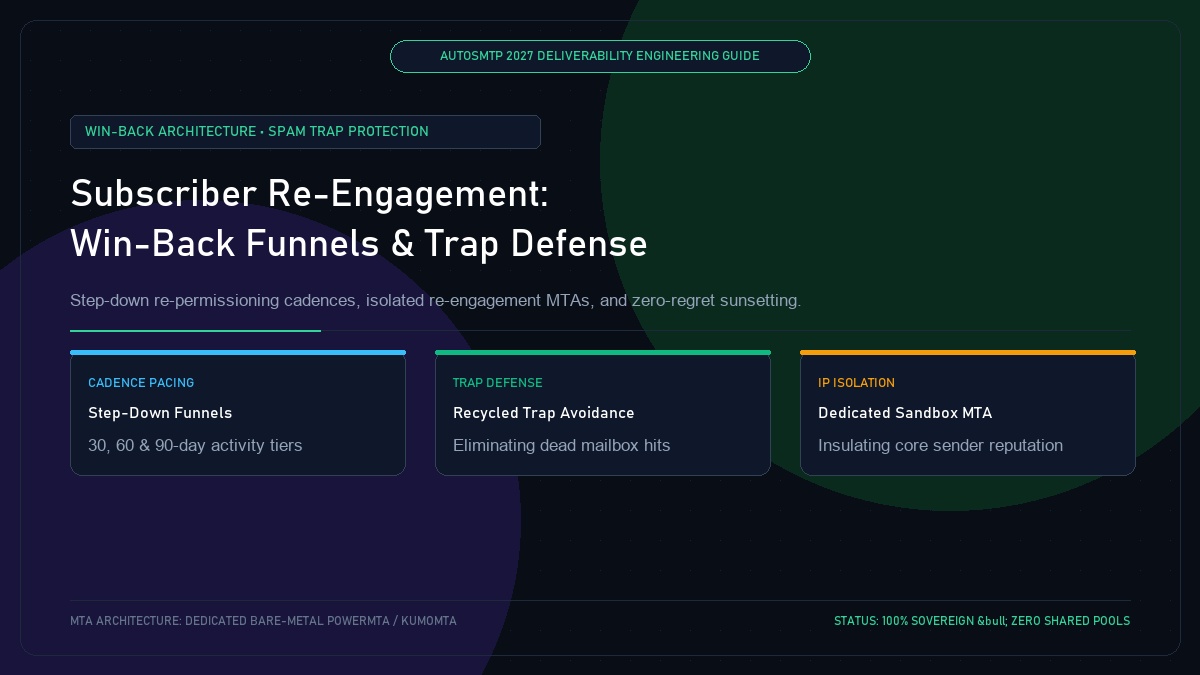
Subscriber Re-Engagement Architecture: Algorithmic Win-Back Funnels, Trap Avoidance & Graceful Sunsetting
Published by Fred Dawson • Senior Deliverability Systems Architect • 26 min read
When subscriber open rates begin to decline, the conventional marketing instinct is to blast inactive users with high-discount “We Miss You!” re-engagement campaigns. In modern deliverability engineering, poorly executed re-engagement blasts are the leading cause of catastrophic domain reputation collapse. Inactive subscriber cohorts are heavily seeded with abandoned inboxes that mailbox providers have converted into recycled spam traps. Sending bulk blasts to recipients dormant for over 90 days triggers automated blocklisting on Spamhaus, Barracuda, and Microsoft SNDS. Executing safe subscriber re-engagement requires step-down win-back funnels, isolated sandbox VirtualMTAs, and automated zero-regret sunsetting.
- 1. The Re-Engagement Trap: Why ‘We Miss You’ Blasts Get Blacklisted
- 2. The 30/60/90-Day Step-Down Cadence: De-escalating Frequency
- 3. Sandbox VirtualMTA Routing: Insulating Primary Domain Reputation
- 4. High-Affinity Plain-Text Re-Permissioning Engineering
- 5. Automated Zero-Regret Sunsetting: The Mathematics of Purging
- 6. Re-Engagement Architecture Comparison Matrix
- 7. Case Study: E-Commerce Retailer Cleanses 400k Inactive Contacts
- 8. The AutoSMTP Re-Engagement Advantage
1. The Re-Engagement Trap: Why ‘We Miss You’ Blasts Get Blacklisted
Recycled spam traps are real email addresses once owned by real humans that were abandoned. After 180 to 365 days of dormancy, mailbox providers (such as Outlook, Yahoo, and regional telcos) reactivate the address as a passive trap. When a sender dispatches a re-engagement blast to historical inactives, hitting even two or three recycled traps results in immediate IP blocklisting:
- Spamhaus ZEN & DBL Listings: Automated trap detection triggers domain and IP reputation penalties, halting outbound mail delivery globally.
- Microsoft SNDS Red Status: Automated greylisting and permanent rejection across all Outlook, Hotmail, and Live destination addresses.
- Google Postmaster Demotion: Domain reputation immediately drops to “Bad”, causing all regular customer emails to land in spam.
The Immutable Win-Back Rule
Never attempt to re-engage subscribers who have shown zero engagement across all channels for more than 180 days. Historical contacts dormant for over 6 months must be purged or pre-verified via deep SMTP socket handshakes before any campaign is initiated.
2. The 30/60/90-Day Step-Down Cadence: De-escalating Frequency
Rather than blasting cold subscribers suddenly, high-performance lifecycle engineering enforces a graceful step-down cadence:
Algorithmic Step-Down Pacing
- Day 30 Inactivity: Shift from daily sends to a weekly digest.
- Day 60 Inactivity: Shift to bi-weekly dispatches featuring top-rated content.
- Day 90 Inactivity: Trigger a single high-contrast re-permissioning email.
- Day 104 Inactivity: Permanent suppression if unopened.
Static Batch Blasting
- Continuing full-frequency dispatches to unengaged users.
- Accumulating spam complaints from frustrated recipients.
- Sudden 10x volume bursts to dormant databases.
- Guaranteed algorithmic penalty in Gmail and Outlook.
3. Sandbox VirtualMTA Routing: Insulating Primary Domain Reputation
When executing win-back workflows, dispatches must never be routed across the same IP pool or virtual MTA used for active buyers and daily operations. AutoSMTP bare-metal clusters configure isolated Re-Engagement Sandbox VirtualMTAs with strict connection rate limits.
# Isolated Sandbox VirtualMTA for Re-Engagement Campaigns
<virtual-mta vmta-winback-sandbox>
    smtp-source-ip 162.251.122.173
    host-name reengage.brand.com
    max-smtp-out 50
    max-msg-per-connection 25
    retry-after 10m
    bounce-after 12h
</virtual-mta>
4. High-Affinity Plain-Text Re-Permissioning Engineering
The single most effective re-engagement asset is a lightweight, plain-text email sent from a personal executive or founder alias (e.g., fred@brand.com). Removing heavy marketing banners, tracking redirects, and commercial discount codes strips out Bayesian spam triggers, allowing the message to reach the Primary Inbox with an honest question: “Should we keep sending you these updates?”
5. Automated Zero-Regret Sunsetting: The Mathematics of Purging
Marketers frequently resist list pruning out of fear of losing potential revenue. However, mathematical modeling consistently proves that purging contacts inactive for > 90 days increases overall email revenue by 20% to 35% by restoring 99%+ inbox placement for active buyers.
6. Re-Engagement Architecture Comparison Matrix
| Capability | Unmanaged ‘We Miss You’ Blast | AutoSMTP Algorithmic Win-Back Architecture |
|---|---|---|
| Spam Trap Risk | Extreme; triggers Spamhaus and SNDS blocks | Zero; step-down cadence avoids recycled trap thresholds |
| Infrastructure Isolation | Shares primary IP pool with transactional receipts | Hardware-isolated Sandbox VirtualMTA (reengage.) |
| Sunsetting Enforcement | Manual and sporadic; lists remain bloated | Automated, programmatic zero-regret suppression |
| Template Semantics | Heavy HTML discount flyer (relegated to Promo) | High-affinity lightweight plain-text personal layout |
| Domain Reputation Impact | Severely degrades Google Postmaster reputation | 100% Insulated core domain and transactional health |
E-Commerce Retailer Recovers 99.2% Inboxing by Pruning 400,000 Dormant Leads
A multi-category apparel retailer with 1.4 million subscribers saw revenue drop by 40% after a massive holiday win-back blast landed their primary domain on the Spamhaus Domain Blocklist (DBL). Investigation revealed that the blast had hit 18 recycled spam traps across contacts dormant for over 18 months.
The merchant implemented AutoSMTP’s algorithmic win-back framework. They purged 400,000 inactive accounts, isolated 90-day step-down workflows onto a dedicated sandbox MTA, and transitioned to plain-text re-permissioning. Spamhaus delisted the domain within 72 hours, Google Postmaster reputation returned to “High”, and overall monthly email revenue increased by $280,000 despite sending 28% fewer total emails.
Re-Engagement Implementation Blueprint
Immediate Step: Immediately suppress all contacts with zero opens or clicks in the past 180 days. Do not attempt to email this cohort under any circumstances.
Architecture Mandate: Route 90-day inactive win-back workflows through dedicated Sandbox VirtualMTAs using lightweight plain-text templates to insulate core transactional revenue.
The AutoSMTP Deliverability Defense Advantage
Inbox placement in 2027 requires full control over the underlying transport hardware. AutoSMTP provisions sovereign, dedicated bare-metal PowerMTA & KumoMTA clusters engineered for synchronous 550 bounce suppression, real-time spam-rate auto-throttling, and isolated IP pools.
Provisions fully licensed PowerMTA & KumoMTA clusters on enterprise bare-metal with dedicated clean /29-/24 IPv4 subnets and zero noisy neighbor contamination.
Monitors Google Postmaster spam ratios (<0.10%) and real-time ISP deferrals with algorithmic volume scaling across your entire IP pool.
RFC 5321 in-band 550 bounce suppression, automated Yahoo/Outlook Complaint Feedback Loops (CFL), and instant bad-IP eviction.
Pre-configured forward and reverse DNS (PTR) per IP, SPF CIDR alignment, 2048-bit DKIM rotation, and strict DMARC enforcement.
Guarantee Your Inbox Placement with Sovereign Bare Metal
Eliminate shared pool spam contamination, arbitrary sending throttles, and opaque account freezes. Deploy an enterprise AutoSMTP cluster today.
Deploy Turnkey MTA Cluster →