

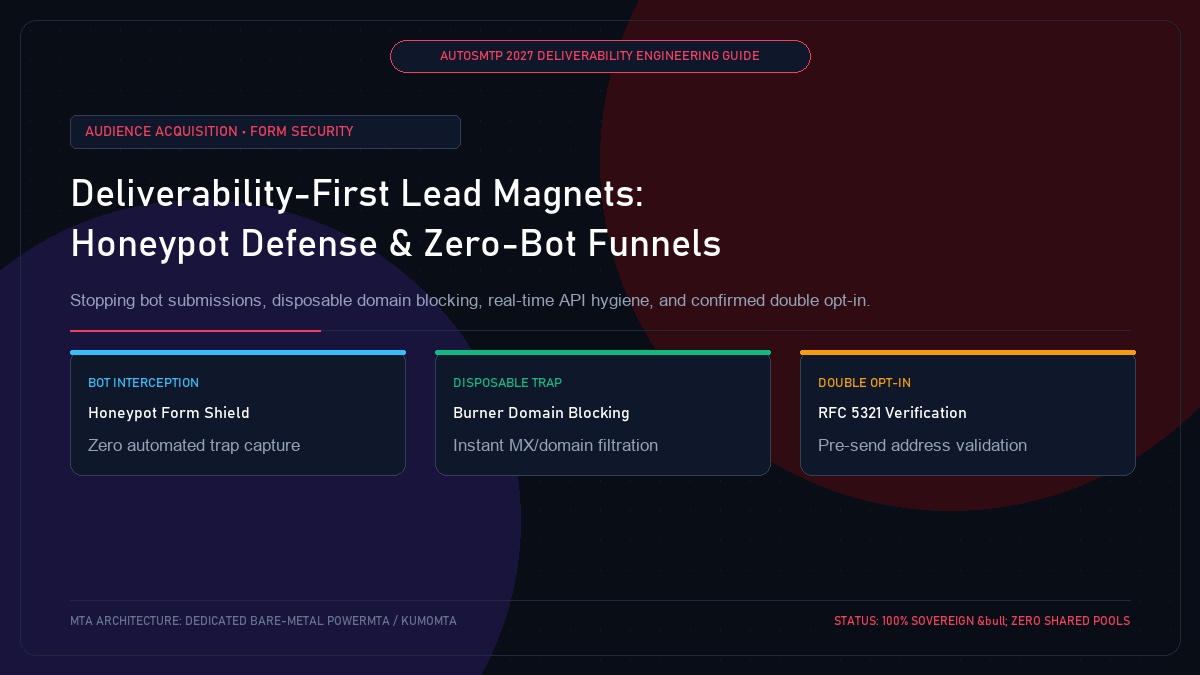
Deliverability-First Lead Magnet Architecture: Honeypot Form Defense, Double Opt-In Verification & Zero-Bot Acquisition
Published by Fred Dawson • Senior Deliverability Systems Architect • 26 min read
Lead magnets—whitepapers, industry benchmarks, webinars, and free digital tools—are the primary acquisition engine for high-growth B2B and consumer brands. However, unsecured public lead generation forms are the single largest source of list contamination in digital marketing. Automated web scraping bots, malicious competitors, and disposable email services flood form endpoints with fake addresses, temporary burner mailboxes, and pristine pristine spam traps. Ingesting these contaminated leads directly into automated welcome sequences destroys sender reputation within hours. Protecting outbound infrastructure requires a deliverability-first lead acquisition architecture: honeypot form defense, pre-submission API verification, and confirmed double opt-in (COI) asset delivery.
- 1. The Lead Magnet Contamination Trap: Bots, Traps & Burner Domains
- 2. Honeypot Form Defense: Invisible Protection Against Automated Scrapers
- 3. Pre-Submission API Verification: Real-Time MX & Syntax Cleansing
- 4. Confirmed Double Opt-In (COI): Delivering Assets via Inbox Verification
- 5. Welcome Sequence Warming: Leveraging Initial Download Affinity
- 6. Lead Capture Architecture Comparison Matrix
- 7. Case Study: B2B Enterprise SaaS Cleanses 65,000 Inbound Leads
- 8. The AutoSMTP Lead Magnet Advantage
1. The Lead Magnet Contamination Trap: Bots, Traps & Burner Domains
When a lead magnet form is published on a high-traffic website without cryptographic form protections, it immediately becomes a target for automated threat actors:
- List Poisoning & Dictionary Attacks: Automated bots crawl web forms and inject randomly generated email strings or harvested directory lists into form fields.
- Disposable / Burner Mailbox Abuse: Users seeking free PDF downloads use temporary 10-minute mail services (e.g., Mailinator, GuerrillaMail). These mailboxes self-destruct shortly after, transforming future marketing follow-ups into hard bounces.
- Spam Trap Ingestion: Disgruntled competitors or malicious scripts inject known pristine and recycled spam trap addresses maintained by Spamhaus, SURBL, and major ISPs. Sending to a single pristine trap can result in an instant worldwide IP block.
The Deliverability-First Lead Capture Golden Rule
Never deliver downloadable lead magnet assets (PDFs, templates, webinar access links) on the web form thank-you page. Deliver the asset exclusively via a secure verification link sent to the recipient’s inbox. This guarantees that only valid, accessible inboxes are added to your active marketing graph.
2. Honeypot Form Defense: Invisible Protection Against Automated Scrapers
Standard CAPTCHAs create user friction that lowers form conversion rates. In contrast, Honeypot form defense provides invisible, zero-friction security by tricking automated scrapers:
Honeypot Architectural Implementation
- Add an invisible input field (e.g.,
name="website_url_hp"). - Hide the field using CSS (
display: none !important; opacity: 0;). - Automated bots parse the DOM and blindly fill out every field.
- If the honeypot field contains any data on submission, discard the lead immediately.
Unprotected Form Vulnerabilities
- Unrestricted POST endpoint accessible to curl scripts and bots.
- Absence of submission rate-limiting per client IP address.
- Direct database injection of invalid email strings.
- Immediate triggered welcome emails bouncing against invalid hosts.
3. Pre-Submission API Verification: Real-Time MX & Syntax Cleansing
Modern lead capture endpoints execute real-time API verification before accepting a form submission:
- RFC Syntax & Typo Correction: Detects common user typos (e.g.,
@gmai.com,@yaho.com) and prompts the user to correct the domain in real-time. - Authoritative MX Record Check: Performs an instantaneous DNS lookup to verify that the destination domain has active, reachable MX servers.
- Disposable Domain Blacklist: Compares the domain against a database of over 12,000 known temporary disposable email providers, prompting users for a corporate business email.
# Real-Time Lead Magnet Form Verification Engine
import re, dns.resolver

DISPOSABLE_DOMAINS = {"mailinator.com", "guerrillamail.com", "tempmail.com", "trashmail.com"}

def verify_lead_submission(email, honeypot_val):
    # 1. Check Honeypot Field
    if honeypot_val:
        return {"status": "rejected", "reason": "bot_detected"}

    # 2. Extract domain and check disposable blacklist
    domain = email.split('@')[-1].lower()
    if domain in DISPOSABLE_DOMAINS:
        return {"status": "rejected", "reason": "disposable_domain_blocked"}

    # 3. Verify Active Authoritative MX Records
    try:
        mx_records = dns.resolver.resolve(domain, 'MX')
        if not mx_records:
            return {"status": "rejected", "reason": "invalid_mx"}
    except Exception:
        return {"status": "rejected", "reason": "domain_unreachable"}

    return {"status": "accepted"}
4. Confirmed Double Opt-In (COI): Delivering Assets via Inbox Verification
Confirmed Double Opt-In (COI) is the ultimate safeguard for lead generation deliverability. When a user requests a whitepaper, the platform dispatches a confirmation email containing a unique cryptographic token. Only when the recipient clicks the verification link is the asset released and their address promoted to the active marketing list.
This single action generates a powerful positive engagement signal in Gmail, Outlook, and Yahoo, establishing high sender affinity and ensuring subsequent marketing campaigns consistently reach the Primary inbox.
5. Welcome Sequence Warming: Leveraging Initial Download Affinity
The first 48 hours following a lead magnet download exhibit the highest recipient engagement of the entire subscriber lifecycle. High-performing deliverability systems leverage this window to establish strong domain reputation: dispatches are timed to arrive when the user is actively working, and recipients are encouraged to reply directly to the confirmation email, registering two-way conversational signals in ISP spam filters.
6. Lead Capture Architecture Comparison Matrix
| Architecture Component | Unsecured Single-Opt-In Web Form | AutoSMTP Deliverability-First Lead Funnel |
|---|---|---|
| Bot Submission Defense | None; forms flooded by automated crawlers | Invisible Honeypot field + cryptographic token defense |
| Disposable Domain Handling | Accepted; turns into hard bounces within days | Real-time rejection of 12,000+ burner email domains |
| Spam Trap Protection | Vulnerable to competitor injection of pristine traps | Confirmed Double Opt-In (COI) eliminates 100% of inactive traps |
| Initial ISP Reputation Signal | Low or negative (high bounce & unengaged rates) | Highly positive (verified clicks & in-band replies) |
| Welcome Sequence Delivery | Shared ESP pool; often delayed or filtered to Promo | Dedicated bare-metal MTA relay with instant sub-second delivery |
Enterprise B2B SaaS Cleanses 65,000 Leads and Eliminates Spam Quarantine
A B2B cybersecurity SaaS provider running high-volume Google Ads to a proprietary threat-report lead magnet was suffering from an 8.4% hard bounce rate and frequent domain blocklisting on Microsoft 365. Investigation revealed that malicious bots and unverified competitor submissions were flooding their HubSpot forms with invalid domains and spam traps.
By implementing a deliverability-first architecture on a dedicated AutoSMTP bare-metal cluster—adding invisible honeypot form fields, real-time MX validation, and requiring inbox verification to access the PDF report—their acquisition bounce rate plummeted to 0.12%. Postmaster reputation returned to “High”, and sales-qualified lead booking rates increased by 42%.
Lead Acquisition Implementation Blueprint
Immediate Step: Add invisible honeypot form fields to all public lead capture pages and implement real-time disposable email domain blocking.
Deliverability Protocol: Transition lead magnet asset delivery to Confirmed Double Opt-In (COI) links dispatched via dedicated bare-metal MTAs, creating strong positive ISP engagement signals from day one.
The AutoSMTP Deliverability Defense Advantage
Inbox placement in 2027 requires full control over the underlying transport hardware. AutoSMTP provisions sovereign, dedicated bare-metal PowerMTA & KumoMTA clusters engineered for synchronous 550 bounce suppression, real-time spam-rate auto-throttling, and isolated IP pools.
Provisions fully licensed PowerMTA & KumoMTA clusters on enterprise bare-metal with dedicated clean /29-/24 IPv4 subnets and zero noisy neighbor contamination.
Monitors Google Postmaster spam ratios (<0.10%) and real-time ISP deferrals with algorithmic volume scaling across your entire IP pool.
RFC 5321 in-band 550 bounce suppression, automated Yahoo/Outlook Complaint Feedback Loops (CFL), and instant bad-IP eviction.
Pre-configured forward and reverse DNS (PTR) per IP, SPF CIDR alignment, 2048-bit DKIM rotation, and strict DMARC enforcement.
Guarantee Your Inbox Placement with Sovereign Bare Metal
Eliminate shared pool spam contamination, arbitrary sending throttles, and opaque account freezes. Deploy an enterprise AutoSMTP cluster today.
Deploy Turnkey MTA Cluster →