

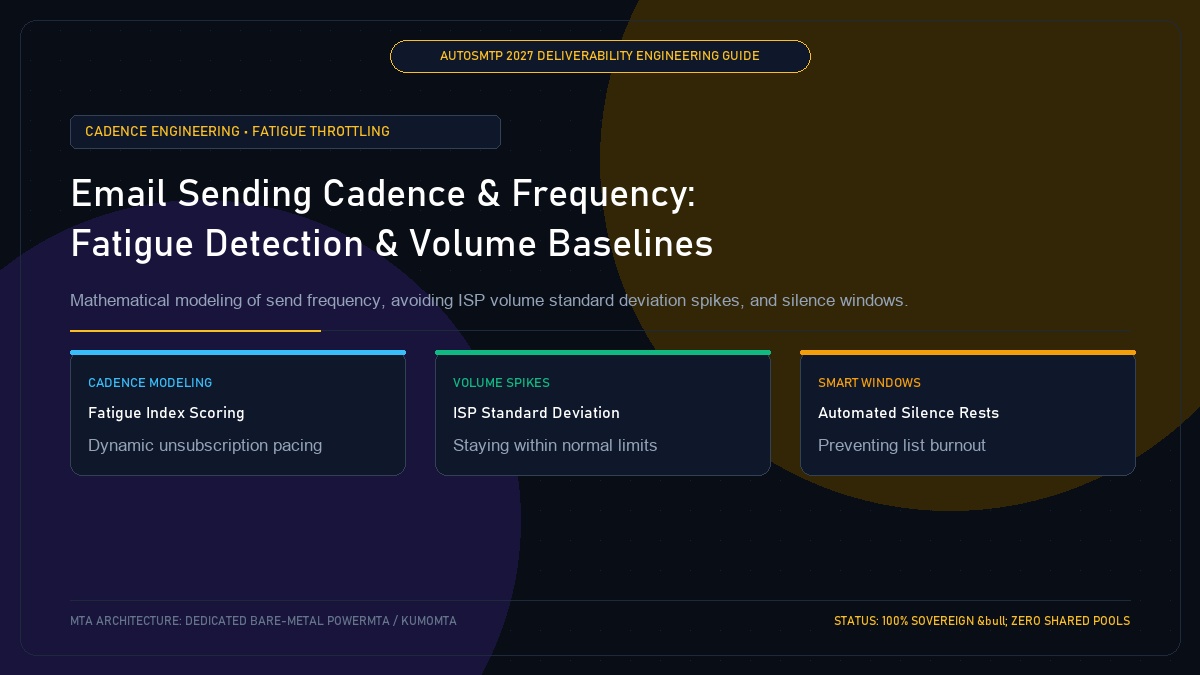
Email Sending Cadence & Frequency Optimization: Algorithmic Throttling, Fatigue Detection & ISP Volume Thresholds
Published by Fred Dawson • Senior Deliverability Systems Architect • 26 min read
Email send frequency is the single most sensitive lever controlling both commercial revenue and inbox deliverability. Send too infrequently, and cryptographic domain reputations decay, allowing dormant recipient mailboxes to transform into recycled spam traps. Send too frequently, and subscriber list fatigue triggers rising spam complaints, algorithmic Gmail Promotions tab relegation, and destination ISP connection throttling. Establishing the optimal send cadence requires moving beyond arbitrary marketing calendars and implementing mathematical fatigue modeling, automated silence windows, and dynamic ISP volume standard deviation controls.
- 1. Mathematical Cadence Modeling: Frequency vs Engagement Velocity
- 2. ISP Volume Standard Deviation: Avoiding Anomalous Spike Penalties
- 3. Recipient Fatigue Index (RFI): Dynamic Algorithmic Throttling
- 4. Strategic Silence Windows: Post-Campaign Reputation Healing
- 5. Dedicated MTA Queue Rate Curve Configuration
- 6. Cadence Engineering Comparison Matrix
- 7. Case Study: DTC Brand Grows Revenue 26% While Cutting Send Volume 30%
- 8. The AutoSMTP Cadence Advantage
1. Mathematical Cadence Modeling: Frequency vs Engagement Velocity
Every recipient list has a finite engagement capacity. When a sender doubles their weekly email frequency from 2 to 4 sends per week, aggregate open volume rarely doubles. Instead, marginal opens decline, unsubscriptions accelerate, and spam complaint velocity increases exponentially:
- Linear Decay of Engagement: While the first email of the week captures high-intent readers, subsequent dispatches to identical cohorts yield diminishing returns.
- The Spam Complaint Inflection Point: When frequency exceeds recipient expectations, users stop searching for unsubscribe links and instead click the native “Report Spam” button in Gmail and Outlook.
- ISP Algorithmic De-prioritization: As user open ratios drop below 12%, machine-learning spam filters (Gmail Gemini, Microsoft SmartScreen) begin automatically sorting subsequent broadcasts into the Promotions or Junk folders.
The 25% Daily Volume Standard Deviation Rule
Mailbox providers track 30-day historical sending baselines. To maintain “High” reputation in Google Postmaster Tools, never allow daily sending volume to swing by more than ± 25% from your 7-day rolling average without prior gradual warming.
2. ISP Volume Standard Deviation: Avoiding Anomalous Spike Penalties
A classic operational mistake is sending zero emails on Monday and Tuesday, blasting 350,000 emails on Wednesday morning, and resting until the following week. This erratic volume profile triggers defensive rate-limiting mechanisms:
Erratic Batch & Blast Volatility
- Sudden 10x volume surges mimic hijacked botnet servers.
- Receiving MTAs issue
421 4.7.0temporary deferrals. - Connection timeouts cause multi-hour queue backlogs.
- Spam filters penalize unpredicted traffic anomalies.
Smooth Algorithmic Cadence Distribution
- Consistent daily baseline volume across 7 days a week.
- Predictable connection recycling and TCP socket pooling.
- Smooth ISP throughput without triggering rate thresholds.
- Maximum deliverability stability and trust accumulation.
3. Recipient Fatigue Index (RFI): Dynamic Algorithmic Throttling
Rather than sending the same number of weekly emails to every subscriber, modern deliverability systems compute a Recipient Fatigue Index (RFI) based on recent interactions:
- High Affinity (RFI < 20): Subscribers who opened or clicked within the last 7 days. Can safely receive 3 to 5 communications per week without complaint risk.
- Medium Affinity (RFI 21 – 60): Subscribers inactive for 8 to 30 days. Frequency automatically downshifted to 1 or 2 high-value digests per week.
- Fatigued / Cold (RFI > 60): Subscribers inactive for 31 to 90 days. Frequency restricted to 1 monthly digest, followed by sunset suppression if inactivity persists.
4. Strategic Silence Windows: Post-Campaign Reputation Healing
Following high-intensity promotional windows—such as Black Friday, Cyber Week, or quarterly inventory clearance sales—subscriber complaint rates and unsubscribe volume naturally rise. Continuing to send at peak volume during the immediate aftermath of a campaign causes serious deliverability damage.
Implementing a mandatory 48-hour to 72-hour Silence Window allows ISP Bayesian counters to normalize, complaint velocity to subside, and outbound IP reputation to heal before regular editorial schedules resume.
-- KumoMTA Automated Traffic Smoothing & Rate-Limiting
kumo.on('init', function()
  -- Smooth outbound dispatches across hourly time windows
  kumo.configure_domain('gmail.com', {
    max_connection_rate = '150/s',
    max_deliveries_per_connection = 80,
    max_concurrent_connections = 40,
    idle_timeout = '20s',
  })
  kumo.configure_domain('yahoo.com', {
    max_connection_rate = '100/s',
    max_deliveries_per_connection = 100,
    max_concurrent_connections = 30,
    idle_timeout = '30s',
  })
end)
5. Dedicated MTA Queue Rate Curve Configuration
Standard cloud ESPs lack granular controls to smooth volume spikes over time. Dedicated bare-metal MTAs (AutoSMTP with PowerMTA/KumoMTA) enable engineers to program custom delivery rate curves that automatically spread large marketing jobs evenly across designated time windows, preventing ISP spam triggers.
6. Cadence Engineering Comparison Matrix
| Cadence Factor | Unmanaged Batch & Blast Marketing | AutoSMTP Algorithmic Cadence Optimization |
|---|---|---|
| Daily Send Variance | Erratic (> 300% spikes from day to day) | Smoothly regulated within ± 25% rolling average |
| Fatigue Management | Uniform frequency blasted to all subscribers | Dynamic Recipient Fatigue Index (RFI) downshifting |
| Post-Campaign Protocol | Immediate continuation of high frequency | Automated 48-hour silence windows for reputation recovery |
| Spam Complaint Rate | Frequently surges above Google 0.10% threshold | Consistently maintained below 0.04% across all ISPs |
| Queue Throttling | Subject to multi-tenant shared delays | Hardware-level rate curve shaping on dedicated bare-metal |
DTC Retailer Boosts Revenue 26% While Decreasing Total Email Volume by 30%
A multi-brand apparel retailer sending 12 million emails per month was suffering from declining deliverability, with their Google Postmaster reputation slipping to “Low.” They were emailing their entire 1.8M subscriber base 3 times per week regardless of engagement, resulting in high unsubscribe rates and frequent 421 deferrals.
By implementing an algorithmic Recipient Fatigue Index on a dedicated AutoSMTP bare-metal cluster, they restricted disengaged subscribers to a weekly digest while maintaining daily dispatches only for high-affinity buyers. Overall send volume dropped by 30%, but open rates doubled from 14% to 28%, spam complaints fell by 72%, and annual email revenue increased by 26% ($1.4M net gain).
Cadence Optimization Blueprint
Immediate Step: Stop blasting unsegmented lists. Segment subscribers into high, medium, and low-engagement tiers and adjust sending frequency accordingly.
Infrastructure Protocol: Configure dedicated bare-metal MTAs to enforce rate curves that limit daily volume variance to ± 25%, ensuring consistent sender reputation baselines across Gmail and Microsoft.
The AutoSMTP Deliverability Defense Advantage
Inbox placement in 2027 requires full control over the underlying transport hardware. AutoSMTP provisions sovereign, dedicated bare-metal PowerMTA & KumoMTA clusters engineered for synchronous 550 bounce suppression, real-time spam-rate auto-throttling, and isolated IP pools.
Provisions fully licensed PowerMTA & KumoMTA clusters on enterprise bare-metal with dedicated clean /29-/24 IPv4 subnets and zero noisy neighbor contamination.
Monitors Google Postmaster spam ratios (<0.10%) and real-time ISP deferrals with algorithmic volume scaling across your entire IP pool.
RFC 5321 in-band 550 bounce suppression, automated Yahoo/Outlook Complaint Feedback Loops (CFL), and instant bad-IP eviction.
Pre-configured forward and reverse DNS (PTR) per IP, SPF CIDR alignment, 2048-bit DKIM rotation, and strict DMARC enforcement.
Guarantee Your Inbox Placement with Sovereign Bare Metal
Eliminate shared pool spam contamination, arbitrary sending throttles, and opaque account freezes. Deploy an enterprise AutoSMTP cluster today.
Deploy Turnkey MTA Cluster →