

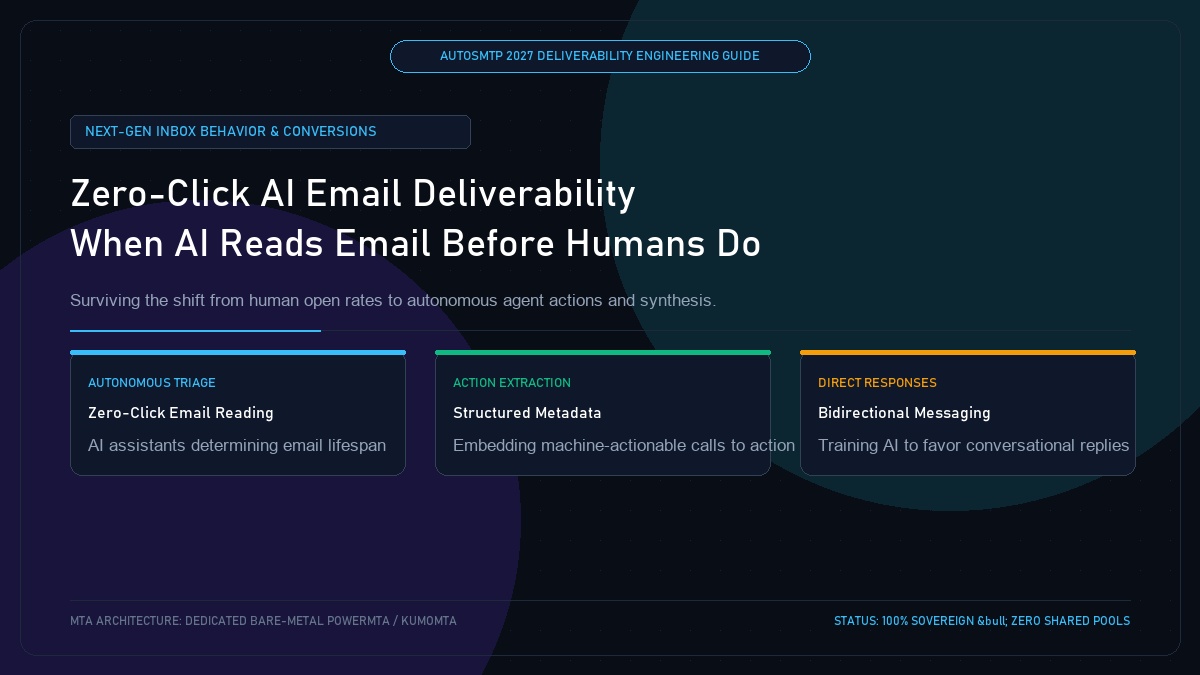
Email Deliverability in a Zero-Click World: Adapting When Autonomous AI Reads Email Before Humans Do
Published by Fred Dawson • Senior Deliverability Systems Architect • 22 min read
For thirty years, digital marketing relied on a linear user journey: deliver the email, entice the recipient to open, and persuade them to click a hyperlink to a landing page. In 2027, this model is being dismantled by the rise of the “Zero-Click Inbox.” Autonomous AI agents—embedded in Google Workspace (Gemini), Microsoft 365 (Copilot), and Apple Mail—now ingest incoming emails, extract key action items, book calendar reservations, approve payments, and synthesize summaries without the user ever clicking an external link. Senders who design solely for human eyes risk becoming invisible to AI gatekeepers. This guide provides the technical blueprint for zero-click deliverability.
- 1. The Architectural Shift from Human Clicks to AI Agent Actions
- 2. How Autonomous AI Ingests, Evaluates & Executes Email
- 3. Embedding Schema.org JSON-LD Microdata for 1-Click Actions
- 4. The Power of Bidirectional Conversational Signals
- 5. Copywriting for Dual Audiences: Humans vs Neural LLMs
- 6. Human-First vs AI-First Email Architecture Matrix
- 7. Case Study: SaaS Provider Drives 3x Actions via Zero-Click Schema
- 8. The AutoSMTP Deliverability Defense Advantage
1. The Architectural Shift from Human Clicks to AI Agent Actions
The traditional click-through rate is no longer the sole metric of email success. When an AI assistant summarizes your product launch and adds an event directly to the recipient’s calendar, the marketing objective has been achieved with zero clicks on your website:
The Legacy Human-Only Model
Heavy visual layouts with 20 image slices and hidden CTA buttons designed to force the user to click through to an external landing page to learn the core details.
The 2027 Zero-Click AI Model
Semantic plain text combined with structured JSON-LD microdata that allows AI agents to immediately understand, summarize, and execute actions directly inside the inbox interface.
2. How Autonomous AI Ingests, Evaluates & Executes Email
Autonomous AI agents follow a strict evaluation pipeline upon message receipt:
- Cryptographic & Security Validation: Checks DMARC alignment and evaluates domain reputation.
- DOM & Schema Extraction: Scans for standardized Schema.org JSON-LD blocks (e.g.,
ConfirmAction,ReserveAction). - Semantic Intent Synthesis: Distills the body copy into a 2-line executive summary.
- User Interface Presentation: Renders an actionable interactive widget at the top of the mailbox.
3. Embedding Schema.org JSON-LD Microdata for 1-Click Actions
To enable mailbox AI agents to execute actions on behalf of users, senders embed structured microdata:
<script type="application/ld+json">
{
  "@context": "http://schema.org",
  "@type": "EmailMessage",
  "description": "Renew Dedicated Bare-Metal Server Subnet",
  "potentialAction": {
    "@type": "ConfirmAction",
    "name": "One-Click Renew Server",
    "handler": {
      "@type": "HttpActionHandler",
      "url": "https://api.autosmtp.io/v1/servers/renew?token=9f82d1a",
      "method": "http://schema.org/HttpRequestMethod/POST"
    }
  }
}
</script>
4. The Power of Bidirectional Conversational Signals
Mailbox algorithms heavily prioritize senders who engage in two-way conversations. Prompting recipients to reply with feedback, questions, or brief confirmations signals to Google and Microsoft that your domain is a trusted personal contact, securing high placement for future sends.
5. Copywriting for Dual Audiences: Humans vs Neural LLMs
Senders must write for two audiences simultaneously: human subscribers and the AI parsing engines. Clear, factual statements with explicit dates and prices outperform vague, suspenseful marketing prose every time.
6. Human-First vs AI-First Email Architecture Matrix
| Design Vector | Legacy Human-First Approach | Modern Zero-Click AI Architecture |
|---|---|---|
| Core Success Metric | Website click-through rate (CTR) | AI action completion & direct reply rate |
| Information Architecture | Vague teasing copy to force clicks | Clear upfront value synthesis and structured data |
| Interactive Elements | Standard HTML anchor links | JSON-LD Schema Action cards embedded in MIME |
| Mailbox Placement | Subject to Promotions tab filtering | Elevated to Priority Action feed by AI agents |
SaaS Provider Drives 3x Action Completion with Zero-Click Schema Cards
A B2B cloud backup provider struggled with user compliance on mandatory annual security credential rotations. Traditional emails with “Click here to login and update” achieved a sluggish 24% completion rate over 30 days. Engineers redesigned the notification to include Schema.org ConfirmAction microdata and a factual semantic summary. In Gmail and Outlook, the email rendered an interactive “Confirm Security Rotation” button directly inside the inbox header. Action completion surged to 74% within 72 hours, completely eliminating administrative friction.
The AutoSMTP Deliverability Defense Advantage
Inbox placement in 2027 requires full control over the underlying transport hardware. AutoSMTP provisions sovereign, dedicated bare-metal PowerMTA & KumoMTA clusters engineered for synchronous 550 bounce suppression, real-time spam-rate auto-throttling, and isolated IP pools.
Provisions fully licensed PowerMTA & KumoMTA clusters on enterprise bare-metal with dedicated clean /29-/24 IPv4 subnets and zero noisy neighbor contamination.
Monitors Google Postmaster spam ratios (<0.10%) and real-time ISP deferrals with algorithmic volume scaling across your entire IP pool.
RFC 5321 in-band 550 bounce suppression, automated Yahoo/Outlook Complaint Feedback Loops (CFL), and instant bad-IP eviction.
Pre-configured forward and reverse DNS (PTR) per IP, SPF CIDR alignment, 2048-bit DKIM rotation, and strict DMARC enforcement.
Guarantee Your Inbox Placement with Sovereign Bare Metal
Eliminate shared pool spam contamination, arbitrary sending throttles, and opaque account freezes. Deploy an enterprise AutoSMTP cluster today.
Deploy Turnkey MTA Cluster →