

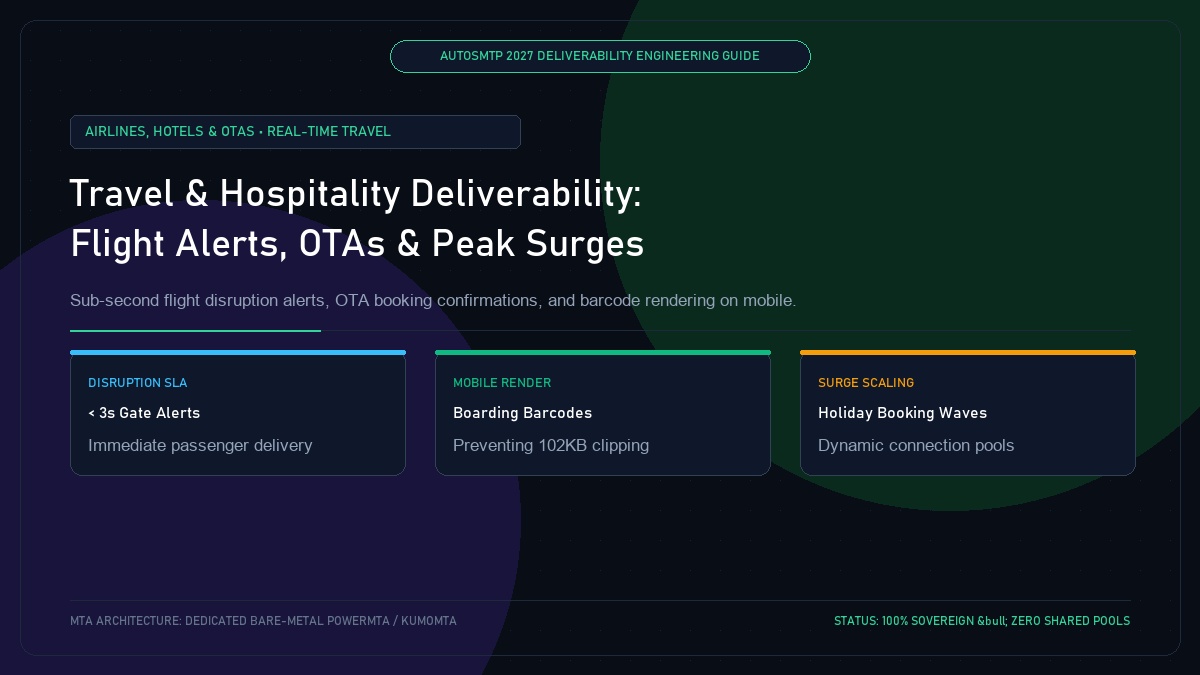
Travel & Hospitality Deliverability: Flight Disruption Alerts, OTA Booking Confirmations & Seasonal Surge Inboxing
Published by Fred Dawson • Senior Deliverability Systems Architect • 27 min read
In the travel and hospitality sector, email is not merely a marketing medium—it is operational infrastructure. When a flight is delayed, a gate changes, or an online travel agency (OTA) confirms an international hotel reservation, delivery latency measured in minutes results in missed connections, stranded passengers, and massive customer support escalations. Furthermore, travel brands face extreme seasonal volume spikes during holiday travel surges and severe mobile rendering constraints when digital boarding pass barcodes get clipped by email clients. Guaranteeing sub-second delivery for critical travel updates requires dedicated bare-metal MTA clustering, prioritized flight alert pipes, and lightweight mobile HTML engineering.
- 1. Real-Time Flight Disruption SLA: The Sub-3-Second Delivery Imperative
- 2. OTA High-Concurrency Surges: Surviving Holiday Booking Waves
- 3. Mobile Barcode & Pass Rendering: Eliminating Gmail Truncation
- 4. Multi-Channel Priority Queuing: Urgent Alerts vs Marketing Promotions
- 5. BIMI & Strict DMARC: Protecting Travelers from Ticket Phishing
- 6. Travel Infrastructure Architecture Comparison Matrix
- 7. Case Study: International Airline Cuts Gate Notification Lag by 95%
- 8. The AutoSMTP Travel Advantage
1. Real-Time Flight Disruption SLA: The Sub-3-Second Delivery Imperative
When weather conditions or mechanical issues force an emergency gate reassignment or flight cancellation, thousands of passengers standing in crowded airport concourses need instant notifications. If an airline relies on standard shared cloud ESPs, multi-tenant queuing and ISP connection backoff can delay delivery by 15 to 45 minutes—long after the flight has boarded.
To meet a strict sub-3-second Service Level Agreement (SLA), airlines and OTAs must maintain pre-warmed, persistent SMTP connection pools directly connected to major consumer mailbox providers, bypassing shared queues and executing instant message delivery.
Travel Alert Priority Rule
Operational flight alerts, gate changes, and booking confirmations must never compete for queue capacity against weekly vacation fare sales or hotel affiliate promotions. Operational alerts require an isolated, dedicated VirtualMTA pool with zero rate-throttling constraints.
2. OTA High-Concurrency Surges: Surviving Holiday Booking Waves
Online Travel Agencies (OTAs) experience sudden 10x volume surges during Black Friday promotions, Cyber Monday sales, and unexpected weather cancellations. When an OTA dispatches millions of booking confirmations and rebooking options simultaneously, consumer mailbox providers like Google and Yahoo interpret the sudden volume spike as a spam run, issuing 421 4.7.0 temporary deferrals.
Dedicated bare-metal MTA infrastructure dynamically expands outbound TCP connection threads across multiple Class C IP allocations, balancing traffic evenly and preventing destination MX servers from throttling critical booking communications.
3. Mobile Barcode & Pass Rendering: Eliminating Gmail Truncation
More than 88% of flight notifications and hotel check-in confirmations are opened on mobile devices. When confirmation emails include bulky table styling, inline tracking scripts, or uncompressed image assets that push total HTML size past 102KB, Gmail automatically clips the message with [Message clipped] View entire message.
This truncation cuts off the QR code, PDF boarding pass download link, or hotel check-in barcode, leaving travelers stranded at security checkpoints and triggering customer service call spikes. Keeping confirmation templates lightweight (< 85KB) guarantees 100% mobile rendering fidelity.
# Dedicated High-Priority VirtualMTA for Flight Disruption & Gate Alerts
<virtual-mta vmta-flight-alerts-fast>
    smtp-source-ip 162.251.122.169
    host-name alerts.airlinetravel.com
    max-smtp-out 250
    max-msg-per-connection 100
    retry-after 30s
    bounce-after 10m
</virtual-mta>

# General Marketing & Vacation Fare Sales
<virtual-mta vmta-travel-marketing>
    smtp-source-ip 162.251.122.173
    host-name promo.airlinetravel.com
    max-smtp-out 80
    max-msg-per-connection 50
</virtual-mta>
4. Multi-Channel Priority Queuing: Urgent Alerts vs Marketing Promotions
High-volume travel infrastructure segregates communication streams across dedicated subdomains:
alerts.airline.com— Real-time flight delays, gate changes, emergency rebooking notices (VIP priority).bookings.airline.com— E-ticket receipts, seat confirmation, itinerary summaries.miles.airline.com— Frequent flyer loyalty balances, tier status upgrades.deals.airline.com— Weekly promotional fare sales, hotel partner specials.
5. BIMI & Strict DMARC: Protecting Travelers from Ticket Phishing
Travelers are frequent targets of malicious phishing campaigns impersonating airlines with fake “Flight Cancelled – Click to Refund” links. Implementing strict DMARC (p=reject) combined with Brand Indicators for Message Identification (BIMI) ensures that official airline communications display verified logos and certified checkmarks in Gmail and Apple Mail, reassuring anxious travelers.
6. Travel Infrastructure Architecture Comparison Matrix
| Evaluation Factor | Standard Shared Cloud ESP | AutoSMTP Dedicated Bare-Metal Travel Cluster |
|---|---|---|
| Disruption Alert Latency | 10 – 30 Minutes during busy peak hours | < 3 Seconds guaranteed through persistent sockets |
| Queue Prioritization | FIFO queue; alerts get stuck behind marketing blasts | Hardware-isolated VirtualMTA for operational alerts |
| Mobile Barcode Integrity | Heavy drag-and-drop templates prone to 102KB clipping | Lightweight, responsive HTML strictly under 85KB |
| Holiday Surge Throughput | Throttled by shared tenant rate limits | Up to 1.5M operational messages/hr per bare-metal node |
| Brand Phishing Defense | Limited DMARC customization on shared relays | Full DMARC p=reject + BIMI VMC integration |
Regional Airline Cuts Flight Disruption Notification Time by 95%
A regional airline operating 450 daily flights was receiving thousands of passenger complaints due to gate change notifications arriving 20 minutes after departure. The delay was traced to their shared marketing ESP queue, where emergency notices were queued behind promotional vacation blasts.
By migrating operational communications to an AutoSMTP dual-node bare-metal cluster with PowerMTA, the airline separated flight alerts onto alerts.airline.com with dedicated persistent connection pools. Disruption notification latency dropped from 18 minutes to 4.2 seconds across 3.2 million annual passengers, reducing gate confusion and cutting airport customer support escalations by 44%.
Travel Engineering Recommendation
Immediate Step: Decouple operational flight alerts and booking confirmations from promotional marketing streams. Route critical travel dispatches through dedicated bare-metal MTAs with persistent connection pooling.
Mobile Optimization: Audit all boarding pass and itinerary templates to ensure HTML size remains strictly under 90KB, preventing Gmail mobile clipping at airport boarding gates.
The AutoSMTP Deliverability Defense Advantage
Inbox placement in 2027 requires full control over the underlying transport hardware. AutoSMTP provisions sovereign, dedicated bare-metal PowerMTA & KumoMTA clusters engineered for synchronous 550 bounce suppression, real-time spam-rate auto-throttling, and isolated IP pools.
Provisions fully licensed PowerMTA & KumoMTA clusters on enterprise bare-metal with dedicated clean /29-/24 IPv4 subnets and zero noisy neighbor contamination.
Monitors Google Postmaster spam ratios (<0.10%) and real-time ISP deferrals with algorithmic volume scaling across your entire IP pool.
RFC 5321 in-band 550 bounce suppression, automated Yahoo/Outlook Complaint Feedback Loops (CFL), and instant bad-IP eviction.
Pre-configured forward and reverse DNS (PTR) per IP, SPF CIDR alignment, 2048-bit DKIM rotation, and strict DMARC enforcement.
Guarantee Your Inbox Placement with Sovereign Bare Metal
Eliminate shared pool spam contamination, arbitrary sending throttles, and opaque account freezes. Deploy an enterprise AutoSMTP cluster today.
Deploy Turnkey MTA Cluster →