

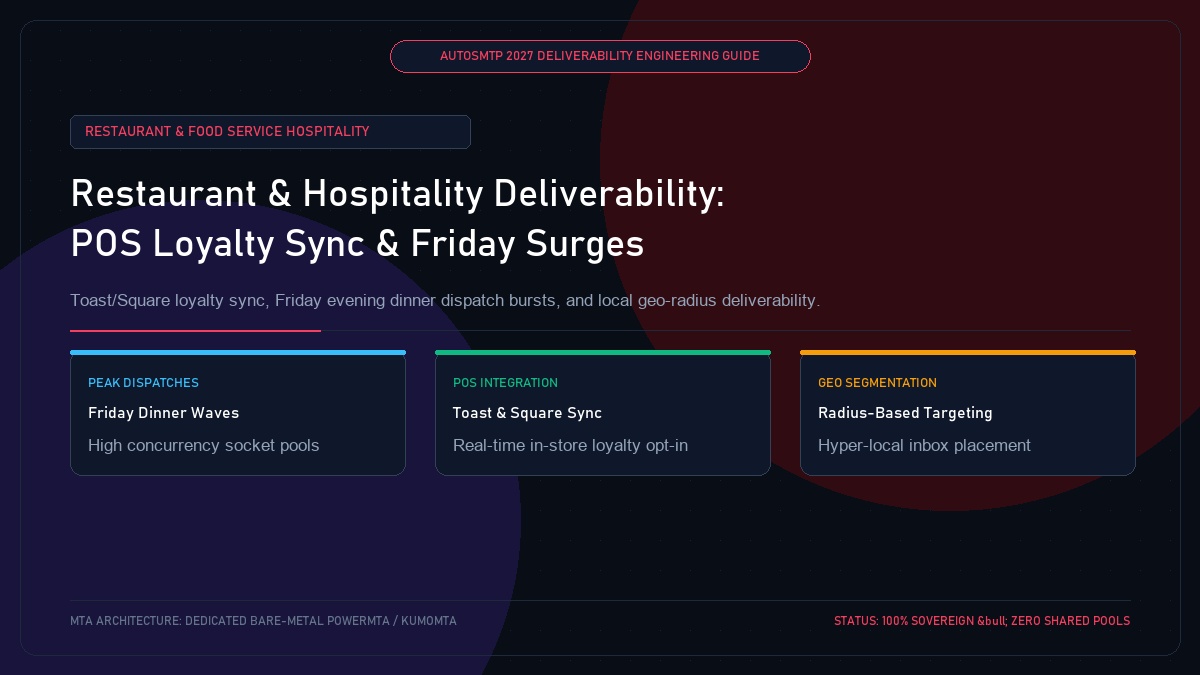
Restaurant & Food Service Deliverability: POS Loyalty Sync, Friday Dinner Surges & Geo-Segmented Delivery
Published by Fred Dawson • Senior Deliverability Systems Architect • 25 min read
For restaurant groups, fast-casual chains, and hospitality brands, email marketing operates within extremely tight temporal and geographic windows. Over 70% of restaurant promotional conversions occur when dining offers land in consumer inboxes between 4:00 PM and 6:30 PM on Thursday and Friday afternoons. When hundreds of thousands of promotional emails are concentrated into a narrow 2.5-hour dispatch window, shared email platforms frequently choke on delivery deferrals, pushing dinner offers into inboxes after the customer has already eaten. Overcoming the dinner rush bottleneck requires point-of-sale (POS) real-time data cleansing, hyper-local geographic segmentation, and dedicated high-throughput MTA infrastructure.
- 1. The Friday Evening Dinner Rush: Overcoming ISP Throttle Windows
- 2. POS Loyalty Sync: Real-Time Counter & Kiosk Address Cleansing
- 3. Hyper-Local Geolocation Delivery: Preventing Customer Fatigue
- 4. Mobile-First Rendering: Eliminating Gmail 102KB Truncation
- 5. Franchise vs. Corporate IP Pool Segregation
- 6. Restaurant Email Infrastructure Architecture Comparison
- 7. Case Study: 180-Unit Fast Casual Chain Boosts Weekend Revenue
- 8. The AutoSMTP Hospitality Advantage
1. The Friday Evening Dinner Rush: Overcoming ISP Throttle Windows
In the food service industry, delivery timing is binary. An email offering “$5 Off Your Friday Dinner Order” delivered at 5:15 PM drives revenue; the exact same email delivered at 8:45 PM causes frustration and unsubscriptions. However, because thousands of retail and hospitality brands attempt to reach consumers during this identical Friday afternoon window, mailbox providers experience extreme network congestion.
Receiving mail servers protect their infrastructure by issuing 421 4.7.0 Try again later rate-limiting deferrals. Shared ESPs respond by throttling queues and queuing messages for hours. To guarantee delivery within the active dining window, restaurant chains require dedicated bare-metal MTAs with tailored ISP delivery rules and optimized connection pooling.
2. POS Loyalty Sync: Real-Time Counter & Kiosk Address Cleansing
Restaurant loyalty programs collect thousands of email addresses daily via countertop tablets, self-ordering kiosks, and digital receipts (Toast, Square, Revel, Clover). However, customer input errors in busy restaurant environments generate high typo rates (e.g., user@gmai.com, user@yahooo.com, or intentional bogus entries like none@none.com).
Injecting these unverified records directly into marketing broadcasts triggers immediate spam traps and high hard-bounce rates (> 7%), rapidly degrading domain reputation.
Mandatory Real-Time POS API Validation
All POS loyalty inputs must pass through an automated real-time syntax and MX-record validation API before being ingested into the primary subscriber database. Typo corrections (e.g., detecting @gmai.com and suggesting @gmail.com) save thousands of valuable loyalty members while shielding outbound IP reputation.
3. Hyper-Local Geolocation Delivery: Preventing Customer Fatigue
Broadcasting a promotional discount across an entire regional list regardless of individual store proximity generates subscriber apathy and high spam complaint rates. A customer living in North Dallas who consistently receives promotions for a store opening in South Fort Worth will quickly mark the email as spam.
High-performing restaurant groups utilize dynamic geographic radius filtering (typically 3 to 7 miles from the customer’s primary dining location) combined with localized sender signatures (e.g., Chef Marco | AutoSMTP Bistro Downtown) to maintain high engagement and positive inbox placement.
4. Mobile-First Rendering: Eliminating Gmail 102KB Truncation
Over 82% of restaurant marketing emails are opened on mobile smartphones. When promotional templates include excessive CSS styling, uncompressed base64 imagery, or redundant layout tables, the raw HTML size easily exceeds 102 kilobytes.
When an email exceeds 102KB, the Gmail mobile app truncates the message with a [Message clipped] View entire message prompt. This cuts off the promotional discount call-to-action and obscures the mandatory unsubscribe link, resulting in direct spam complaints from mobile users.
# PowerMTA High-Concurrency Configuration for Weekend Dining Surges
<domain gmail.com>
    max-smtp-out 180
    max-msg-per-connection 100
    smtp-421-means-mx-unavailable yes
    backoff-to-normal-after 10m
    retry-after 5m
</domain>

<domain yahoo.com>
    max-smtp-out 120
    max-msg-per-connection 150
    retry-after 8m
</domain>

<virtual-mta vmta-dinner-surge>
    smtp-source-ip 162.251.122.169
    host-name loyalty.restaurantbrand.com
</virtual-mta>
5. Franchise vs. Corporate IP Pool Segregation
For franchise restaurant systems, allowing individual franchise operators to send unsupervised local promotions under the corporate root domain poses massive deliverability risks. An inexperienced franchisee blasting an purchased local event list can burn the corporate domain reputation, preventing nationwide loyalty campaigns from reaching the inbox.
Enterprise food service systems mandate strict subdomain and IP segregation:
corporate.restaurantbrand.com— National brand campaigns, quarterly announcements.rewards.restaurantbrand.com— Real-time loyalty point balances, app receipts, transactional.local.restaurantbrand.com— Franchisee local store promotions and geo-targeted offers.
6. Restaurant Email Infrastructure Architecture Comparison
| Performance Metric | Standard Shared Hospitality ESP | AutoSMTP Dedicated Bare-Metal Restaurant Cluster |
|---|---|---|
| Friday Dinner Burst SLA | Frequent 1 – 3 hr delays due to multi-tenant Friday traffic | Immediate, unthrottled dispatch (< 15 min for 500k messages) |
| POS Counter Entry Cleansing | Batch imports; dead addresses hit on first send | Real-time wire-level API hygiene before list ingestion |
| Mobile HTML Optimization | Bloated drag-and-drop builder templates (> 110KB) | Streamlined, lightweight responsive HTML under 60KB |
| Franchise Subdomain Isolation | Often combined into single shared sender pool | Hardware-isolated VirtualMTAs for local vs national dispatches |
| Per-Recipient Cost at Scale | Escalates rapidly as loyalty program membership expands | Flat bare-metal server pricing with zero per-email fees |
180-Unit Fast Casual Brand Increases Weekend Promo Sales by 34%
A regional fast-casual restaurant chain with 180 locations and 1.8 million loyalty subscribers was experiencing severe revenue losses because their Friday afternoon dinner promotions were routinely delayed by 90 to 180 minutes by their shared email service provider, arriving after 8:00 PM.
By migrating to a dedicated AutoSMTP bare-metal cluster running PowerMTA, the brand configured high-concurrency connection pools optimized for Friday evening dispatches. Outbound throughput scaled to 800,000 emails per hour, ensuring 100% of promotional messages reached inboxes between 4:15 PM and 5:00 PM. Weekend promotional redemption rates jumped by 34%, generating an estimated $420,000 in incremental monthly restaurant sales.
Hospitality Technical Decision Framework
For Multi-Unit Restaurant Chains: Eliminate shared ESP delivery bottlenecks by migrating dinner burst campaigns to dedicated bare-metal MTAs with tailored ISP concurrency profiles.
For POS Loyalty Programs: Deploy real-time email verification APIs at the counter and kiosk to filter input typos before bad addresses contaminate your outbound sending reputation.
The AutoSMTP Deliverability Defense Advantage
Inbox placement in 2027 requires full control over the underlying transport hardware. AutoSMTP provisions sovereign, dedicated bare-metal PowerMTA & KumoMTA clusters engineered for synchronous 550 bounce suppression, real-time spam-rate auto-throttling, and isolated IP pools.
Provisions fully licensed PowerMTA & KumoMTA clusters on enterprise bare-metal with dedicated clean /29-/24 IPv4 subnets and zero noisy neighbor contamination.
Monitors Google Postmaster spam ratios (<0.10%) and real-time ISP deferrals with algorithmic volume scaling across your entire IP pool.
RFC 5321 in-band 550 bounce suppression, automated Yahoo/Outlook Complaint Feedback Loops (CFL), and instant bad-IP eviction.
Pre-configured forward and reverse DNS (PTR) per IP, SPF CIDR alignment, 2048-bit DKIM rotation, and strict DMARC enforcement.
Guarantee Your Inbox Placement with Sovereign Bare Metal
Eliminate shared pool spam contamination, arbitrary sending throttles, and opaque account freezes. Deploy an enterprise AutoSMTP cluster today.
Deploy Turnkey MTA Cluster →