

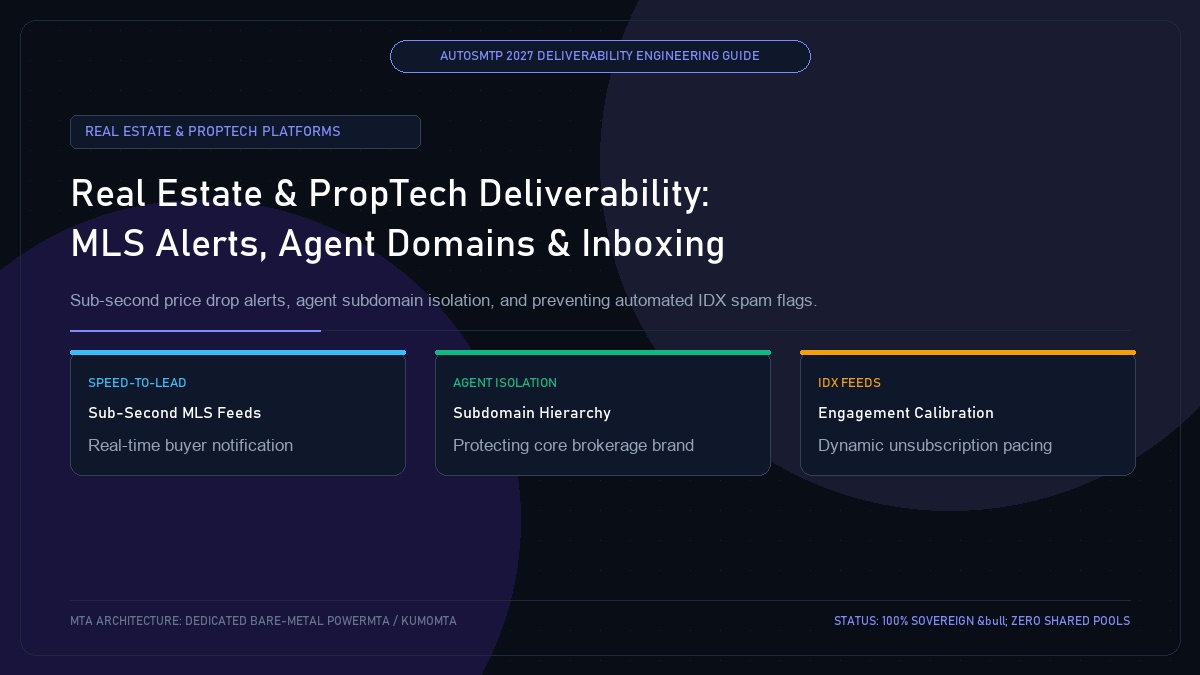
Real Estate & PropTech Email Deliverability: MLS Alerts, Agent Subdomains & High-Intent Inboxing
Published by Fred Dawson • Senior Deliverability Systems Architect • 26 min read
In residential and commercial real estate, timing is everything. When a new property listing matches a buyer’s criteria or a price drop occurs, the agent or PropTech platform that places the alert in the buyer’s inbox first captures the showing and the commission. However, real estate email ecosystems face unique architectural challenges: automated MLS search feeds generate high volume with declining recipient engagement over time, hundreds of independent real estate agents frequently send outbound mail under a single brokerage root domain, and shared email relays introduce unpredictable delivery delays. Achieving sub-second speed-to-lead requires dedicated MTA clustering and rigorous agent subdomain segregation.
- 1. Speed-to-Lead Architecture: Why 3-Minute Delays Cost Real Estate Commissions
- 2. The Multi-Agent Dilemma: Insulating Brokerage Domains from Rogue Sendouts
- 3. Enterprise Real Estate Subdomain Hierarchy
- 4. Automated IDX Search Fatigue: Dynamic Frequency Throttling
- 5. Dedicated Bare-Metal MTA Configuration for PropTech Platforms
- 6. Real Estate Email Architecture Comparison Matrix
- 7. Case Study: National Brokerage Achieves 99.8% Alert Inboxing
- 8. The AutoSMTP PropTech Advantage
1. Speed-to-Lead Architecture: Why 3-Minute Delays Cost Real Estate Commissions
In competitive real estate markets, multiple brokerage feeds syndicate the same MLS listing data. If Brokerage A delivers a property notification in 4 seconds while Brokerage B’s shared cloud ESP queues the message for 12 minutes, the buyer opens Brokerage A’s notification and schedules the viewing with Brokerage A’s agent.
Standard cloud ESPs process outbound mail in shared batches, introducing latency that is fatal to PropTech platforms. To guarantee sub-second delivery, real estate platforms require dedicated bare-metal MTAs with persistent open connections to major receiving domains (Gmail, Yahoo, Microsoft 365, Apple).
2. The Multi-Agent Dilemma: Insulating Brokerage Domains from Rogue Sendouts
A typical mid-sized brokerage employs 200 to 1,000 independent agents. When individual agents purchase unverified prospect lists, scrape local phone directories, or blast generic holiday greetings without proper list hygiene, mailbox providers penalize the entire brokerage’s root domain (brokerage.com). Soon, routine transaction closing emails, mortgage disclosures, and escrow communications begin landing in spam.
The Immutable Brokerage Isolation Principle
Individual agent outbound marketing and cold outreach must never share the same cryptographic domain or IP pool used for core corporate operations or automated MLS transactional alerts. Each communication channel must be routed across isolated subdomains and dedicated VirtualMTAs.
3. Enterprise Real Estate Subdomain Hierarchy
Robust PropTech deliverability relies on a multi-tiered subdomain architecture:
brokerage.com— Core corporate transactions, escrow, legal, management correspondence (Google Workspace / M365).alerts.brokerage.com— Automated MLS search feeds, price-drop alerts, property matches (Dedicated High-Speed MTA).agents.brokerage.com— Agent-specific marketing newsletters, open house announcements (Dedicated Marketing VirtualMTA).deals.brokerage.com— Commercial investment syndications and investor newsletters (Segregated High-Volume IP).
4. Automated IDX Search Fatigue: Dynamic Frequency Throttling
When buyers begin house-hunting, they open every daily MLS alert. However, once they purchase a property or pause their search, they stop clicking. If an automated system continues to dispatch 3 emails a day to unengaged recipients, mailbox providers interpret the drop in engagement as spam, lowering the sender’s reputation across the entire domain.
PropTech engineering teams must implement engagement decay algorithms that automatically downshift email frequency:
Adaptive Engagement Rhythms
- 0 – 30 Days of Activity: Instant real-time alerts on every MLS match.
- 31 – 60 Days Inactive: Shift from instant alerts to daily summary digest.
- 61 – 90 Days Inactive: Shift to weekly featured property roundup.
- 90+ Days Inactive: Automatic pause with re-permissioning confirmation.
Static Delivery Pitfalls
- Sending multiple daily notifications indefinitely to inactive users.
- Skyrocketing open-rate declines triggering ISP algorithmic penalties.
- Frustrated recipients clicking “Report Spam” instead of unsubscribing.
- Mailbox abandonment leading to recycled spam trap acquisition.
5. Dedicated Bare-Metal MTA Configuration for PropTech Platforms
High-volume MLS alerts require an MTA capable of multiplexing thousands of concurrent connections while respecting recipient ISP throttling thresholds.
-- KumoMTA Low-Latency Real Estate Alert Dispatch Configuration
kumo.on('smtp_server_message_received', function(msg)
  local campaign = msg:get_meta('campaign_type')
  if campaign == 'instant_mls_alert' then
    msg:set_meta('routing_pool', 'pool_instant_alerts')
    msg:set_meta('queue_priority', 'critical')
  else
    msg:set_meta('routing_pool', 'pool_agent_marketing')
    msg:set_meta('queue_priority', 'normal')
  end
end)

kumo.configure_domain('gmail.com', {
  max_connection_rate = '250/s',
  max_concurrent_connections = 50,
  idle_timeout = '20s',
})
6. Real Estate Email Architecture Comparison Matrix
| Feature | Standard Shared PropTech CRM (e.g., KvCORE, Follow Up Boss) | AutoSMTP Dedicated Bare-Metal PropTech Cluster |
|---|---|---|
| MLS Alert Dispatch Latency | 8 – 25 Minutes (shared multi-tenant queue queues) | < 5 Seconds (dedicated bare-metal socket pipeline) |
| Agent Subdomain Isolation | Single shared domain or unauthenticated generic relays | Cryptographically isolated subdomains per agent or branch |
| Dynamic Frequency Decay | Manual agent list curation; frequently neglected | Automated API-driven engagement downshifting |
| IP Reputation Ownership | Shared pool; vulnerable to poor practices of other brokerages | 100% Dedicated bare-metal IP pool owned by the brokerage |
| RFC 8058 One-Click Unsubscribe | Often missing or misconfigured in legacy real estate CRMs | Fully compliant instant list-unsubscribe header injection |
Regional Brokerage Cuts MLS Notification Lag by 94% and Increases Showing Bookings by 31%
A regional brokerage with 850 agents across 4 states was losing buyer leads to Zillow and Redfin because automated property notifications dispatched through their existing CRM were delayed by up to 25 minutes during peak evening listing updates.
By implementing a dedicated dual-node AutoSMTP bare-metal cluster, the brokerage routed instant MLS alerts through alerts.brokerage.com while moving individual agent newsletter marketing to agents.brokerage.com. Alert dispatch latency plummeted from 22 minutes to 4.2 seconds. This speed advantage enabled agents to book 31% more property showings within the first 60 minutes of listing syndication.
PropTech Technical Decision Framework
For Fast-Growing Brokerages: Disentangle automated MLS notifications from agent marketing immediately. Move MLS alerts to a dedicated bare-metal MTA cluster to guarantee sub-second delivery to active buyers.
For Compliance & Security: Implement strict DMARC p=reject on the brokerage root domain and issue delegated subdomains to individual agents to prevent rogue list blasting from degrading enterprise email operations.
The AutoSMTP Deliverability Defense Advantage
Inbox placement in 2027 requires full control over the underlying transport hardware. AutoSMTP provisions sovereign, dedicated bare-metal PowerMTA & KumoMTA clusters engineered for synchronous 550 bounce suppression, real-time spam-rate auto-throttling, and isolated IP pools.
Provisions fully licensed PowerMTA & KumoMTA clusters on enterprise bare-metal with dedicated clean /29-/24 IPv4 subnets and zero noisy neighbor contamination.
Monitors Google Postmaster spam ratios (<0.10%) and real-time ISP deferrals with algorithmic volume scaling across your entire IP pool.
RFC 5321 in-band 550 bounce suppression, automated Yahoo/Outlook Complaint Feedback Loops (CFL), and instant bad-IP eviction.
Pre-configured forward and reverse DNS (PTR) per IP, SPF CIDR alignment, 2048-bit DKIM rotation, and strict DMARC enforcement.
Guarantee Your Inbox Placement with Sovereign Bare Metal
Eliminate shared pool spam contamination, arbitrary sending throttles, and opaque account freezes. Deploy an enterprise AutoSMTP cluster today.
Deploy Turnkey MTA Cluster →