

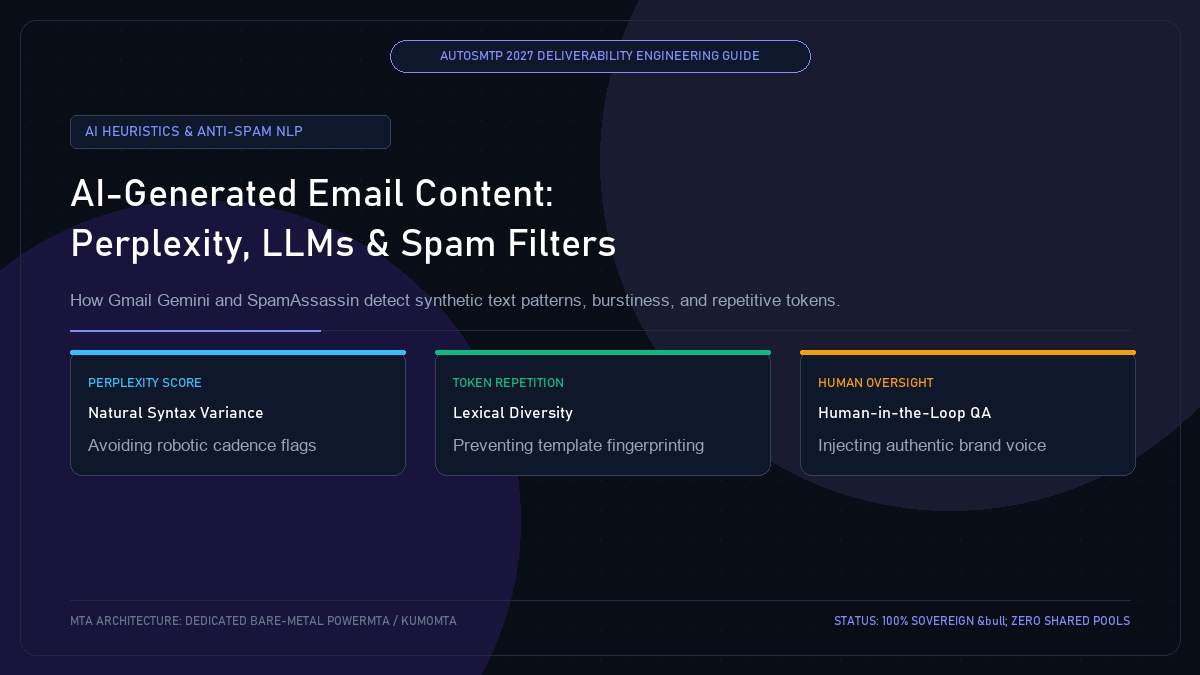
AI-Generated Email Content & Spam Filters: Perplexity, LLMs & Heuristic Scoring in 2027
Published by Fred Dawson • Senior Deliverability Systems Architect • 23 min read
The proliferation of generative Large Language Models (LLMs) has democratized high-volume cold email outreach and marketing copy generation. However, mailbox providers have responded with sophisticated in-line machine learning models that analyze the statistical properties of incoming text. Today, Google Gemini in Google Workspace and Microsoft Copilot in Defender evaluate perplexity scores, burstiness metrics, and repetitive token fingerprints to identify synthetic text. Senders who deploy unedited, generic AI copy find their messages silently diverted into the Promotions tab or outright Junk folder. This technical guide explains how modern spam filters detect AI-generated email copy and how to preserve inbox placement.
- 1. How Mailbox Providers Inspect Text: Perplexity & Burstiness
- 2. Synthetic Token Fingerprints: Words That Trigger AI Filters
- 3. In-Line Mailbox Models: Gemini, Copilot & Smart Screeners
- 4. The Human-in-the-Loop Standard: Preserving Deliverability
- 5. Natural vs Synthetic Text Heuristic Comparison Matrix
- 6. Case Study: Outbound Agency Slashes Spam Complaints by 80%
- 7. The AutoSMTP Deliverability Defense Advantage
1. How Mailbox Providers Inspect Text: Perplexity & Burstiness
Natural human writing exhibits high variance: short punchy sentences interspersed with complex compound thoughts, unexpected vocabulary choices, and natural colloquialisms. Generative AI models operate on probabilistic token selection:
- Perplexity: A measure of how likely a word sequence is. LLMs select high-probability tokens, yielding low perplexity. Spam filters flag low perplexity text as synthetic.
- Burstiness: The variation in sentence structure and length across a paragraph. LLMs generate uniform, rhythmic sentences (typically 14–18 words each), whereas human writing exhibits dramatic structural spikes and troughs.
2. Synthetic Token Fingerprints: Words That Trigger AI Filters
Unvetted AI drafts consistently lean on specific transition phrases that modern anti-spam heuristics flag as promotional boilerplate:
Synthetic Clichés (Filter Traps)
Phrases like “In today’s fast-paced digital landscape”, “Delve into the possibilities”, “Furthermore, let’s explore”, “A testament to innovation”, and “Unleash your potential” trigger high synthetic classification scores.
Authentic Conversational Voice
Direct, specific statements citing real operational metrics, concrete dates, technical facts, and genuine organizational context score as authentic human communication.
3. In-Line Mailbox Models: Gemini, Copilot & Smart Screeners
Both Google Workspace (via Gemini) and Microsoft 365 (via Defender Copilot) now analyze incoming email payloads with embedded LLMs. These models do not just look for malicious links—they classify message intent: separating authentic peer-to-peer dialogues from mass-generated synthetic marketing pitches, moving the latter directly to the Promotions tab.
4. The Human-in-the-Loop Standard: Preserving Deliverability
To safely utilize generative AI for email drafting without impairing sender reputation:
- Use AI strictly for outlining, structural organization, and brainstorming—never for final copy generation.
- Inject specific, verifiable data points, customer anecdotes, and brand voice guidelines.
- Vary sentence length deliberately: combine single-word statements with detailed multi-clause observations.
5. Natural vs Synthetic Text Heuristic Comparison Matrix
| Text Metric | Unedited AI-Generated Copy | Human-Refined Technical Copy | Spam Filter Response |
|---|---|---|---|
| Sentence Length Variance | Uniform (15–18 words avg) | High Variance (3 to 35 words) | Synthetic flagged as Promotional |
| Perplexity Score | Low (predictable tokens) | High (unusual domain terminology) | High perplexity scores as Personal |
| Transition Markers | Overused (“Delve”, “Furthermore”) | Direct, contextual transitions | Overused markers raise spam score |
| Factual Specificity | Abstract generalizations | Concrete technical specs & data | High specificity routes to Primary |
B2B Agency Slashes Spam Complaints by 80% After Re-Engineering Copy Architecture
A B2B marketing agency deployed an outbound SDR campaign sending 60,000 monthly messages written entirely with unedited ChatGPT prompt templates. Within 6 weeks, their sender domain reputation in Google Postmaster crashed to “Low”, with 82% of emails landing in the spam folder due to automated NLP synthetic classification and elevated complaint rates. Deliverability engineers stepped in: banning generic synthetic clichés, introducing mandatory human editorial rewrites, injecting specific technical case data, and pacing sends across dedicated bare-metal AutoSMTP relays. Within 21 days, spam complaints dropped by 80%, domain reputation recovered to “High”, and sales meeting bookings tripled.
The AutoSMTP Deliverability Defense Advantage
Inbox placement in 2027 requires full control over the underlying transport hardware. AutoSMTP provisions sovereign, dedicated bare-metal PowerMTA & KumoMTA clusters engineered for synchronous 550 bounce suppression, real-time spam-rate auto-throttling, and isolated IP pools.
Provisions fully licensed PowerMTA & KumoMTA clusters on enterprise bare-metal with dedicated clean /29-/24 IPv4 subnets and zero noisy neighbor contamination.
Monitors Google Postmaster spam ratios (<0.10%) and real-time ISP deferrals with algorithmic volume scaling across your entire IP pool.
RFC 5321 in-band 550 bounce suppression, automated Yahoo/Outlook Complaint Feedback Loops (CFL), and instant bad-IP eviction.
Pre-configured forward and reverse DNS (PTR) per IP, SPF CIDR alignment, 2048-bit DKIM rotation, and strict DMARC enforcement.
Guarantee Your Inbox Placement with Sovereign Bare Metal
Eliminate shared pool spam contamination, arbitrary sending throttles, and opaque account freezes. Deploy an enterprise AutoSMTP cluster today.
Deploy Turnkey MTA Cluster →