

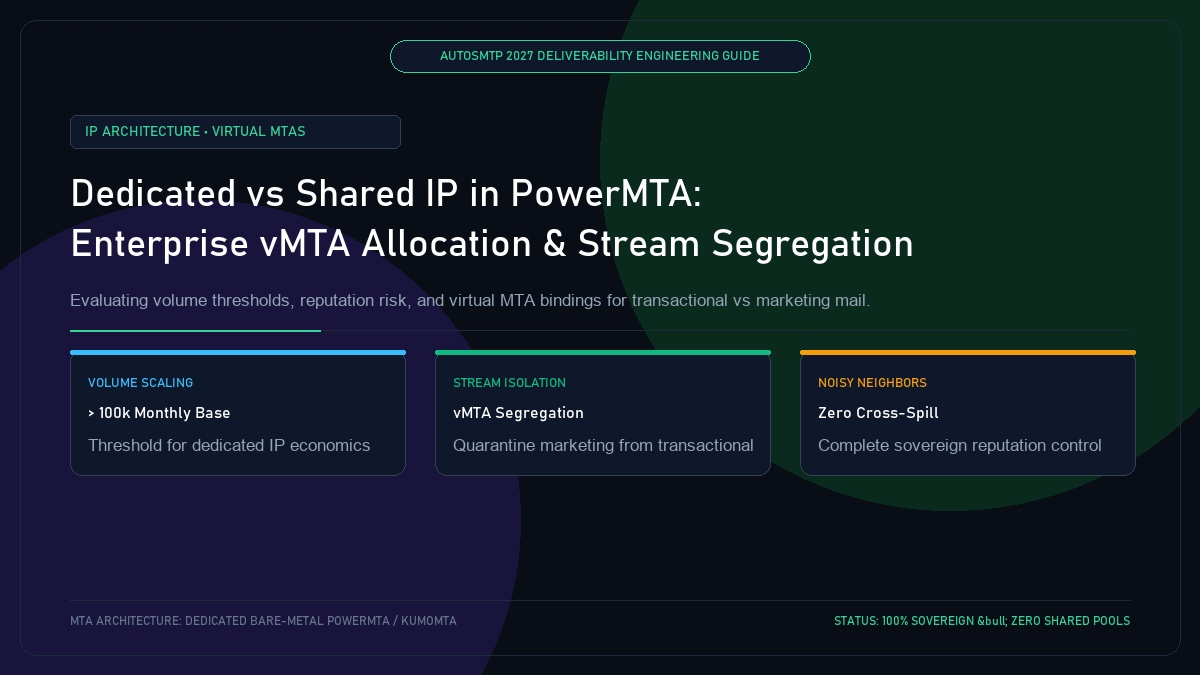
Dedicated vs Shared IP in PowerMTA: Architectural Guide for Enterprise Senders
Published by Fred Dawson • Senior Deliverability Systems Architect • 22 min read
Every enterprise deploying PowerMTA confronts a fundamental architectural choice: should you route outbound mail through dedicated IPv4 addresses that you alone govern, or utilize shared IP pools where reputation is shared among multiple senders? In 2027, mailbox providers evaluate sender identity using strict dual-track heuristics: domain reputation via cryptographic alignment and IP reputation via connection behavior. Choosing between dedicated and shared infrastructure is not merely a budgetary decision—it dictates your warming trajectory, burst capacity, and vulnerability to noisy-neighbor contamination. This guide breaks down the technical mechanics of virtual MTA binding, volume thresholds, and stream segregation.
- 1. The Fundamental Architectural Divide: Shared Pools vs Sovereign vMTAs
- 2. Volume Thresholds & Sending Cadence Requirements
- 3. The Noisy Neighbor Contamination Problem: Wire-Level Realities
- 4. Configuring Isolated Virtual MTAs (<virtual-mta>) & Source IP Bindings
- 5. Hybrid Enterprise Pools: Segregating Cold, Marketing & Transactional
- 6. Strategic Architectural Decision Matrix
- 7. Case Study: SaaS Platform Rescues Transactional OTP Inboxing
- 8. The AutoSMTP Strategic Advantage
1. The Fundamental Architectural Divide: Shared Pools vs Sovereign vMTAs
In standard commercial ESP environments (Mailchimp, SendGrid, Brevo), customers default to shared IP pools. Under this model, thousands of disparate accounts share a common cluster of IP addresses:
- The Shared Model: Benefits low-volume senders (< 50,000 emails per month) because consistent aggregate sending volume maintains warm IP status with major mailbox providers. However, any single bad actor sending spam or buying dirty lists on that pool instantly degrades delivery for every other tenant on the shared IP.
- The Dedicated PowerMTA Model: You configure dedicated IPv4 addresses bound to specific Virtual MTAs (
<virtual-mta>). Your reputation is 100% sovereign. No other company can taint your IP with spam traps, complaints, or blacklists. However, you bear complete responsibility for IP warming, volume consistency, and bounce hygiene.
The 2027 Reputation Equation
ISPs judge senders on both IP Reputation and Domain Reputation. On a shared IP, your Domain Reputation may be pristine, but a blacklisted IP from a noisy neighbor will still trigger connection-level rate limiting (421) and deferrals across Yahoo and Microsoft.
2. Volume Thresholds & Sending Cadence Requirements
Dedicated IPs require consistent sending volume to maintain reputation metrics with Gmail Postmaster and Microsoft SNDS. ISPs interpret sudden volume bursts from dormant IPs as compromised infrastructure or spam attacks:
- Under 50,000 / month: Dedicated IPs struggle to maintain stable reputation metrics. If you send 5,000 emails once every two weeks, the IP “cools down” between dispatches, forcing the ISP to treat every send as a cold broadcast.
- 50,000 – 150,000 / month: The transition zone. Senders with steady daily cadence (e.g., 3,000 – 5,000 emails per day) can comfortably operate a single dedicated IP.
- 150,000+ / month: Dedicated IP infrastructure is mandatory. At this scale, the risk of shared pool contamination vastly outweighs the minor operational overhead of IP warming.
3. The Noisy Neighbor Contamination Problem: Wire-Level Realities
When an unethical sender on a shared pool blasts a purchased consumer list, the recipient ISPs react in real-time:
- Spam complaints spike past 0.30% within 15 minutes.
- Spamhaus or Barracuda lists the shared IP on their DNSBL.
- Gmail and Yahoo lower the connection rate limit on that IP from 100 msg/sec to 2 msg/sec.
- Your mission-critical transactional emails (password resets, purchase confirmations) sit in queue behind millions of delayed marketing messages.
4. Configuring Isolated Virtual MTAs (<virtual-mta>) & Source IP Bindings
PowerMTA enables precise IP management through virtual MTAs, allowing you to bind individual physical IP addresses to distinct sending pools:
# Virtual MTA for Transactional Stream (Mission-Critical)
<virtual-mta vmta-transactional-01>
    smtp-source-ip 198.51.100.10
    host-name mail-tx.yourdomain.com
</virtual-mta>

# Virtual MTA for Marketing & Newsletters
<virtual-mta vmta-marketing-01>
    smtp-source-ip 198.51.100.11
    host-name mail-mkt.yourdomain.com
</virtual-mta>

# Pool Grouping for High-Volume Marketing Dispatches
<virtual-mta-pool pool-marketing>
    virtual-mta vmta-marketing-01
</virtual-mta-pool>

# Directing Outbound Traffic via Custom Headers
<source 127.0.0.1>
    always-allow-relaying yes
    process-x-virtual-mta yes
</source>
5. Hybrid Enterprise Pools: Segregating Cold, Marketing & Transactional
Leading enterprises never send all mail through a single pipeline. A multi-IP PowerMTA deployment segregates streams into isolated reputation tiers:
- Tier 1: Transactional vMTA (Clean / Dedicated): Password resets, 2FA codes, order confirmations. Zero marketing. Never experiences complaints. 99.9% inbox placement guaranteed.
- Tier 2: Engaged Marketing vMTA (Dedicated): Newsletters and product announcements sent to users who opened within 90 days. High engagement offsets moderate complaint rates.
- Tier 3: Winback / Re-engagement vMTA (Isolated Dedicated or Warm Pool): Inactive users (90-180 days). Higher bounce and unsubscribe risk quarantined away from core transactional IPs.
6. Strategic Architectural Decision Matrix
| Evaluation Factor | Shared ESP IP Pool | Dedicated PowerMTA Infrastructure |
|---|---|---|
| Reputation Control | Zero; diluted across thousands of senders | 100% sovereign; dictated solely by your list practices |
| Warmup Requirement | None; pre-warmed pool | Mandatory 21–30 day gas-pedal warmup |
| Minimum Monthly Volume | No minimum (suitable for 1,000/mo) | 50,000 – 100,000+ per IP recommended |
| Cost Structure | Metered per-email pricing (scales expensively) | Flat bare-metal hardware cost (infinite scale) |
| Stream Segregation | Limited by ESP tier or paid add-ons | Native unlimited vMTAs and custom IP pools |
| Blacklist Vulnerability | High risk from neighbor abuse | Zero risk from third parties; protected subnets |
SaaS Platform Eliminates OTP Delivery Delays by Migrating to Dedicated vMTAs
A B2B software platform sending 450,000 login OTP codes and 2 million marketing updates monthly was using a shared enterprise ESP pool. During a major holiday weekend, an unknown tenant on the shared pool triggered a Spamhaus Zen listing, delaying OTP delivery times from 2 seconds to 45 minutes.
The company migrated to a dedicated 4-IP PowerMTA cluster with AutoSMTP. Transactional OTP codes were routed exclusively through vmta-tx-01, completely isolated from marketing dispatches on pool-marketing. OTP delivery latency dropped back to 1.8 seconds globally, and login abandonment dropped by 94%.
IP Architecture Blueprint
Under 50k / month: Maintain high-grade shared relays with strict domain authentication.
Over 100k / month: Provision dedicated bare-metal PowerMTA nodes with segregated transactional and promotional virtual MTAs to eliminate noisy-neighbor risks forever.
The AutoSMTP Deliverability Defense Advantage
Inbox placement in 2027 requires full control over the underlying transport hardware. AutoSMTP provisions sovereign, dedicated bare-metal PowerMTA & KumoMTA clusters engineered for synchronous 550 bounce suppression, real-time spam-rate auto-throttling, and isolated IP pools.
Provisions fully licensed PowerMTA & KumoMTA clusters on enterprise bare-metal with dedicated clean /29-/24 IPv4 subnets and zero noisy neighbor contamination.
Monitors Google Postmaster spam ratios (<0.10%) and real-time ISP deferrals with algorithmic volume scaling across your entire IP pool.
RFC 5321 in-band 550 bounce suppression, automated Yahoo/Outlook Complaint Feedback Loops (CFL), and instant bad-IP eviction.
Pre-configured forward and reverse DNS (PTR) per IP, SPF CIDR alignment, 2048-bit DKIM rotation, and strict DMARC enforcement.
Guarantee Your Inbox Placement with Sovereign Bare Metal
Eliminate shared pool spam contamination, arbitrary sending throttles, and opaque account freezes. Deploy an enterprise AutoSMTP cluster today.
Deploy Turnkey MTA Cluster →