

Cold Email vs Marketing Email Infrastructure: 2027 Multi-Inbox Architecture, Compliance & Stream Separation
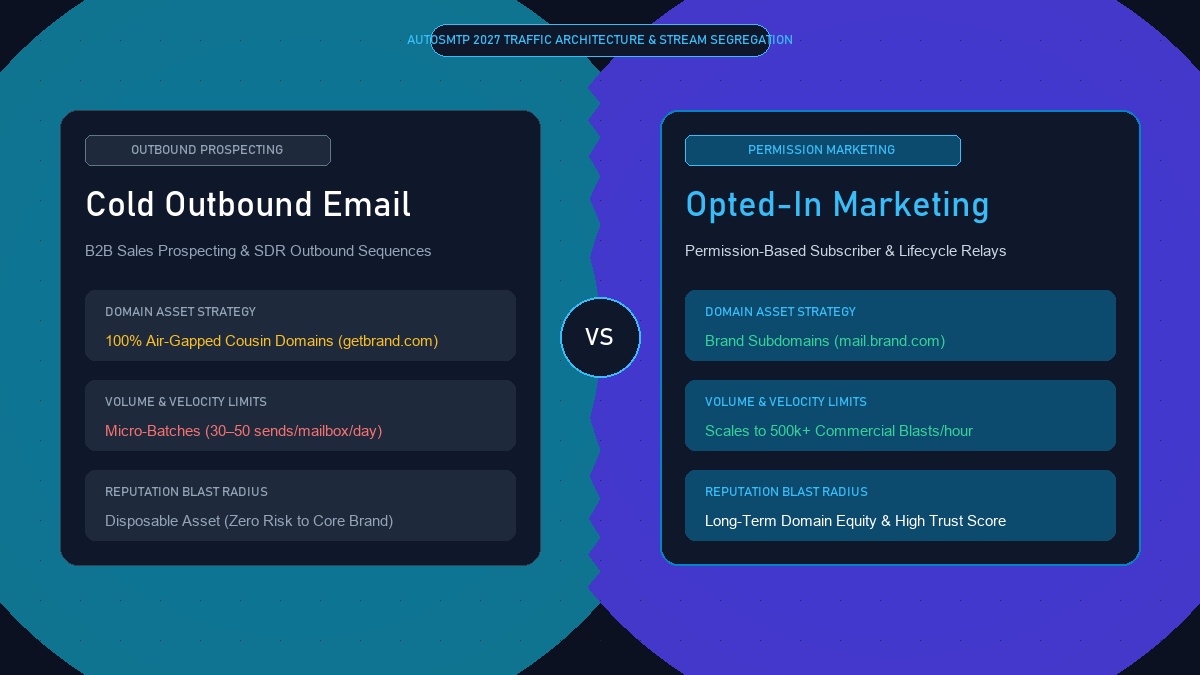
Cold outreach and opt-in email marketing represent two fundamentally incompatible operational paradigms. Marketing email infrastructure is built around high-throughput, concentrated sending from centralized dedicated IP pools or cloud ESPs (SendGrid, Mailgun, Klaviyo), delivering millions of opt-in messages to recipients with established brand affinity. Cold email infrastructure operates as a highly distributed mesh of secondary domains and individual sending inboxes (Google Workspace, Microsoft 365, private SMTP relays) strictly constrained to 20–30 sends per day per inbox to mimic organic 1:1 human correspondence.
In 2027, attempting to send cold outreach through commercial marketing ESPs triggers immediate account termination, shared IP pool blacklisting, and brand domain destruction. Conversely, utilizing multi-inbox cold stacks for high-volume newsletters is economically ruinous ($3,500/month vs $200/month). This technical guide details the architectural segregation rules, GDPR/CAN-SPAM compliance divergence, and production PowerMTA/KumoMTA queue isolation configurations required to operate both streams safely.
- 1. Two Streams, Two Incompatible Stacks
- 2. Distributed Cold Email Infrastructure
- 3. Concentrated Marketing Infrastructure
- 4. The ESP Account Termination Cascade
- 5. Regulatory Compliance: GDPR vs CAN-SPAM
- 6. Deliverability Benchmarks & Cost Math
- 7. Production PowerMTA & KumoMTA Topologies
- 8. 2027 Technical Architecture Matrix
- 9. Enterprise Case Study: B2B SaaS Tri-Stream Split
- 10. Operator Decision Framework
- 11. The AutoSMTP Dedicated Advantage
1. Two Streams, Two Incompatible Stacks
The divide between cold email and marketing email stems from a single foundational reality: prior consent.
- Marketing Email (Opt-In): Every recipient has explicitly subscribed via a web form, checkout flow, or verified double-opt-in handshake. The recipient recognizes the brand, expects communications, and rarely marks messages as spam. Senders operate with high positive engagement signals (30%+ open rates, high click-throughs, long read dwell times). Mailbox providers reward this historical affinity with direct inbox placement.
- Cold Email (Non-Opt-In Prospecting): Recipients are prospective business decision-makers identified through external data intelligence (Apollo, Clay, LinkedIn). They have never heard of the sender. Even with meticulous ICP targeting and relevant B2B value propositions, a measurable fraction of recipients will flag unsolicited messages as spam. Because mailbox algorithms evaluate spam complaint velocity over tiny rolling windows, cold email cannot withstand the high-velocity blasts typical of marketing software.
Cold Email Operational Physics
- Architecture: Highly distributed across 20–100+ separate domains and Google/M365 inboxes.
- Volume Cap: Strictly throttled to 20–30 sends per inbox per day with randomized intervals.
- Domain Defense: Never sent from the primary corporate root domain (
brand.com). - Complaint Sensitivity: Extreme vulnerability; a single spam flag per 1,000 sends triggers spam jail.
Marketing Email Operational Physics
- Architecture: Concentrated high-volume sending from dedicated bare-metal MTA pools or ESPs.
- Volume Capacity: Hundreds of thousands to millions of emails per hour across dedicated IPv4s.
- Domain Equity: Builds long-term domain reputation directly on corporate subdomains (
news.brand.com). - Complaint Ceiling: Safe operation under Gmail/Yahoo 0.10% spam complaint guidelines.
2. Distributed Cold Email Infrastructure
To deliver cold B2B outreach into corporate inboxes without triggering machine-learning anomaly defenses, cold email infrastructure is engineered around human simulation:
The 5 Structural Pillars of Cold Email Stacks
1. Domain Sharding: Operators register 5 to 20 secondary domains (e.g., getbrand.com, trybrand.io, brandhq.co). Each domain is configured with 2 to 3 user mailboxes.
2. Tenant Hosting: Inboxes are provisioned inside genuine Google Workspace or Microsoft 365 enterprise tenants. This ensures messages originate from Microsoft and Google ASN IP ranges, bypassing perimeter IP blacklists.
3. Automated Peer Warming: Inboxes participate in peer-to-peer warmup networks (MailReach, Instantly, Warmbox) for 14 to 28 days before live sending, generating automated open, reply, and folder rescue signals.
4. Custom Tracking CNAMEs: Click and open tracking links are rewritten to unique custom subdomains (e.g., track.getbrand.com) equipped with valid SSL certificates to avoid shared spam-flagged proxy domains.
5. Jitter & Spacing Algorithms: Dispatch engines inject random delays (3–8 minutes) between sends, restricting total daily output to 25 emails per mailbox.
3. Concentrated Marketing Infrastructure
Marketing email infrastructure solves for aggregate throughput, connection efficiency, and deliverability governance across massive audiences:
- Dedicated MTA Clusters: High-performance MTAs (PowerMTA, KumoMTA, Postfix) or enterprise ESPs (Klaviyo, SendGrid Pro) maintain persistent TCP connection pools to receiving MX servers.
- Destination Rate Shaping: Automatically adheres to receiving ISP concurrency limits (e.g., Gmail 100 outbound connections, Yahoo 40 connections, Microsoft 30 connections).
- RFC 5321 Automated In-Band Bounce Suppression: Instantly catches synchronous
550 5.1.1 User unknownhard bounces and adds them to suppression caches before retry queues can damage IP reputation. - Cryptographic Authentication Alignment: Enforces 100% SPF/DKIM identifier alignment and publishes strict DMARC
p=rejectrecords alongside verified BIMI SVG logos. - One-Click List-Unsubscribe: Injects RFC 8058
List-Unsubscribe: <https://...>, <mailto:...>headers into every message, enabling recipient unsubscription without spam complaints.
4. The ESP Account Termination Cascade
One of the most frequent enterprise email disasters occurs when sales development teams attempt to pipe cold prospect lists into commercial marketing ESPs (SendGrid, Mailgun, Brevo, Klaviyo, AWS SES).
| Stage of Failure | What the Operator Does | What the ESP & Mailbox Providers Detect | Systemic Consequence |
|---|---|---|---|
| Day 1 – 3: Initial Blast | Uploads 25,000 scraped B2B prospect emails to SendGrid or Mailgun. | Bounce rate spikes to 6.8% due to outdated corporate emails; zero historical domain affinity. | ESP automated risk engine flags account for compliance audit. |
| Day 4 – 7: Complaint Surge | Continues automated outbound campaign cadence. | Spam complaint rate crosses 0.25% (2.5x Gmail’s recommended 0.10% threshold). | ESP downgrades account to a dirty quarantine IP pool. Delivery rates collapse to 20%. |
| Day 8 – 14: Termination | Submits support ticket complaining of low inbox placement. | ESP compliance officer requests proof of opt-in consent for recipient list. | Instant Account Termination: Account frozen, suppression lists locked, and sending IP reported to Spamhaus. |
5. Regulatory Compliance: GDPR vs CAN-SPAM
The legal foundations governing cold outreach versus marketing campaigns are distinct across international jurisdictions:
| Regulatory Framework | Marketing Email Requirement | Cold B2B Outreach Requirement | Key Compliance Mandates |
|---|---|---|---|
| US CAN-SPAM Act | Prior consent not legally required, but commercial ESPs mandate opt-in. | Permitted without prior consent. | Valid physical address, truthful header/subject line, functional 1-click opt-out honoured within 10 days. |
| EU GDPR (PECR / ePrivacy) | Strict Article 6(1)(a) Prior Explicit Consent mandatory. Double opt-in standard. | Permitted under Article 6(1)(f) Legitimate Interest for corporate B2B contacts. | Must document Legitimate Interest Assessment (LIA), target relevant job titles, provide instant opt-out. |
| Canada CASL | Express Opt-In Consent mandatory. | Limited implied consent (inquiries <6 months; existing business relationships). | Conspicuous publication exemption requires outreach directly relevant to recipient’s business role. |
| 2024+ Gmail/Yahoo/Outlook Rules | Strict SPF/DKIM/DMARC, RFC 8058 1-click unsubscribe, <0.10% spam complaint rate. | Technically applies to bulk >5k/day, but enforced algorithmically against cold inboxes. | Exceeding 0.30% spam complaint rate produces immediate domain-wide junk routing. |
6. Deliverability Benchmarks & Cost Math
Because cold email requires distributed infrastructure while marketing leverages economies of scale, their cost per send diverges by more than an order of magnitude:
| Monthly Sending Volume | Cold Email Infrastructure Cost | Marketing Email Infrastructure Cost | Operational Architecture |
|---|---|---|---|
| 15,000 emails / month (500/day) | $250 – $350 / month | $20 – $40 / month | Cold: 25 inboxes on 8 domains. Marketing: Basic ESP tier on 1 domain. |
| 75,000 emails / month (2,500/day) | $850 – $1,200 / month | $80 – $150 / month | Cold: 100 inboxes on 25 domains. Marketing: Mid-tier ESP on dedicated IP. |
| 300,000 emails / month (10,000/day) | $3,200 – $4,500 / month | $250 – $450 / month | Cold: 400 inboxes on 80 domains. Marketing: AutoSMTP Dedicated 2-IP PowerMTA Node. |
| 1,000,000 emails / month | $10,000+ / month (unfeasible) | $450 – $850 / month | Cold: Reaches operational breaking point. Marketing: AutoSMTP 4-IP Bare-Metal Cluster. |
The Strategic ROI Justification: Spending $4,000/month to send 300,000 cold emails is highly profitable when an enterprise SaaS SDR team generates 20 qualified demos yielding $350,000 in software pipeline. Conversely, paying cold email rates for monthly marketing newsletters to existing customers is completely unviable.
7. Production PowerMTA & KumoMTA Queue Isolation Topologies
For organizations operating both high-volume opt-in marketing campaigns and outbound sales automation over their own infrastructure, Virtual MTAs must be strictly segregated to avoid cross-stream reputation contamination:
# ==============================================================================
# AutoSMTP PowerMTA Configuration: Strict Stream Segregation Architecture
# ==============================================================================

# Virtual MTA: Transactional High-Priority Stream (Pristine Dedicated IP)
<virtual-mta vmta-transactional>
    smtp-source-ip 162.251.122.170
    host-name auth.yourbrand.com
</virtual-mta>

# Virtual MTA: Opt-In Marketing Campaigns (High Throughput Pool)
<virtual-mta vmta-marketing-1>
    smtp-source-ip 162.251.122.171
    host-name news.yourbrand.com
</virtual-mta>
<virtual-mta vmta-marketing-2>
    smtp-source-ip 162.251.122.172
    host-name news.yourbrand.com
</virtual-mta>

# Virtual MTA: Secondary B2B Sales Outreach Relay (Isolated Outreach Domain)
<virtual-mta vmta-sales-outreach>
    smtp-source-ip 162.251.122.173
    host-name relay.brand-outreach.com
</virtual-mta>

# Virtual MTA Pool Groupings
<virtual-mta-pool pool-marketing>
    virtual-mta vmta-marketing-1
    virtual-mta vmta-marketing-2
</virtual-mta-pool>

<virtual-mta-pool pool-sales-outreach>
    virtual-mta vmta-sales-outreach
</virtual-mta-pool>

# Strict Delivery Queue Priorities
<queue-priority>
    priority 10 vmta-transactional
    priority 5  pool-marketing
    priority 1  pool-sales-outreach
</queue-priority>

# Destination Rate Limits: Outreach Relay Throttling
<domain *>
    # Global fallback for outreach: strictly throttled connections
    max-smtp-out 20
    max-msg-per-connection 10
    retry-after 15m
</domain>-- ==============================================================================
-- AutoSMTP KumoMTA Policy: Multi-Tenant Stream Isolation
-- ==============================================================================
local kumo = require 'kumo'
kumo.on('get_queue_config', function(domain, tenant, campaign)
-- Tenant: Cold Sales Outreach
if tenant == 'cold-sales' then
return kumo.make_queue_config {
egress_pool = 'sales-outreach-ips',
max_connection_rate = '10/s',
max_deliveries_per_connection = 15,
protocol = {
smtp = {
-- Enforce mandatory TLS and separate envelope domain
enable_tls = 'Required',
}
}
}
-- Tenant: High-Volume Opt-In Marketing
elseif tenant == 'marketing' then
return kumo.make_queue_config {
egress_pool = 'marketing-pool-ips',
max_connection_rate = '200/s',
max_deliveries_per_connection = 100,
retry_interval = '10m',
}
end
end)8. 2027 Technical Architecture Matrix
| Architectural Attribute | Cold Email Infrastructure | Marketing Email Infrastructure | AutoSMTP Segregated Standard |
|---|---|---|---|
| Recipient Consent | Non-opt-in (targeted B2B prospects) | Explicit opt-in consent (subscribers, users) | Strict CRM state tracking & dual-list gating |
| Sending Identity Topology | Distributed across 20–100+ separate domains | Centralized on primary brand subdomain | Complete DNS & domain separation (buffer domains) |
| Daily Volume Limits | 20 – 30 emails / day / inbox | 50,000 – 2,000,000+ emails / day / pool | Automated queue rate-shaping & jitter injection |
| Average Open Rate | 25% – 45% (subject line curiosity driven) | 20% – 30% (brand affinity driven) | Debounced engagement telemetry |
| Average Spam Complaint Rate | 0.08% – 0.25% (high vulnerability) | 0.01% – 0.04% (low baseline) | Automated in-band 550 bounce & FBL suppression |
| Average Cost Per Send | $0.50 – $1.50 per send | $0.001 – $0.05 per send | Bare-metal flat pricing eliminating per-send ESP markup |
| Platform Ecosystem | Instantly, Smartlead, Google Workspace, M365 | AutoSMTP PowerMTA / KumoMTA, MailWizz, Klaviyo | Dedicated bare-metal clusters with private IPs |
9. Enterprise Case Study: B2B SaaS Tri-Stream Split
Operating 120K Marketing, 90K Cold & 300K Transactional Streams in Parallel
The Incident: A B2B cybersecurity company with $4M ARR relied on three distinct email motions: product transactional emails (300K/month), marketing product updates (120K/month), and an outbound sales development team sending cold outreach to IT directors (90K/month). Originally, marketing and sales shared a commercial cloud ESP account configured on subdomains of the primary corporate domain (marketing.cybercorp.com and outreach.cybercorp.com). In Q3, sales launched an aggressive cold sequence targeting 15,000 unverified contacts. Spam complaints surged to 0.42%. Microsoft Defender and Proofpoint blacklisted the entire cybercorp.com parent domain. Overnight, critical transactional password resets and enterprise sales correspondence failed delivery, halting $600,000 in active sales pipeline.
The AutoSMTP Remediation: The enterprise executed a complete architectural overhaul:
- Brand Domain Protection: The primary domain
cybercorp.comwas immediately detached from all sales prospecting and reserved exclusively for 1:1 employee communications and authenticated transactional notifications running over AutoSMTP High-Priority PowerMTA. - Cold Outreach Mesh: The sales team was migrated to 6 dedicated buffer domains (e.g.,
cybercorp-insights.com,getcybercorp.io) hosted across 30 Google Workspace and Microsoft 365 inboxes, managed via Instantly with an enforced cap of 25 sends/inbox/day. - Marketing Cluster: Marketing broadcasts were migrated to an isolated AutoSMTP KumoMTA bare-metal cluster with 4 dedicated clean IPs on
updates.cybercorp.com, fully aligned with strict DMARCp=reject. - CRM Suppression Bridge: A bi-directional webhook synchronized opt-outs between HubSpot and the cold outreach platform, ensuring that any cold prospect who converted was instantly suppressed from future prospecting.
The Results: Corporate transactional inbox placement recovered to 100% within 48 hours. Sales SDRs generated 22 qualified enterprise demos per month from the isolated buffer domains, while marketing campaign deliverability stabilized at 99.4%. Zero domain blacklisting incidents have occurred since the segregation.
10. Operator Decision Framework
Rule 1: Never Send Cold Outreach from Your Primary Corporate Domain
Cold outreach carries inherent spam complaint risks. Always register secondary buffer domains with slight branding variations (e.g., getcompany.com, companyhq.io) and point their web traffic to your main site via 301 redirects.
Rule 2: Never Ingest Scraped Lists into Commercial Marketing ESPs
Commercial marketing ESPs (SendGrid, Mailgun, Klaviyo, Brevo) operate under strict anti-spam acceptable use policies. Violations result in sudden account freezing, forfeited prepaid credits, and IP blacklisting.
Rule 3: Deploy Dedicated Bare-Metal MTAs for High-Volume Marketing
Once opt-in marketing volume exceeds 100,000 emails per month, ditch shared cloud ESP pricing. Operating dedicated PowerMTA or KumoMTA clusters on bare-metal hardware cuts sending costs by 60–80% while granting 100% control over IP warming and queue prioritization.
The 4-Tier Enterprise Email Infrastructure Roadmap
- Tier 1 — Transactional Core: Pristine dedicated IP relay strictly for password resets, 2FA codes, and billing alerts. SLA: P99 latency <5 seconds.
- Tier 2 — Opt-In Marketing Engine: High-throughput bare-metal MTA cluster configured with dedicated warm IPs, automated bounce parsing, and strict DMARC alignment.
- Tier 3 — Outbound Cold Prospecting Mesh: Multi-domain, multi-inbox rotation using secondary tenants, peer-to-peer warming, and strict 25/day inbox limits.
- Tier 4 — Centralized Governance Bridge: Automated CRM webhooks that synchronize suppression, opt-outs, and lead lifecycle transitions across all three tiers.
The AutoSMTP Dedicated Segregation Engine
Safeguard your corporate reputation and scale both outbound prospecting and high-volume marketing with AutoSMTP’s dedicated bare-metal infrastructure.
Provisions fully licensed PowerMTA and KumoMTA clusters on enterprise bare-metal with dedicated hardware and flat, predictable pricing.
Monitors Google Postmaster spam ratios (<0.1%) and real-time deferrals across clean IPv4 subnets for safe, automated ramp-up.
RFC 5321 in-band 550 bounce suppression and automated Yahoo/Outlook CFL ingest keep your reputation completely pristine.
Pre-configured rDNS/PTR, SPF, 2048-bit DKIM, strict DMARC, and BIMI integration ready for immediate high-volume sending.
Ready for Dedicated, Segregated Email Infrastructure?
Deploy enterprise PowerMTA and KumoMTA clusters engineered for deterministic sub-second delivery and unshakeable sender reputation.
Deploy Your Dedicated Cluster →