

PowerMTA vs GreenArrow: Enterprise Mail Server Architecture, Virtual MTAs & Deliverability Benchmark
Published by Fred Dawson • Senior Deliverability Systems Architect • 18 min read
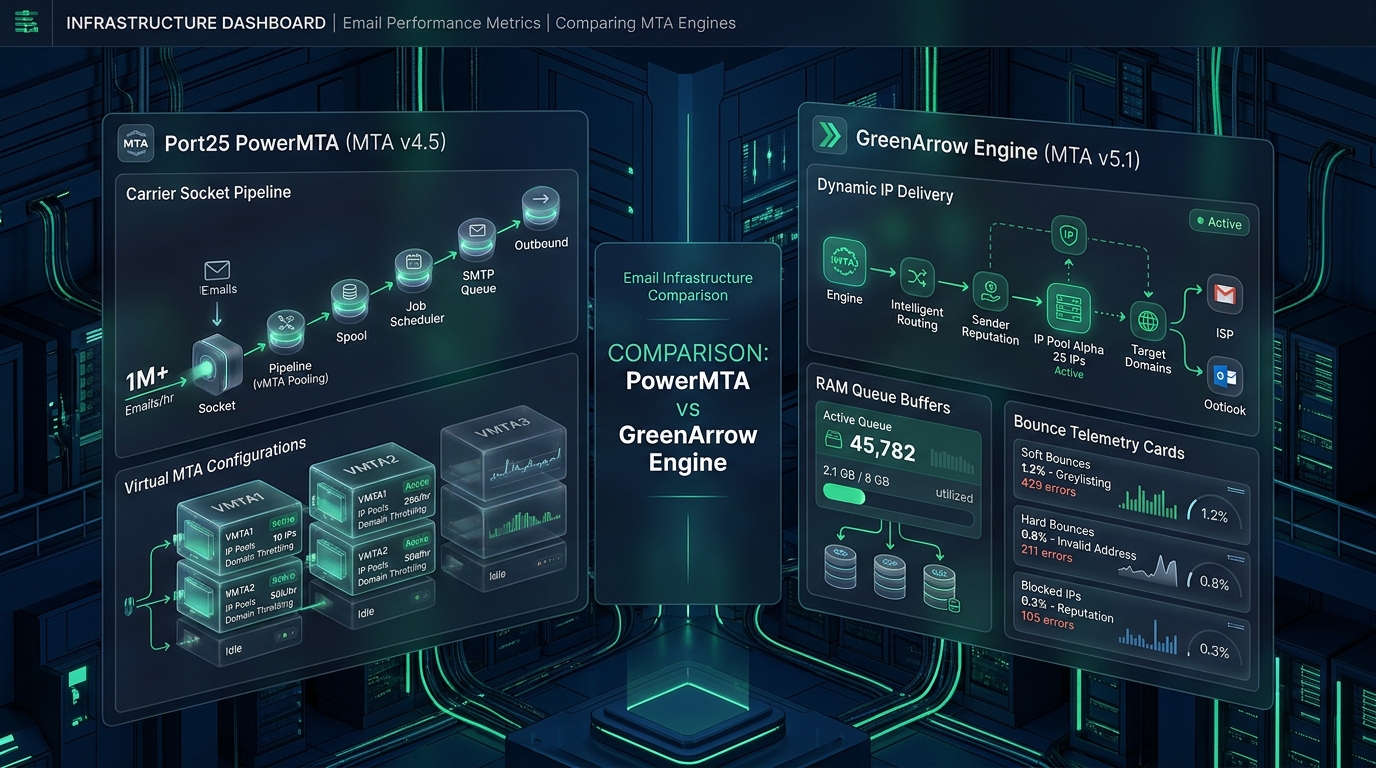
When enterprise bulk broadcasters choose an on-premises or dedicated mail transfer agent (MTA) rather than relying on multi-tenant cloud APIs, the two most distinguished specialized platforms are Port25 PowerMTA and GreenArrow Engine (by DRH Internet). Both solutions were purpose-built to replace standard Unix daemons (such as Postfix and Exim) with high-concurrency, multi-IP routing engines equipped with sophisticated ISP throttling capabilities. However, their underlying internal architectures differ drastically: PowerMTA operates as a lean, compiled C++ memory-and-spool daemon, while GreenArrow integrates an entire ecosystem combining an MTA engine, a PostgreSQL reporting datastore, and dynamic IP allocation logic. This guide delivers a rigorous comparative benchmark of throughput, queue resilience, bounce classification, and operational total cost of ownership (TCO).
- 1. Core Engine Foundations: Lean Daemon vs Integrated Appliance
- 2. Queue Management: In-Memory Buffers vs PostgreSQL Spooling
- 3. IP Pooling & Routing: Virtual MTAs vs Dynamic Delivery
- 4. Bounce Classification, FBLs & SMTP 550 Remediation
- 5. Concurrency Benchmarks & System Resource Footprint
- 6. Pricing & Licensing Models: Flat vs Volume Tiers
- 7. PowerMTA vs GreenArrow Comparison Matrix
- 8. The AutoSMTP Clustered Advantage
1. Core Engine Foundations: Lean Daemon vs Integrated Appliance
The philosophical difference between PowerMTA and GreenArrow shapes how systems engineers deploy and maintain them:
Core Architectural Contrast
Port25 PowerMTA: PowerMTA is designed strictly as a high-performance transport daemon. It focuses exclusively on socket concurrency, RFC 5321 compliance, IP rotation, and wire delivery. It does not dictate what database, analytics suite, or campaign tool you use; it outputs high-speed binary or CSV accounting records and provides an interactive command line interface (pmtcmd) and web monitor. Because of this UNIX-style focus, it has an extraordinarily small memory footprint (typically under 2GB RAM even under massive load) and boots instantly.
GreenArrow Engine: GreenArrow is delivered as a comprehensive software appliance. Alongside its core MTA daemon, it embeds PostgreSQL, Redis, Apache, and proprietary background workers for bounce processing, event tracking, and web administration. While this creates a turn-key experience for organizations seeking an all-in-one software package, it creates heavier system resource requirements and tight coupling between delivery and reporting components.
2. Queue Management: In-Memory Buffers vs PostgreSQL Spooling
Queue performance during sudden traffic surges determines whether your email platform remains responsive or suffers from thread exhaustion and disk I/O thrashing:
PowerMTA Disk & RAM Spool Architecture
PowerMTA uses an asynchronous disk spool paired with an in-memory queue index. New messages are committed to disk via non-blocking write buffers while the transit routing logic executes entirely in RAM. Even with a backlog of 10,000,000 queued messages, PowerMTA’s web monitor and CLI respond in milliseconds without degrading injection throughput.
GreenArrow Dynamic Delivery Spooling
GreenArrow relies on a hybrid architecture where active message metadata is coordinated through its underlying relational database and filesystem queues. While this gives administrators powerful SQL-like query capabilities over queued mail, high-concurrency spikes can produce heavy PostgreSQL write load and I/O wait times on budget storage arrays.
3. IP Pooling & Routing: Virtual MTAs vs Dynamic Delivery
Both engines excel at binding outbound connections to specific source IP addresses, but their configuration mechanics differ:
# ==============================================================================
# POWERMTA DIRECTIVE: DECLARATIVE VIRTUAL MTA POOLS
# ==============================================================================
<virtual-mta vmta-transactional-01>
    smtp-source-host 198.51.100.21 mail1.brand.com
</virtual-mta>

<virtual-mta-pool pool-transactional>
    virtual-mta vmta-transactional-01
    virtual-mta vmta-transactional-02
</virtual-mta-pool>

# Route by domain or header in PMTA:
<domain gmail.com>
    use-virtual-mta-pool pool-transactional
    max-smtp-out 60
    max-msg-per-connection 25
</domain>

# ==============================================================================
# GREENARROW CONFIGURATION: DYNAMIC IP DIRECTIVES
# Configured via greenarrow.conf or Web UI routing tables:
# IP Addresses assigned to "Routing IDs" with automated weight distributions
# ==============================================================================
PowerMTA’s declarative config syntax allows instant updates via pmtcmd reload without stopping the daemon, dropping active connections, or flushing queues. GreenArrow provides web-based routing rule builders, making it accessible to non-CLI operators.
4. Bounce Classification, FBLs & SMTP 550 Remediation
Managing bounces and ISP complaints is critical to maintaining high sender scores across Yahoo, Gmail, and Microsoft:
| Capability | Port25 PowerMTA | GreenArrow Engine | Operational Verdict |
|---|---|---|---|
| Bounce Classification | Configurable regex & standard RFC categories (Bad Mailbox, Quota, Greylist) | Deep built-in classification engine (regularly updated by vendor) | GreenArrow has superior out-of-the-box classification heuristics |
| Logging & Accounting | Ultra-fast binary/CSV pipes; zero DB overhead | PostgreSQL relational event schema | PowerMTA scales higher; GreenArrow easier for simple queries |
| Automated Backoff | Granular backoff-to-normal-after on 421/450 response |
Dynamic Delivery auto-throttling per ISP | Both offer top-tier ISP rate-limiting protections |
| FBL / CFL Processing | Routes inbound ARF emails to local pipes or scripts | Native built-in FBL parser and de-activation lists | GreenArrow built-in; PowerMTA requires external script (AutoSMTP FBL) |
5. Concurrency Benchmarks & System Resource Footprint
On identical 16-Core AMD EPYC bare-metal hardware with 64GB RAM and enterprise NVMe storage, throughput benchmarks reveal distinct characteristics:
6. Pricing & Licensing Models: Flat vs Volume Tiers
The financial difference between the two platforms centers on how licensing fees scale:
PowerMTA Flat License Model
PowerMTA licenses are traditionally sold per server instance (or per virtual machine) with flat annual maintenance fees. Whether you send 5 million or 100 million emails per month through that server, the licensing cost does not increase. At scale, this delivers an exceptionally low marginal cost per thousand.
GreenArrow Tiered Subscription Model
GreenArrow Engine is primarily licensed as a software subscription with monthly tiers based on send volume (e.g., $600/mo for 1M/mo, scaling up to $2,500+ /mo for 20M/mo). While this includes support and bounce engine updates, high-volume operations experience steep price escalation as their business expands.
7. PowerMTA vs GreenArrow Comparison Matrix
| Evaluation Dimension | Port25 PowerMTA | GreenArrow Engine | Recommendation |
|---|---|---|---|
| Target Audience | Enterprise ESPs, infrastructure teams, high-volume cold broadcasters | Mid-market senders and marketing agencies wanting all-in-one software | PowerMTA for extreme volume and custom integration |
| Ease of Setup | Requires CLI configuration & DNS architecture knowledge | Guided installation scripts and web management UI | GreenArrow is faster for novice sysadmins |
| Scripting & Extensibility | Lua hooks for pre-submission, envelope routing & DKIM | Ruby/Perl plugins and PostgreSQL schema hooks | PowerMTA Lua hooks execute directly in-memory |
| ISP Rate-Limiting | Fully customizable declarative domain macros | Dynamic Delivery automated engine settings | Tie: Both protect sender reputation reliably |
| Long-Term Scalability | Unlimited sending throughput per node; linear multi-node scaling | Constrained by database server performance and tier costs | PowerMTA wins decisively for 20M+ monthly operations |
Consolidating 3 GreenArrow Instances into a Dual-Node PowerMTA Cluster
A financial media publisher was operating 3 GreenArrow Engine servers to deliver 28M monthly market updates. Rising monthly tier fees and occasional PostgreSQL lock contention during morning market-open blasts led their team to benchmark PowerMTA.
The Results: By deploying a dual-node PowerMTA bare-metal cluster with AutoSMTP management, morning burst delivery times dropped from 48 minutes to 11 minutes. Monthly software licensing and hosting expenses were reduced by 58%, saving over $21,000 annually.
The AutoSMTP Deliverability Defense Advantage
Inbound and outbound filtering pipelines require robust underlying transport hardware. AutoSMTP provisions sovereign, dedicated bare-metal MTA infrastructure engineered for high-throughput filtering, synchronous 550 bounce suppression, and permanent reputation control.
Provisions fully licensed PowerMTA and KumoMTA clusters on enterprise bare-metal with dedicated IPv4 subnets and predictable flat pricing.
Monitors Google Postmaster spam ratios (<0.1%) and real-time ISP deferrals with algorithmic volume scaling across your entire IP pool.
RFC 5321 in-band 550 bounce suppression, automated Yahoo/Outlook Complaint Feedback Loops (CFL), and instant bad-IP eviction.
Pre-configured forward and reverse DNS (PTR) per IP, SPF CIDR alignment, 2048-bit DKIM rotation, and strict DMARC enforcement.
Upgrade Your Email Infrastructure with Dedicated Bare Metal
Eliminate filter lag, queue serialization bottlenecks, and noisy neighbor contamination. Deploy a turnkey AutoSMTP cluster today.
Deploy Turnkey MTA Cluster →