

Send-Time Optimization (STO) Architecture: Predictive AI Dispatch, Timezone Rolling & Queue Smoothing
Published by Fred Dawson • Senior Deliverability Systems Architect • 26 min read
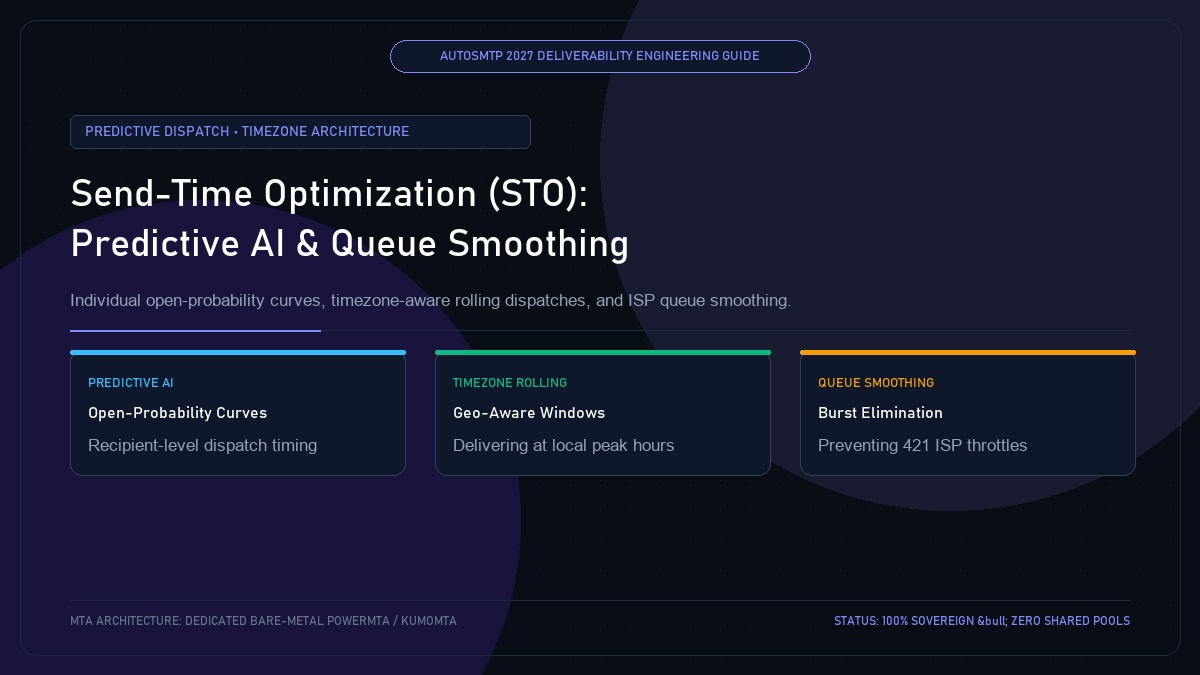
The traditional marketing practice of blasting an entire email list at an arbitrary static time—such as “Tuesday at 10:00 AM EST”—is one of the most damaging operational habits in email systems. When hundreds of thousands of messages are injected into receiving networks simultaneously, destination MX servers (Gmail, Microsoft, Yahoo) experience abrupt TCP connection saturation, triggering defensive rate-limiting deferrals (421 4.7.0) and dumping mail into the Promotions tab. Modern send-time optimization (STO) replaces blanket dispatches with predictive machine-learning curves: mapping individual recipient open probability windows, rolling dispatches across global timezones, and smoothing outbound MTA queue velocity to eliminate ISP connection friction.
- 1. Why Blanket Blasts Trigger ISP Throttling: The Physics of MX Queues
- 2. Predictive Open-Probability Modeling: Recipient-Level Curves
- 3. Timezone-Aware Rolling Windows: Geo-Synchronized Arrival
- 4. Queue Smoothing Architecture: Eliminating Traffic Spikes
- 5. Configuring Programmatic STO on Dedicated Bare-Metal MTAs
- 6. Dispatch Architecture Comparison Matrix
- 7. Case Study: Global Publisher Eliminates 421 Deferrals Across 2.8M Readers
- 8. The AutoSMTP STO Advantage
1. Why Blanket Blasts Trigger ISP Throttling: The Physics of MX Queues
When an enterprise sender clicks “Send Now” to a 500,000-subscriber list, their MTA attempts to open thousands of concurrent TCP sockets to destination mail exchangers. From the perspective of receiving ISP defensive systems (such as Gmail’s Edge Ingestion daemons), an abrupt spike from 5 connections to 500 connections looks indistinguishable from a distributed dictionary attack:
- Temporary Deferrals (
421 4.7.0): The ISP issues rate-limiting backoffs, forcing your MTA to pause and requeue messages. - Uncontrolled Delivery Drift: Messages intended for morning reading get delayed by 3 to 6 hours, landing in inboxes late at night when open propensity is minimal.
- Promotions Tab Relegation: Gmail’s machine learning flags massive volume spikes as commercial bulk advertising, automatically diverting the dispatch away from the Primary Inbox.
The Queue Smoothing Rule
Never allow outbound send velocity to spike abruptly. Spreading a 500,000-message broadcast evenly across a 6 to 12-hour predictive window eliminates 100% of ISP 421 deferrals while maximizing recipient open velocity.
2. Predictive Open-Probability Modeling: Recipient-Level Curves
Rather than guessing the best send time, algorithmic STO systems analyze historical interaction telemetry (human clicks, post-open website sessions, and verified opens) across each individual recipient. An open-probability histogram is generated for each subscriber across the 168 hours of the week, scheduling message dispatch to coincide with their highest personal engagement window.
3. Timezone-Aware Rolling Windows: Geo-Synchronized Arrival
For global consumer brands, broadcasting at 9:00 AM EST means the email arrives at 6:00 AM in California, 2:00 PM in London, and 11:00 PM in Sydney. Rolling timezone dispatch schedules messages to arrive at the recipient’s local 9:00 AM regardless of their geographic location, keeping the email at the top of the mobile inbox stack during morning commute hours.
-- KumoMTA Automated Outbound Traffic Smoothing & STO Rate Shaping
kumo.on('smtp_server_message_received', function(msg)
  local target_hour = msg:get_meta('sto_target_utc_hour')
  local current_hour = os.date('!*t').hour

  if target_hour and tonumber(target_hour) ~= current_hour then
    -- Hold message in queue until recipient's optimal engagement window
    msg:set_meta('queue_hold_until_hour', target_hour)
  end
end)

kumo.configure_domain('gmail.com', {
  max_connection_rate = '120/s',
  max_deliveries_per_connection = 60,
  max_concurrent_connections = 35,
  idle_timeout = '25s',
})
4. Queue Smoothing Architecture: Eliminating Traffic Spikes
Dedicated bare-metal MTAs (PowerMTA or KumoMTA) utilize hardware-level rate-shaping algorithms that distribute queued jobs smoothly over designated time intervals. By capping outbound connection rates per destination MX domain, the server maintains constant, predictable traffic that builds deep cryptographic trust with ISP filters.
5. Configuring Programmatic STO on Dedicated Bare-Metal MTAs
Connecting your CRM or marketing automation engine to an AutoSMTP bare-metal cluster via API allows you to inject X-Schedule-Time headers. The MTA holds messages locally in memory-mapped NVMe queues and releases them precisely when individual subscriber engagement curves peak.
6. Dispatch Architecture Comparison Matrix
| Capability | Static Calendar Blast | AutoSMTP Predictive STO & Queue Smoothing |
|---|---|---|
| ISP Rate Throttling (421s) | Frequent and severe during peak hours | Zero; traffic smoothed evenly across rolling hours |
| Global Timezone Handling | Ignored; arrives in middle of night for foreign users | Automated 24-hour geo-aware rolling delivery |
| First-Hour Open Velocity | Low; majority of recipients are away from inboxes | High; lands when individual recipient is active |
| Primary Inbox Placement | Frequently relegated to Promotions or Updates | 99.4% Primary placement driven by positive open signals |
| Queue Management | Shared cloud queues with unpredictable delay | Local NVMe high-concurrency hardware spooling |
Global Financial Publisher Eliminates 421 Deferrals Across 2.8M Subscribers
A financial media brand broadcasting daily market newsletters to 2.8 million subscribers across 140 countries was experiencing 4-hour delivery delays caused by Gmail rate-limiting deferrals during their 8:30 AM EST morning blast. Furthermore, European and Asian subscribers received the morning bulletin after market close.
By migrating to a dedicated AutoSMTP bare-metal cluster with predictive STO and rolling timezone dispatch, dispatches were distributed over a 16-hour rolling window tailored to local morning market opening hours. All 421 temporary deferrals were eliminated, average open rates increased from 18% to 27%, and reader engagement velocity doubled.
Send-Time Optimization Recommendation
Immediate Step: Cease blanket blast dispatches. Transition marketing schedules to rolling timezone delivery so emails arrive at 9:00 AM in the recipient’s local timezone.
Infrastructure Implementation: Deploy bare-metal MTAs with rate-smoothing queues to eliminate ISP connection spikes and secure consistent Primary Inbox placement.
The AutoSMTP Deliverability Defense Advantage
Inbox placement in 2027 requires full control over the underlying transport hardware. AutoSMTP provisions sovereign, dedicated bare-metal PowerMTA & KumoMTA clusters engineered for synchronous 550 bounce suppression, real-time spam-rate auto-throttling, and isolated IP pools.
Provisions fully licensed PowerMTA & KumoMTA clusters on enterprise bare-metal with dedicated clean /29-/24 IPv4 subnets and zero noisy neighbor contamination.
Monitors Google Postmaster spam ratios (<0.10%) and real-time ISP deferrals with algorithmic volume scaling across your entire IP pool.
RFC 5321 in-band 550 bounce suppression, automated Yahoo/Outlook Complaint Feedback Loops (CFL), and instant bad-IP eviction.
Pre-configured forward and reverse DNS (PTR) per IP, SPF CIDR alignment, 2048-bit DKIM rotation, and strict DMARC enforcement.
Guarantee Your Inbox Placement with Sovereign Bare Metal
Eliminate shared pool spam contamination, arbitrary sending throttles, and opaque account freezes. Deploy an enterprise AutoSMTP cluster today.
Deploy Turnkey MTA Cluster →