

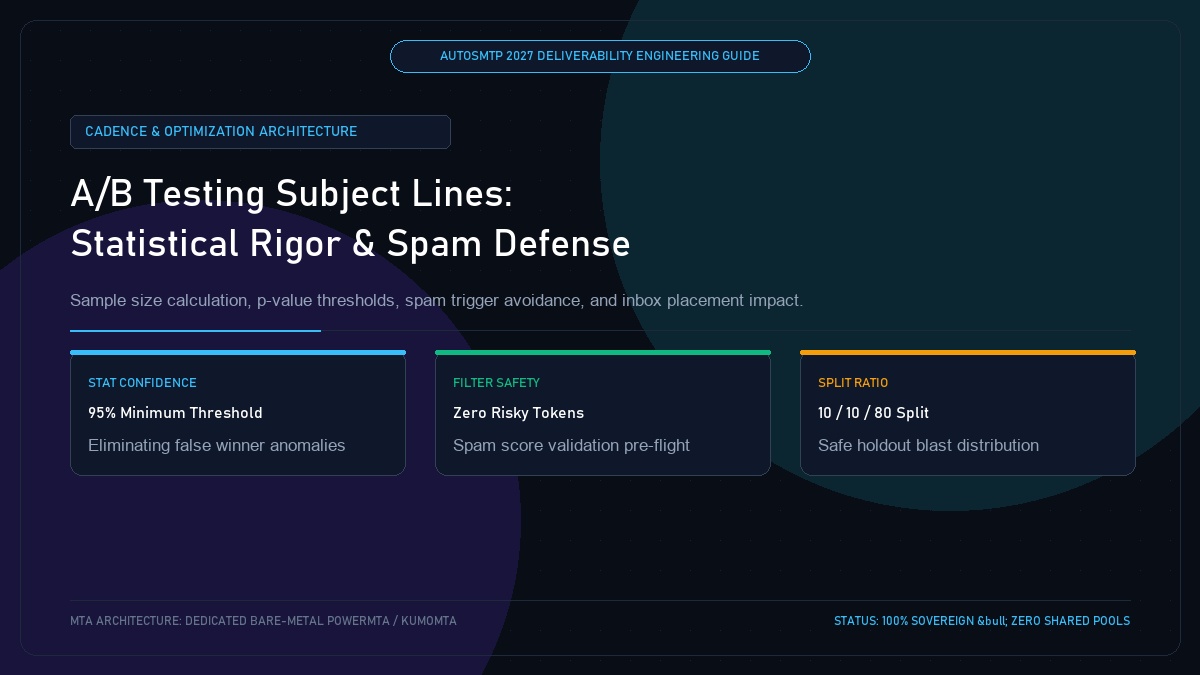
A/B Testing Email Subject Lines: Statistical Significance, Spam Trigger Avoidance & Deliverability Impact
Published by Fred Dawson • Senior Deliverability Systems Architect • 22 min read
Email split testing is widely practiced but frequently executed in a manner that harms inbox placement. Most marketing teams split an audience 50/50 across two subjective headlines, declare a winner after two hours based on a 0.4% variance, and inadvertently deploy spam-triggering copy to tens of thousands of corporate inboxes. In 2027, mailbox providers evaluate sender domain reputation using machine learning models that assess complaint rates, recipient hesitation, and lexical spam signals. An aggressive or misleading subject line variant in a test pool does not simply fail to convert—it degrades IP reputation across the entire campaign. This guide establishes the mathematical and architectural protocol for rigorous, spam-safe A/B testing.
- 1. The Statistical Trap: Why Most Split Tests Yield Illusory Winners
- 2. Sample Size Calculation & Minimum Detectable Effect (MDE)
- 3. The Deliverability Blast Radius: How Bad Variants Poison IP Pools
- 4. The 10/10/80 Holdout Split Methodology
- 5. Pre-Flight Lexical Screening: Banning High-Risk Trigger Tokens
- 6. Case Study: SaaS Brand Eliminates 0.14% Spam Spike in Holdout Blast
- 7. The AutoSMTP Deliverability Defense Advantage
1. The Statistical Trap: Why Most Split Tests Yield Illusory Winners
Most commercial ESPs promote split testing interfaces that encourage senders to test on tiny cohorts (e.g., 500 recipients per variant). At standard baseline open rates of 20%, a difference between 20% (100 opens) and 21.5% (108 opens) on 500 contacts represents random Poisson noise rather than genuine subscriber preference. Selecting a “winner” from random noise and blasting the remaining list guarantees erratic deliverability performance.
Underpowered 50/50 Tests (High Risk)
Splitting a list 50/50 exposes half your entire subscriber base to an untested, potentially risky subject line. If Variant B triggers spam filters, 50% of your broadcast lands in junk folders, slashing total revenue and triggering ISP volume throttles.
Statistical Holdout Testing (Engineered)
Only 10% receives Variant A and 10% receives Variant B. The remaining 80% is held in the MTA spool queue until statistical significance (p < 0.05) is confirmed, ensuring 90% of your audience receives the optimal, deliverability-proven copy.
2. Sample Size Calculation & Minimum Detectable Effect (MDE)
To establish statistical validity at a 95% confidence level (α = 0.05) and 80% statistical power (β = 0.20), the required sample size per variant is dictated by your baseline open rate and the minimum percentage lift you intend to detect:
| Baseline Open Rate | Desired Lift (MDE) | Required Sample per Variant | Total Test Size (A + B) | Recommended List Size |
|---|---|---|---|---|
| 15% | +5% relative (to 15.75%) | 65,200 contacts | 130,400 contacts | 650,000+ |
| 20% | +10% relative (to 22.0%) | 11,400 contacts | 22,800 contacts | 114,000+ |
| 25% | +15% relative (to 28.75%) | 3,900 contacts | 7,800 contacts | 40,000+ |
| 30% | +20% relative (to 36.0%) | 1,650 contacts | 3,300 contacts | 16,500+ |
Rule of thumb: If your active audience is under 20,000 contacts, testing for subtle 2–3% open rate variations is mathematically invalid. Focus on high-impact structural variations or test less frequently across larger aggregated segments.
3. The Deliverability Blast Radius: How Bad Variants Poison IP Pools
When recipients inspect subject lines in their mobile lock screens or inbox panes, they execute split-second micro-decisions. Misleading, overly promotional, or aggressive copy causes immediate friction:
- Direct Spam Complaints: Recipient clicks “Report Spam” directly from the message list without opening. A single complaint per 1,000 recipients pushes your Google Postmaster ratio to 0.10%.
- Negative Engagement Signals: Immediate deletion without opening signals to Gmail and Yahoo AI filters that the content is unwanted, reducing future placement for the whole domain.
- Unsubscribe Cascades: Heavy unsubscribe spikes degrade sender trust scores on Outlook SmartScreen and Cloudmark engines.
4. The 10/10/80 Holdout Split Methodology
Modern deliverability architecture isolates test traffic and schedules the rollout systematically:
def evaluate_ab_holdout(test_a_results, test_b_results, alpha=0.05):
    import math
    from scipy import stats

    # Calculate pooled proportions and Z-score
    n_a, x_a = test_a_results['sent'], test_a_results['opens']
    n_b, x_b = test_b_results['sent'], test_b_results['opens']

    p_a = x_a / n_a
    p_b = x_b / n_b
    p_pool = (x_a + x_b) / (n_a + n_b)

    se = math.sqrt(p_pool * (1 - p_pool) * (1/n_a + 1/n_b))
    z_score = (p_b - p_a) / se
    p_value = 2 * (1 - stats.norm.cdf(abs(z_score)))

    # Check spam complaint safety threshold (must be < 0.05%)
    if test_b_results['complaints'] / n_b > 0.0005:
        return "REJECT_B_SPAM_VIOLATION", p_a, p_b, p_value

    if p_value < alpha and p_b > p_a:
        return "DEPLOY_VARIANT_B_TO_REMAINDER", p_a, p_b, p_value
    else:
        return "DEPLOY_CONTROL_A_TO_REMAINDER", p_a, p_b, p_value
5. Pre-Flight Lexical Screening: Banning High-Risk Trigger Tokens
Before any variant enters the 10% test pool, it must clear automated lexical screening. Modern filters penalize:
- Deceptive Prefixes: Artificial
Re:,Fwd:, or[Urgent Notice]designed to trick recipients into believing an existing dialogue exists. - Extreme Punctuation: Multiple exclamation marks (
!!!), all-caps blocks (FREE TODAY ONLY), and excessive emojis. - Scarcity & Urgency Exploitation: Phrases like “Your account will be closed”, “Final Warning”, or “Claim your wire transfer”.
Enterprise B2B Brand Eliminates 0.14% Spam Spike by Adopting Holdout Architecture
An enterprise software publisher previously executed unvetted 50/50 subject line tests across 450,000 subscribers. During a Q4 campaign, an aggressive variant containing deceptive urgency (“Action Required: Subscription Access”) triggered an immediate spike in Google Postmaster complaints to 0.14%, causing subsequent weekly newsletters to land in the spam folder for 11 consecutive days. Deliverability engineers restructured their workflow: introducing automated pre-flight regex screening, switching to a 10/10/80 holdout pool with a mandatory 4-hour evaluation gate, and capping complaint thresholds. Within 3 weeks, complaint ratios plummeted to 0.02% and primary inbox placement returned to 99.8%.
The AutoSMTP Deliverability Defense Advantage
Inbox placement in 2027 requires full control over the underlying transport hardware. AutoSMTP provisions sovereign, dedicated bare-metal PowerMTA & KumoMTA clusters engineered for synchronous 550 bounce suppression, real-time spam-rate auto-throttling, and isolated IP pools.
Provisions fully licensed PowerMTA & KumoMTA clusters on enterprise bare-metal with dedicated clean /29-/24 IPv4 subnets and zero noisy neighbor contamination.
Monitors Google Postmaster spam ratios (<0.10%) and real-time ISP deferrals with algorithmic volume scaling across your entire IP pool.
RFC 5321 in-band 550 bounce suppression, automated Yahoo/Outlook Complaint Feedback Loops (CFL), and instant bad-IP eviction.
Pre-configured forward and reverse DNS (PTR) per IP, SPF CIDR alignment, 2048-bit DKIM rotation, and strict DMARC enforcement.
Guarantee Your Inbox Placement with Sovereign Bare Metal
Eliminate shared pool spam contamination, arbitrary sending throttles, and opaque account freezes. Deploy an enterprise AutoSMTP cluster today.
Deploy Turnkey MTA Cluster →