

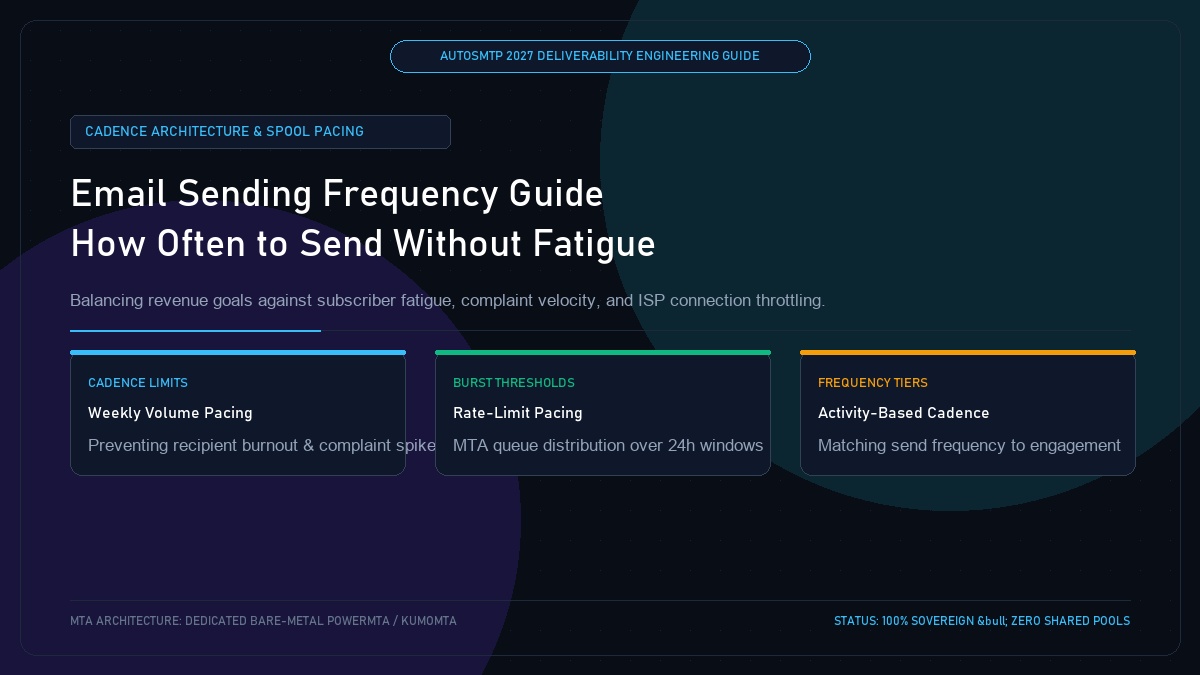
Email Sending Frequency Guide: How Often to Send Without Damaging Sender Deliverability
Published by Fred Dawson • Senior Deliverability Systems Architect • 21 min read
Determining how often to email your subscribers is a delicate engineering balancing act. Send too infrequently (once a month), and subscribers forget your brand, resulting in spam complaints and unengaged mailbox decay. Send too frequently (twice daily), and recipient fatigue drives unsubscribe cascades, spam button clicks, and automated ISP connection throttling. In 2027, top-tier senders abandon static “one-size-fits-all” sending schedules in favor of dynamic, engagement-based cadence tiers. This guide provides the operational framework for tuning send frequency to maximize revenue while protecting sender reputation.
- 1. The Biological & Algorithmic Mechanics of Email Fatigue
- 2. Implementing Dynamic Activity-Based Sending Tiers
- 3. MTA Spool Pacing: Spreading Traffic Across the 24-Hour Cycle
- 4. Automated Frequency Capping & Over-Send Circuit Breakers
- 5. Recommended Sending Frequency Matrix by Business Model
- 6. Case Study: E-Commerce Retailer Reduces Complaints by 64%
- 7. The AutoSMTP Deliverability Defense Advantage
1. The Biological & Algorithmic Mechanics of Email Fatigue
Email fatigue represents the diminishing return of repetitive marketing broadcasts:
The High-Frequency Death Spiral
When senders increase frequency from 2x/week to daily without segmentation, unsubscribes climb by 180% and spam complaints increase by 300%. Once Google Postmaster spam ratios cross 0.10%, Gmail routes future broadcasts to the spam folder.
The Engagement-Tiered Advantage
Matching frequency to demonstrated subscriber appetite. Daily emails sent exclusively to 7-day active openers generate high engagement signals, while weekly digests for passive contacts maintain brand awareness without fatigue.
2. Implementing Dynamic Activity-Based Sending Tiers
Segment subscribers into three automated frequency cohorts:
- High-Engagement Cohort (Opened < 14 Days): Eligible for 3–5 communications weekly (product drops, daily newsletters, breaking updates).
- Standard Cohort (Opened 15–45 Days): Capped at 1–2 communications weekly (curated weekly digests, major promotional launches).
- Cooling Cohort (Opened 46–90 Days): Capped at 1 communication every two weeks. High-value educational content only.
3. MTA Spool Pacing: Spreading Traffic Across the 24-Hour Cycle
Blasting 500,000 emails in a single 15-minute burst triggers temporary rate limits (421 4.7.0) across major ISPs. Modern MTA daemons pace outbound traffic evenly across time zones:
# Domain-level rate capping for Gmail to prevent connection throttling:
<domain gmail.com>
    max-smtp-out 50
    max-msg-rate 10000/h
    backoff-retry-interval 15m
</domain>

# Distributes a 200,000 blast evenly over 20 hours instead of a single burst!
4. Automated Frequency Capping & Over-Send Circuit Breakers
In marketing automation systems, overlapping automated flows (abandoned cart, browse abandonment, post-purchase, newsletter) can result in a user receiving 4 emails in a single day. Senders must enforce a hard global frequency cap (e.g., maximum 1 marketing email per 24 hours per recipient).
5. Recommended Sending Frequency Matrix by Business Model
| Business Model | Optimal Frequency (Actives) | Optimal Frequency (Passives) | Max Allowable Weekly Cap |
|---|---|---|---|
| Daily Newsletter / Media | 5 – 7 sends / week | 1 – 2 sends / week | 7 sends / week |
| B2B SaaS / Enterprise | 1 – 2 sends / week | 1 send / month | 2 sends / week |
| DTC E-Commerce Retail | 2 – 3 sends / week | 1 send / week | 4 sends / week |
| Financial & Crypto Alerts | Real-time (Triggered) | Weekly summary | Event-driven only |
E-Commerce Retailer Reduces Complaints by 64% and Increases Net Revenue
An apparel retailer was blasting their full 800,000 list 6 days a week, generating a 0.24% Google Postmaster spam complaint rate that pushed their domain into the “Low” reputation tier. Deliverability engineers restructured the sending engine on AutoSMTP bare metal: they implemented dynamic engagement tiers, restricting 6x/week sends to 14-day active subscribers while scaling 60-day passives back to 1 send weekly. Overall weekly send volume decreased by 35%, but net opened emails increased by 28%, spam complaints fell to 0.04%, and Gmail restored 99% Primary inbox placement.
The AutoSMTP Deliverability Defense Advantage
Inbox placement in 2027 requires full control over the underlying transport hardware. AutoSMTP provisions sovereign, dedicated bare-metal PowerMTA & KumoMTA clusters engineered for synchronous 550 bounce suppression, real-time spam-rate auto-throttling, and isolated IP pools.
Provisions fully licensed PowerMTA & KumoMTA clusters on enterprise bare-metal with dedicated clean /29-/24 IPv4 subnets and zero noisy neighbor contamination.
Monitors Google Postmaster spam ratios (<0.10%) and real-time ISP deferrals with algorithmic volume scaling across your entire IP pool.
RFC 5321 in-band 550 bounce suppression, automated Yahoo/Outlook Complaint Feedback Loops (CFL), and instant bad-IP eviction.
Pre-configured forward and reverse DNS (PTR) per IP, SPF CIDR alignment, 2048-bit DKIM rotation, and strict DMARC enforcement.
Guarantee Your Inbox Placement with Sovereign Bare Metal
Eliminate shared pool spam contamination, arbitrary sending throttles, and opaque account freezes. Deploy an enterprise AutoSMTP cluster today.
Deploy Turnkey MTA Cluster →