

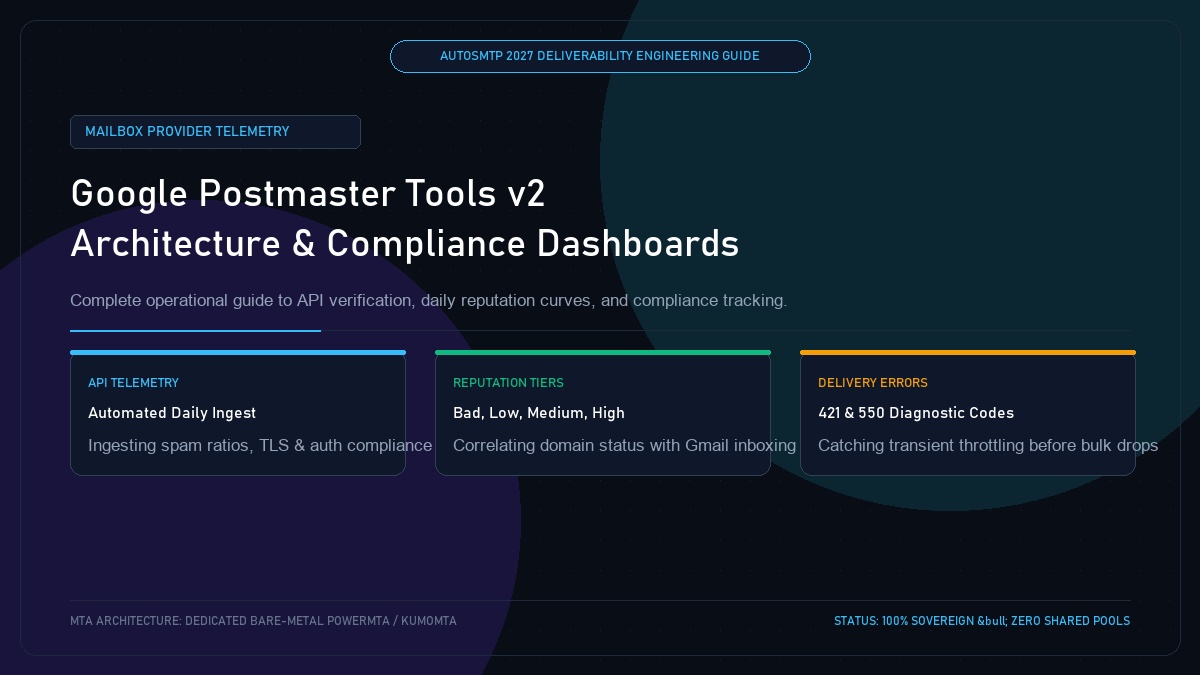
Google Postmaster Tools v2 Architecture: Automated Verification, Reputation Tiers & Compliance Dashboards
Published by Fred Dawson • Senior Deliverability Systems Architect • 21 min read
Google Postmaster Tools (GPT) is the authoritative source of truth for sending to more than 1.8 billion Gmail and Google Workspace inboxes worldwide. With the release of Postmaster Tools v2 and its programmatic REST API, deliverability engineers no longer need to rely on static manual web graphs. GPT v2 provides granular socket-level diagnostics on user-reported spam ratios, IP and domain reputation curves, SPF/DKIM authentication compliance, in-transit TLS encryption, and delivery error codes. This engineering guide provides an exhaustive architectural walkthrough of GPT v2 configuration, automated API ingestion, and compliance monitoring.
- 1. Google Postmaster Tools v2 Core Architecture
- 2. Automated DNS Verification & CNAME Delegation
- 3. Deconstructing the Seven Postmaster Dashboards
- 4. Programmatic API Integration & Automated Alerts
- 5. Decoding Delivery Errors: 421 and 550 Response Codes
- 6. Postmaster Reputation Tier Placement Matrix
- 7. Case Study: Automated API Ingestion Preempts Domain Blacklisting
- 8. The AutoSMTP Deliverability Defense Advantage
1. Google Postmaster Tools v2 Core Architecture
Google Postmaster Tools provides direct telemetry on how Google’s spam algorithms evaluate your sending identity. Crucially, GPT only displays data for domains that send a meaningful daily volume (typically ≥ 100 emails daily to Gmail recipients) to preserve recipient privacy.
2. Automated DNS Verification & CNAME Delegation
To verify ownership of a sending domain in GPT v2, administrators publish a designated DNS TXT record at the root or subdomain level:
# Domain Verification Record Published in Authoritative DNS:
Host: example.com
Type: TXT
TTL:  300
Data: "google-site-verification=AbC123dEf456GhI789jKl012MnOpQrStUvWxYz"

# Verify via Dig:
dig +short TXT example.com | grep google-site-verification
"google-site-verification=AbC123dEf456GhI789jKl012MnOpQrStUvWxYz"
3. Deconstructing the Seven Postmaster Dashboards
GPT v2 aggregates outbound email performance across seven distinct operational dashboards:
Reputation & Spam Ratio
Spam Rate: Percentage of user-reported spam complaints over active inbox volume. Must stay < 0.10%.
Domain Reputation: Overall trust score assigned to your DKIM signing domain.
IP Reputation: Trust score assigned to your sending IP addresses.
Authentication & Delivery
Authentication: Separate percentage graphs for SPF, DKIM, and DMARC passing rates.
Encryption: Percentage of inbound connections negotiated over TLS.
Delivery Errors: Detailed breakdown of temporary 421 deferrals and 550 rejections.
4. Programmatic API Integration & Automated Alerts
Rather than logging into the Google web console daily, enterprise infrastructure teams connect directly to the Google Postmaster Tools REST API:
# Querying Traffic Stats via google-api-python-client
from googleapiclient.discovery import build
from google.oauth2 import service_account

creds = service_account.Credentials.from_service_account_file('gpt-service-key.json')
service = build('gmailpostmastertools', 'v1', credentials=creds)

response = service.domains().trafficStats().get(
    name='domains/marketing.example.com/trafficStats/20270115'
).execute()

spam_rate = response.get('userReportedSpamRatio', 0.0)
domain_rep = response.get('domainReputation', 'UNKNOWN')

if spam_rate >= 0.0008:  # 0.08% Auto-Brake Threshold
    trigger_mta_throttle(domain='marketing.example.com', scale_factor=0.50)
    send_slack_alert(f"WARNING: Google Postmaster Spam Rate Spike: {spam_rate * 100:.2f}%")
5. Decoding Delivery Errors: 421 and 550 Response Codes
When Google throttles or rejects outbound messages, GPT displays the root error category:
- Rate Limit Exceeded: Sending volume spiked faster than Google’s IP warming algorithm could accommodate.
- Suspected Spam: Content heuristics or recipient interaction models flagged the payload as potential bulk abuse.
- Content Attachment Policy: Payload contained disallowed file types (e.g., unsigned executables, encrypted archives).
- DMARC Policy Rejection: Sender’s published DMARC policy instructed Google to reject unaligned messages.
6. Postmaster Reputation Tier Placement Matrix
| GPT Reputation Tier | Definition & History | Inbox Placement Impact |
|---|---|---|
| High | Pristine sending history; near-zero spam complaints; 100% authentication alignment | 98%+ Primary Inbox and Promotions tab placement; zero rate throttling |
| Medium | Consistent sender with occasional minor complaint spikes (0.10%–0.25%) | Messages occasionally routed to spam; subject to conservative volume pacing |
| Low | Regular complaint volume (> 0.30%); elevated bounce rates or trap trips | Substantial volume routed to spam; frequent 421 rate-limit deferrals |
| Bad | Severe or sustained spam history; blacklisting or active spoofing vectors | Almost all outbound volume dropped or sent to spam; severe delivery blocks |
Automated Postmaster Ingestion Prevents a Black Friday Deliverability Failure
A major digital publication with 1.4 million daily newsletter subscribers integrated the Google Postmaster Tools API into their AutoSMTP monitoring dashboard. On a Tuesday morning, the automated worker detected a sudden increase in user-reported spam rate from 0.02% to 0.09% following a partner cross-promotional blast. Before Google’s algorithmic threshold reached the 0.10% penalty mark, the AutoSMTP controller automatically paused the partner campaign and re-routed subsequent sends exclusively to subscribers who had opened within the previous 7 days. The spam rate normalized to 0.03% within 24 hours, preserving the publisher’s High domain reputation status.
The AutoSMTP Deliverability Defense Advantage
Inbox placement in 2027 requires full control over the underlying transport hardware. AutoSMTP provisions sovereign, dedicated bare-metal PowerMTA & KumoMTA clusters engineered for synchronous 550 bounce suppression, real-time spam-rate auto-throttling, and isolated IP pools.
Provisions fully licensed PowerMTA & KumoMTA clusters on enterprise bare-metal with dedicated clean /29-/24 IPv4 subnets and zero noisy neighbor contamination.
Monitors Google Postmaster spam ratios (<0.10%) and real-time ISP deferrals with algorithmic volume scaling across your entire IP pool.
RFC 5321 in-band 550 bounce suppression, automated Yahoo/Outlook Complaint Feedback Loops (CFL), and instant bad-IP eviction.
Pre-configured forward and reverse DNS (PTR) per IP, SPF CIDR alignment, 2048-bit DKIM rotation, and strict DMARC enforcement.
Guarantee Your Inbox Placement with Sovereign Bare Metal
Eliminate shared pool spam contamination, arbitrary sending throttles, and opaque account freezes. Deploy an enterprise AutoSMTP cluster today.
Deploy Turnkey MTA Cluster →