

Cisco Secure Email vs FortiMail: 2027 Carrier-Grade Gateways, Talos Intelligence & Security Fabric
Published by Fred Dawson • Senior Deliverability Systems Architect • 19 min read
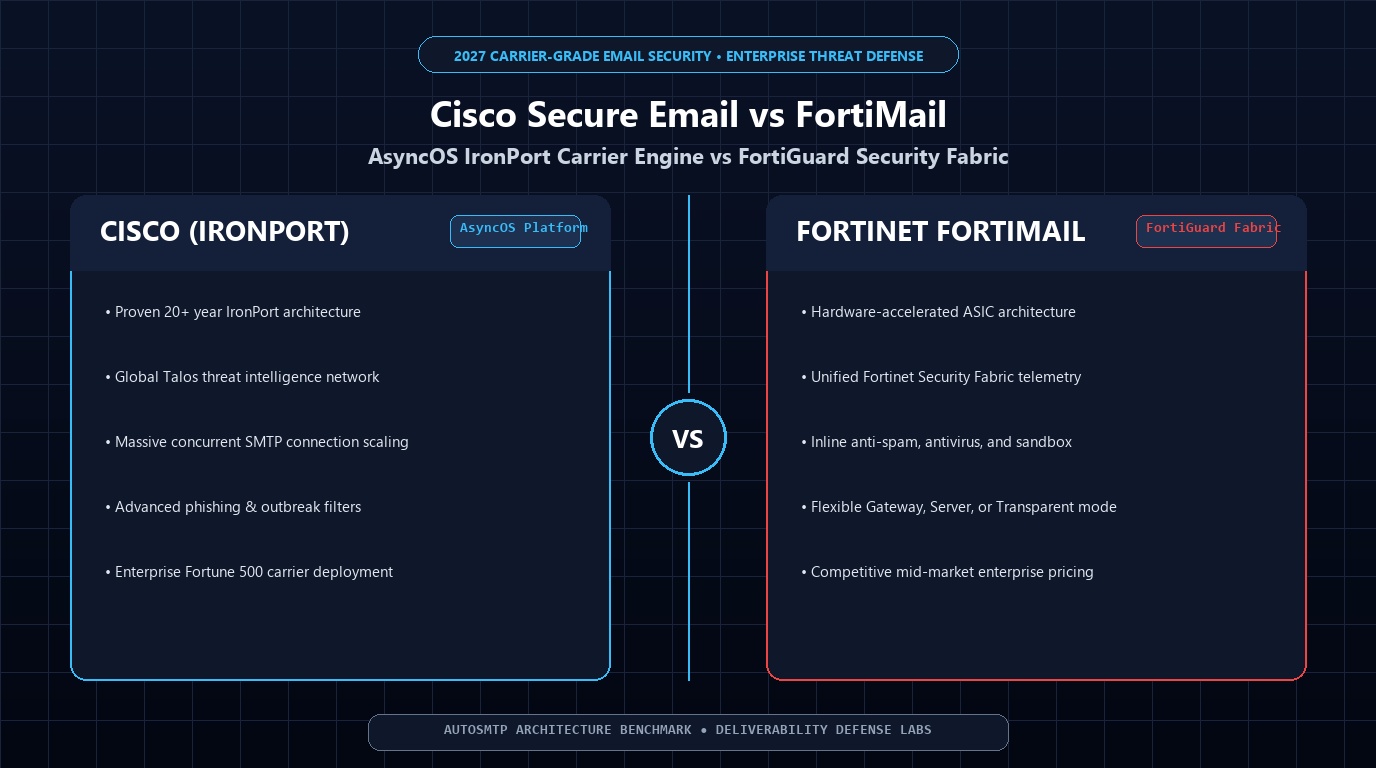
In high-throughput enterprise datacenters and tier-1 ISP networks, generic virtual appliances fail to handle concurrent TCP connection volumes and zero-hour targeted phishing campaigns. The two gold standards for on-premise and hybrid carrier-grade email defense are Cisco Secure Email Gateway (formerly Cisco IronPort) and Fortinet FortiMail. While Cisco leverages its legendary AsyncOS operating system and the global Talos Intelligence Network, Fortinet combines hardware-accelerated ASIC processing with deep telemetry from the Fortinet Security Fabric.
- 1. Operating Systems: IronPort AsyncOS vs Fortinet ASICs
- 2. Threat Intelligence: Cisco Talos vs FortiGuard Labs
- 3. Deployment Architecture: Gateway, Server & Transparent Modes
- 4. Zero-Hour Defense: Outbreak Filters vs FortiSandbox
- 5. Cisco vs FortiMail Technical Matrix
- 6. The AutoSMTP Deliverability Defense Advantage
1. Operating Systems: IronPort AsyncOS vs Fortinet ASICs
Standard Unix kernels assign one thread or process per TCP socket, which causes thread exhaustion when dealing with tens of thousands of simultaneous incoming SMTP connections.
Cisco Secure Email (AsyncOS): Built on a heavily customized FreeBSD kernel, AsyncOS uses an asynchronous event-driven I/O engine designed exclusively for high-volume email. A single Cisco appliance can sustain over 100,000 concurrent active TCP connections with virtually zero CPU context-switching overhead. This enables enterprise senders and receivers to buffer massive DDoS or spam storms without exhausting socket descriptors.
Fortinet FortiMail: Leverages Fortinet’s proprietary hardware architecture, combining multi-core enterprise CPUs with specialized FortiASIC network processors that offload pattern matching, TCP state inspection, and SSL/TLS decryption from the main CPU. This delivers blistering throughput for real-time antivirus unpacking and content disarm & reconstruction (CDR).
2. Threat Intelligence: Cisco Talos vs FortiGuard Labs
Antispam accuracy relies directly on the breadth of the underlying threat telemetry:
- Cisco Talos: The largest non-governmental threat intelligence organization in the world, analyzing over 600 billion emails daily across millions of global security sensors. Cisco SenderBase reputation scores provide unparalleled global IP reputation tracking, catching zero-hour phishing campaigns minutes before other commercial engines.
- FortiGuard Labs: Continuously aggregates telemetry from millions of Fortinet firewalls, endpoints, and email gateways across the globe. Through the Fortinet Security Fabric, an indicator of compromise (IoC) detected by an endpoint or firewall immediately updates FortiMail rules in real time.
3. Deployment Architecture: Gateway, Server & Transparent Modes
FortiMail offers an industry-unique advantage in deployment flexibility:
FortiMail 3-in-1 Deployment Flexibility
FortiMail can operate in Gateway Mode (traditional MX proxy), Server Mode (functions as a standalone complete mail server with internal POP3/IMAP/SMTP mailboxes), or Transparent Mode (acts as an inline network bridge inspecting SMTP packets without altering DNS MX records or network IP topologies).
Cisco Dedicated Gateway Architecture
Cisco Secure Email is strictly engineered as a Mail Transfer Agent (MTA) Gateway proxy. It requires modifying external DNS MX records to point directly to Cisco IP interfaces. It does not provide transparent network bridging or internal user mailbox hosting.
4. Zero-Hour Defense: Outbreak Filters vs FortiSandbox
When a massive zero-day phishing wave hits the internet, signature-based antivirus engines have a 20 to 120-minute gap before definitions are distributed. Cisco addresses this with Outbreak Filters, which dynamically hold suspicious emails in a temporary memory quarantine queue for 15 to 45 minutes while Talos analyzes telemetry, releasing clean messages once signatures finalize.
Fortinet counters zero-hour threats through direct integration with FortiSandbox (either on-premise hardware or Cloud). Suspect attachments are executed in isolated Windows/Linux virtualized environments, inspecting API hooks, memory injections, and command-and-control callbacks before delivering the message.
5. Cisco vs FortiMail Technical Matrix
| Evaluation Dimension | Cisco Secure Email (IronPort) | Fortinet FortiMail | Enterprise Recommendation |
|---|---|---|---|
| Threat Intelligence | Cisco Talos (600B+ emails/day, SenderBase) | FortiGuard Labs + Security Fabric | Cisco: Global gold standard for IP reputation |
| Concurrent Socket Scaling | AsyncOS event loop (100k+ concurrent sockets) | FortiASIC hardware acceleration | Cisco: Unmatched concurrent socket density |
| Deployment Flexibility | Gateway Proxy / Cloud Managed | Gateway, Server, and Transparent Bridge modes | FortiMail: Zero MX-change inline deployment |
| Ecosystem Integration | Cisco Security Cloud / SecureX | Fortinet Security Fabric (Firewalls, EDR) | Tie: Depends on existing enterprise vendor stack |
| Licensing & Pricing | Premium enterprise pricing; strict tiering | Competitive mid-market & enterprise bundles | FortiMail: Better pricing flexibility for SMB/Mid-market |
Global Banking Group: FortiMail Transparent Mode Cutover in 2 Hours
An international banking firm needed to introduce deep content inspection across their on-premise Microsoft Exchange 2019 infrastructure without causing DNS propagation delays or opening new external firewall ports. They deployed redundant FortiMail 1000F appliances in Transparent Mode directly behind their core perimeter switches. Inbound and outbound SMTP traffic was intercepted and scrubbed inline without modifying a single public MX record or touching local mail client configurations.
The AutoSMTP Deliverability Defense Advantage
Inbound and outbound filtering pipelines require robust underlying transport hardware. AutoSMTP provisions sovereign, dedicated bare-metal MTA infrastructure engineered for high-throughput filtering, synchronous 550 bounce suppression, and permanent reputation control.
Provisions fully licensed PowerMTA and KumoMTA clusters on enterprise bare-metal with dedicated IPv4 subnets and predictable flat pricing.
Monitors Google Postmaster spam ratios (<0.1%) and real-time ISP deferrals with algorithmic volume scaling across your entire IP pool.
RFC 5321 in-band 550 bounce suppression, automated Yahoo/Outlook Complaint Feedback Loops (CFL), and instant bad-IP eviction.
Pre-configured forward and reverse DNS (PTR) per IP, SPF CIDR alignment, 2048-bit DKIM rotation, and strict DMARC enforcement.
Upgrade Your Email Infrastructure with Dedicated Bare Metal
Eliminate filter lag, queue serialization bottlenecks, and noisy neighbor contamination. Deploy a turnkey AutoSMTP cluster today.
Deploy Turnkey MTA Cluster →