

DigitalOcean vs AWS for Email Infrastructure: 2027 Simplicity, Egress Taxes & Enterprise Scale
Published by Fred Dawson • Senior Deliverability Systems Architect • 18 min read
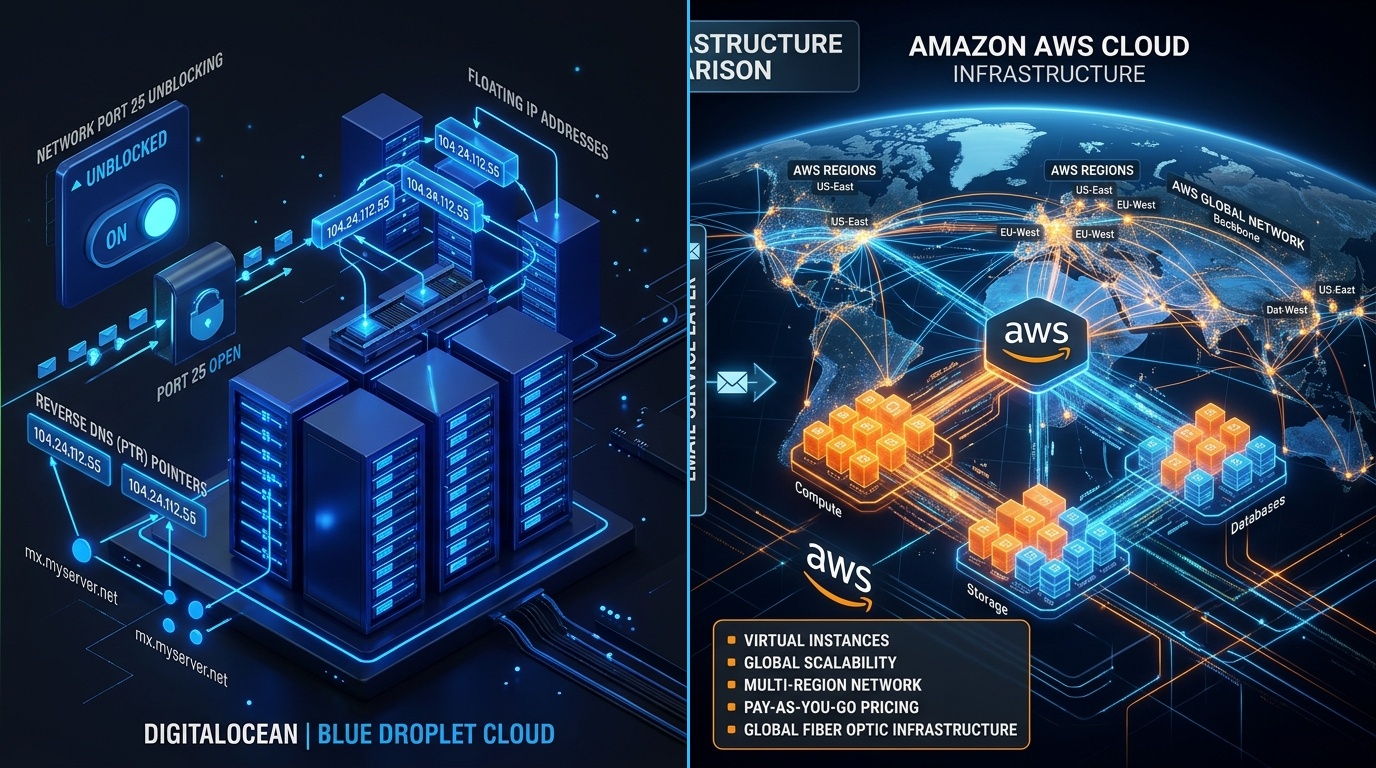
Choosing between DigitalOcean and Amazon Web Services (AWS) for email infrastructure represents a classic software engineering tradeoff: developer simplicity and transparent flat pricing versus hyper-granular multi-region elasticity and enterprise ecosystem depth. However, when evaluating the specific constraints of high-volume email—outbound Port 25 access, reverse DNS (PTR) alignment, egress bandwidth taxes, and native email delivery APIs (AWS SES)—both platforms present stark limitations that often drive scaling senders toward sovereign bare-metal alternatives.
1. Architectural Footprint: Droplets vs The AWS Labyrinth
The developer experience gap between DigitalOcean and Amazon Web Services is immense. Spinning up a virtual machine on DigitalOcean requires choosing an image, selecting a droplet size, picking a datacenter region, and adding an SSH key. Within 55 seconds, an accessible virtual machine is live with an assigned IPv4 address and a predictable $12/month invoice.
On AWS, deploying an equivalent EC2 compute instance requires navigating Virtual Private Clouds (VPCs), subnets, route tables, Internet Gateways (IGWs), Security Groups, Network ACLs, IAM roles and instance profiles, Elastic IPs, and EBS storage volume provisioned policies. While this complexity enables Fortune 500 compliance and enterprise networking, it introduces significant operational overhead for engineering teams whose sole objective is dispatching authenticated email queues.
The Operational Overhead Reality
Setting up a basic mail relay on AWS involves interacting with at least 6 distinct AWS services (EC2, VPC, Route53, IAM, CloudWatch, SES). On DigitalOcean, an entire Droplet and DNS zone can be stood up in 3 API calls or 5 minutes in a unified dashboard.
2. Bandwidth Egress Economics & Bill Shock
Where AWS heavily penalizes high-volume email senders is its data transfer egress pricing. Standard transactional receipts, order confirmations, and image-rich marketing newsletters average 80 KB to 120 KB per MIME message. For high-volume senders dispatching 25M to 50M emails monthly, outbound bandwidth quickly scales to multiple terabytes.
DigitalOcean bundles generous outbound bandwidth pools with every Droplet tier (e.g., a $24/month Droplet includes 4,000 GB / 4 TB of monthly bandwidth, with bandwidth pooled across all droplets in your account). Additional bandwidth overage is billed at just $0.01 per GB. On AWS, outbound bandwidth across the public internet starts at $0.09 per GB. The difference in monthly network cost is staggering:
Total Outbound Egress: 5,000 GB (5.0 TB)

DigitalOcean ($24 Droplet + Overage):
  - 4,000 GB included free with droplet
  - 1,000 GB overage @ $0.01/GB = $10.00
  Total Bandwidth Cost: $10.00 / month

Amazon Web Services (AWS EC2 Egress):
  - First 100 GB free
  - 4,900 GB @ $0.09/GB = $441.00
  Total Bandwidth Cost: $441.00 / month (44x more expensive!)
3. Native Email Pipelines: AWS SES vs DO Third-Party Rely
Despite AWS’s high network egress costs, AWS possesses a formidable advantage that DigitalOcean lacks: a native, hyper-scalable managed email service in the form of Amazon Simple Email Service (SES).
AWS SES: Built-In Scale & API
AWS SES offers flat-rate $0.10 per 1,000 emails sending pricing, integrated Dedicated IP pools with automatic warmup ($24.95/month per IP), Virtual Deliverability Manager, and seamless event publishing to Amazon SNS, Kinesis, and S3. Developers do not need to manage mail queues, disk spools, or SMTP socket daemons.
DigitalOcean: Zero Native Email
DigitalOcean has no proprietary email service. Because DigitalOcean blocks outbound port 25 on new accounts, DO users cannot even self-host a functional MTA without external relay routing. Operators must purchase a third-party commercial ESP (SendGrid, Mailgun) or relay through an external dedicated server.
4. Port 25 Access & Reverse DNS Mechanics
If your goal is self-hosting an open-source MTA like Postfix, KumoMTA, or Haraka, both cloud giants impose severe restrictions:
- DigitalOcean: Imposes an unyielding, permanent block on outbound TCP Port 25 for all newly registered accounts. Support tickets requesting removal are routinely rejected with generic boilerplate messages, preventing direct server-to-server SMTP handshakes.
- AWS EC2: Also blocks outbound Port 25 by default, but provides an official Request to Remove Email Sending Limitations support form. AWS requires proof of domain ownership, SPF/DKIM/DMARC records, and abuse desk contact information. While approval is possible for aged enterprise accounts, new AWS accounts often face multiple rejections.
5. DigitalOcean vs AWS Architectural Matrix
| Evaluation Dimension | DigitalOcean (Droplets) | Amazon Web Services (EC2 / SES) | Architectural Recommendation |
|---|---|---|---|
| Outbound Egress Bandwidth | Generous 1TB – 5TB included; $0.01/GB overage | $0.09 / GB public egress tax | DigitalOcean: 85-90% cheaper data transfer |
| Native Email Service | None (Must use third-party relay) | Amazon SES ($0.10/1k msgs + Dedicated IPs) | AWS: Superior if managed API sending is desired |
| Self-Hosted MTA Viability | Virtually zero (Port 25 permanently blocked) | Low to Moderate (Port 25 unblock request required) | AWS: Possible with ticket approval; DO is blocked |
| Platform Complexity | Minimal; clean UI & straightforward API | Extreme; requires IAM, VPC, and CloudWatch mastery | DigitalOcean: 10x faster developer onboarding |
| Reverse DNS (PTR) Control | Auto-generated based on Droplet name | Requires Route53 / AWS Support ticket | DigitalOcean: Simpler for single-IP workloads |
SaaS Product Dilemma: Cloud Virtualization Trap
An e-commerce notifications platform initially chose DigitalOcean Droplets to run a self-hosted Postfix cluster due to DO’s cheap $24 droplets and free 4TB bandwidth. After discovering Port 25 was hard-blocked, they migrated to AWS EC2. On AWS, they successfully unblocked Port 25 after two weeks of support back-and-forth, but their first 30M campaign generated a surprise $680 bandwidth bill alongside EBS IOPS throttling delays. They ultimately decoupled delivery completely, moving to dedicated bare-metal infrastructure.
The Cloud Email Compromise
Deploying high-volume email on developer clouds or hyperscalers forces a frustrating compromise:
- DigitalOcean gives you cheap bandwidth and simple servers, but blocks the protocol (Port 25) necessary to deliver email.
- AWS permits email delivery via SES or unblocked EC2, but taxes your bandwidth at $0.09/GB and penalizes disk IOPS.
- The Sovereign Solution: Dedicated bare-metal hosting eliminates both compromises: providing open Port 25, zero bandwidth egress taxes, and unmetered NVMe disk performance.
The AutoSMTP Deliverability Defense Advantage
Why compromise between DigitalOcean’s blocked ports and AWS’s punishing egress taxes? AutoSMTP deploys turnkey, dedicated bare-metal MTA clusters on enterprise hardware with zero bandwidth surcharges, automated gas-pedal IP warming, and 100% deliverability sovereignty.
Provisions fully licensed PowerMTA and KumoMTA clusters on enterprise bare-metal with dedicated IPv4 subnets and predictable flat pricing.
Monitors Google Postmaster spam ratios (<0.1%) and real-time ISP deferrals with algorithmic volume scaling across your entire IP pool.
RFC 5321 in-band 550 bounce suppression, automated Yahoo/Outlook Complaint Feedback Loops (CFL), and instant bad-IP eviction.
Pre-configured forward and reverse DNS (PTR) per IP, SPF CIDR alignment, 2048-bit DKIM rotation, and strict DMARC enforcement.
Escape Cloud Virtualization Limits & Taxes
Own your delivery pipeline on dedicated bare metal with flat-rate predictable monthly pricing and enterprise delivery performance.
Deploy Deliverability Defense Cluster →