

Single-Domain vs Multi-Domain Sending: 2027 Reputation Isolation, Volume Thresholds & Subdomain Topologies
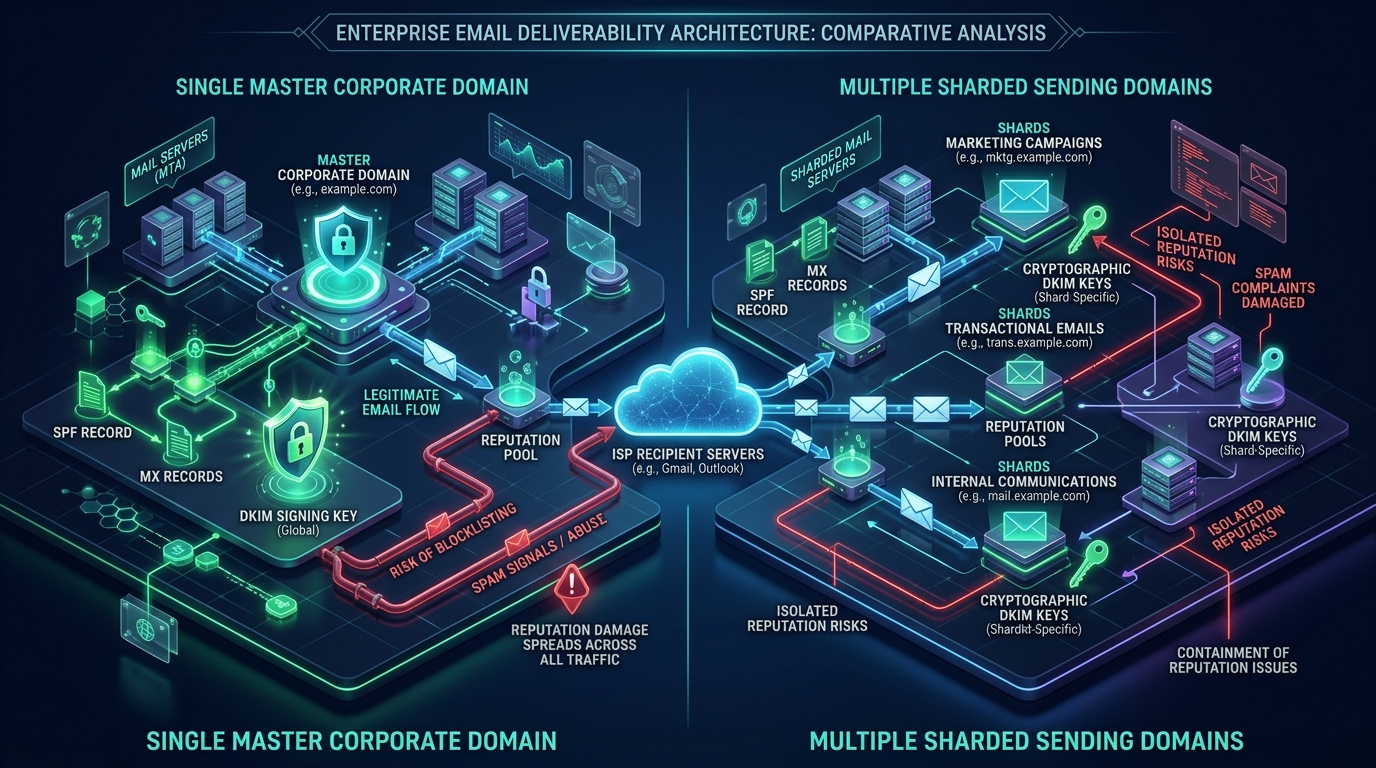
Designing an enterprise email sending architecture centers around a fundamental architectural trade-off: simplicity vs. blast-radius isolation. A single-domain architecture dispatches all outbound streams (transactional alerts, billing notices, marketing newsletters, and sales inquiries) from a unified domain identifier (either the root apex domain or a single dedicated subdomain). While this maximizes operational simplicity and concentrates positive engagement history into a single reputation score, it introduces an existential single point of failure: a marketing spam complaint spike or DNSBL listing immediately threatens critical transactional delivery.
Conversely, a multi-domain sending architecture partitions distinct email streams across dedicated subdomains (auth.domain.com, news.domain.com, notify.domain.com) or secondary root domains. However, multi-domain architectures introduce strict volume floors (a minimum of 50,000 monthly messages per subdomain is required to build stable mailbox provider reputation) and carry the danger of triggering snowshoe-spam heuristics if over-segmented. This comprehensive guide evaluates reputation isolation mechanics, Gmail domain-weighting versus Outlook IP-weighting, parent-domain reputation bleed, and production PowerMTA/KumoMTA multi-tenant configurations.
- 1. Fundamental Trade-off: Simplicity vs Blast-Radius Isolation
- 2. Single-Domain Architecture in Practice
- 3. The Subdomain Segmentation Strategy
- 4. Separate Root Domains: Maximum Insulation
- 5. The Volume Threshold Trap & Under-Warming
- 6. The Snowshoe-Spam Classification Trap
- 7. ISP Disparity: Gmail Domain vs Outlook IP Weighting
- 8. Parent-Domain Reputation Bleed Mechanics
- 9. Production PowerMTA & KumoMTA Topologies
- 10. Volume-Tiered Architecture Matrix
- 11. Enterprise Field Study: Scaling to 12M Sends
- 12. Operator Decision Framework
- 13. The AutoSMTP Dedicated Advantage
1. Fundamental Trade-off: Simplicity vs Blast-Radius Isolation
Every email dispatched across the internet carries a sender identity codified in RFC 5322 header fields (From:, Sender:) and RFC 5321 envelope headers (MAIL FROM: / Return-Path). Major mailbox providers (Gmail, Microsoft 365, Yahoo, Apple Mail) build persistent statistical reputation models around these cryptographic domain identities.
- The Single-Domain Dilemma: Consolidating all sending under a single domain creates maximum brand clarity and aggregates all positive open and click signals into a single score. However, because anti-spam algorithms evaluate domain reputation globally, a poorly timed marketing re-engagement campaign that generates a 0.25% spam complaint spike will penalize password resets, two-factor authentication tokens, and purchase invoices.
- The Multi-Domain Strategy: Dividing traffic across specialized subdomains establishes firewalls between disparate operational streams. Transactional emails maintain a pristine 99%+ deliverability profile on
auth.brand.com, while marketing campaigns absorb the volatility of promotional filtering onnews.brand.com.
Single-Domain Advantages
- Frictionless DNS Administration: Single SPF record, unified DKIM key pair, and one global DMARC record.
- Reputation Aggregation: Every transactional open bolsters marketing inbox placement at low volumes.
- Uncompromising Brand Trust: Recipients see the primary root domain in every user-facing client.
- Zero Snowshoe Risk: Impossible to be misclassified as fragmenting traffic to evade filters.
Single-Domain Vulnerabilities
- Zero Blast-Radius Protection: Marketing blacklisting shuts down critical operational notifications.
- Opaque Deliverability Telemetry: Impossible to isolate which message stream triggered an ISP deferral.
- Catastrophic Recovery Cost: Remediating a burned root domain takes weeks and disrupts corporate mail.
- Vendor Lock-in: Difficult to route marketing through dedicated MTAs while keeping transactional in-house.
2. Single-Domain Architecture in Practice
Single-domain sending appears in two architectural variations:
- Root Apex Only (
brand.com): All outbound traffic shares the corporate website domain. This pattern is common among early-stage startups and small businesses (<50,000 monthly sends). While convenient, it exposes internal corporate employee correspondence (sales calls, executive emails, vendor negotiations) to the hazards of bulk marketing spam filters. If an employee’s 1:1 email lands in a client’s spam folder because of a marketing promo blast, business operations stall. - Single Dedicated Subdomain (
mail.brand.com): All automated applications send from a single subdomain. This air-gaps corporate employee mailboxes onbrand.comfrom automated application mail, but still forces transactional receipts and marketing newsletters to share the same reputation identifier.
3. The Subdomain Segmentation Strategy
For organizations sending more than 50,000 emails per month, subdomain segmentation is the industry gold standard in 2027. Modern anti-spam engines (specifically Google’s SpamNet and Microsoft SmartScreen) track domain reputation hierarchically: they establish independent reputation scores for distinct subdomains while maintaining a parent organizational association.
| Subdomain Identifier | Designated Sending Stream | Engagement Profile | ISP Reputation Sensitivity |
|---|---|---|---|
auth.brand.com / trans.brand.com |
Password resets, OTP 2FA codes, account creation, billing receipts | Extreme (>65% open rate, instant reads) | Zero complaint tolerance; mission-critical priority queue |
notify.brand.com |
In-app notifications, workflow alerts, shipping status, team mentions | High (>45% open rate, moderate clicks) | High priority; isolated from promotional lists |
news.brand.com / mktg.brand.com |
Product announcements, seasonal promotions, educational content | Moderate (20–30% open rate, variable clicks) | Absorbs standard marketing complaint variance (<0.10%) |
events.brand.com / cart.brand.com |
Behavioral triggers, browse abandonment, shopping cart recovery | High engagement (40–55% open rate, 25%+ conversions) | Revenue-critical; isolated from broad broadcast marketing |
4. Separate Root Domains: Maximum Insulation
While subdomains share organizational hierarchy under DNS, utilizing entirely separate root domains (e.g., brand.com for corporate mail, brand-mail.com for marketing, and getbrand.io for sales prospecting) provides 100% cryptographic and administrative isolation.
When Are Separate Root Domains Justified?
1. Cold B2B Outreach: Non-opt-in sales prospecting inherently carries elevated spam complaint rates (0.10%–0.30%). Running outbound sales through secondary buffer domains completely shields the corporate brand domain from Spamhaus or Microsoft Defender blacklists.
2. Multi-Brand Corporate Portfolios: Conglomerates operating distinct e-commerce brands or holding companies managing multiple SaaS products must maintain distinct root domains to avoid cross-brand reputational contamination.
3. High-Risk Affiliate & Ad-Tech Sending: Performance marketing and partner list monetization should never share an apex domain with core customer relationships.
4. Sandboxed Delivery Experiments: Testing new MTA clusters, un-warmed IP blocks, or aggressive subject line variations on a secondary domain prevents operational risk to the primary brand.
5. The Volume Threshold Trap & Under-Warming
The most catastrophic blunder engineering teams make when adopting multi-domain architecture is over-segmentation at inadequate volume. Mailbox providers require a steady, predictable volume of mail to calculate a statistically significant reputation score. If volume drops below the minimum evaluation threshold, the domain reverts to “Unknown / Neutral” status, prompting spam filters to throttle traffic or route mail to Junk as a defensive precaution.
| Monthly Sending Volume | Subdomain Segmentation Recommendation | Operational Deliverability Outcome |
|---|---|---|
| < 25,000 sends/month | Single domain only (mail.brand.com) |
Splitting across subdomains produces under-warmed, cold identifiers that trigger spam filtering. |
| 25,000 – 100,000 sends/month | Maximum 2 subdomains (auth.brand.com + news.brand.com) |
Maintains ~15k–50k volume per identifier, comfortably exceeding the minimum statistical floor. |
| 100,000 – 1,000,000 sends/month | 3 to 4 subdomains (Transactional, Notifications, Marketing, Behavioral) | Optimal reputation isolation; each stream sustains steady diurnal traffic. |
| > 1,000,000 sends/month | 4 to 8 specialized subdomains + dedicated IP pools | Maximum performance; enables granular ISP rate shaping and dedicated virtual queues. |
6. The Snowshoe-Spam Classification Trap
Snowshoe spamming is an evasion technique where abusive senders spread high-volume spam across dozens of subdomains and IP addresses to keep per-identifier volume below anti-spam radar. Consequently, major mailbox algorithms actively look for artificial domain fragmentation.
If an enterprise provisions 15 subdomains (e.g., mail1.brand.com through mail15.brand.com) and rotates them arbitrarily or blasts bursty, inconsistent traffic across them, anti-spam engines will classify the entire organizational domain as a snowshoe operation. To protect your infrastructure from snowshoe heuristics:
- Never exceed 10 to 12 active sending subdomains under a single organizational apex domain unless total monthly volume exceeds 50 million messages.
- Use semantic, purpose-driven subdomain names (
billing.brand.com,updates.brand.com) rather than algorithmic or numbered patterns (mta-node01.brand.com). - Maintain consistent, daily sending rhythms rather than intermittent, massive bursts followed by weeks of silence.
7. ISP Disparity: Gmail Domain vs Outlook IP Weighting
Domain segmentation strategies must account for the fundamental architectural differences between Google and Microsoft spam filters:
| Evaluation Attribute | Google Gmail (SpamNet Engine) | Microsoft 365 & Outlook.com (SmartScreen) |
|---|---|---|
| Primary Scoring Anchor | Domain Reputation (DKIM d= domain) | IP Address Reputation (Connecting CIDR) |
| Subdomain Independence | High: Evaluates news.domain.com separately from auth.domain.com |
Moderate: Blends IP history across all hosted tenants on that IP |
| Impact of Shared IPs | Moderate (DKIM domain reputation can overcome noisy IP neighbors) | Severe (A dirty IP neighbor ruins deliverability regardless of domain) |
| Reputation Recovery Time | 2 to 4 weeks of consistent, low-complaint sending | Immediate ticket escalation via SNDS / Delist Portal |
| Infrastructure Countermeasure | Strict Subdomain Segmentation + DMARC Alignment | Dedicated IP Pool Segregation + Pristine Reverse DNS |
The Core Architectural Insight: Domain segmentation alone will protect you at Gmail, but it will not fully protect you at Microsoft if your subdomains share the exact same outbound IP addresses. True reputation isolation requires pairing subdomain segmentation with dedicated IP pool segregation.
8. Parent-Domain Reputation Bleed Mechanics
Subdomain isolation is powerful, but it is not completely impermeable. Under specific conditions, severe abuse or technical failures on a subdomain can “bleed” upward into the apex domain:
- Organizational Domain Taint: If multiple subdomains simultaneously trigger high spam complaints (>0.30%) or hit pristine spam traps, Gmail and Spamhaus will flag the organizational parent domain (RFC 7489 Organizational Domain), degrading deliverability across all child subdomains.
- Broken DMARC Alignment: If an unauthenticated subdomain publishes a conflicting SPF or DKIM signature while the apex domain enforces
p=reject, receiving MXs will drop the message at the perimeter. - DNSBL Root Listings: While rare, aggressive DNSBL registries (such as SURBL or URIBL) occasionally list apex domains if malicious links appear in emails dispatched from child subdomains.
9. Production PowerMTA & KumoMTA Topologies
To implement proper multi-domain sending, each stream must be mapped to distinct Virtual MTAs and dedicated source IP addresses:
# ==============================================================================
# AutoSMTP PowerMTA Configuration: Multi-Domain Stream & IP Pool Isolation
# ==============================================================================

# Virtual MTA: Transactional Stream (auth.yourbrand.com)
<virtual-mta vmta-transactional>
    smtp-source-ip 162.251.122.170
    host-name auth.yourbrand.com
</virtual-mta>

# Virtual MTA: Marketing Stream (news.yourbrand.com)
<virtual-mta vmta-marketing-01>
    smtp-source-ip 162.251.122.171
    host-name news.yourbrand.com
</virtual-mta>
<virtual-mta vmta-marketing-02>
    smtp-source-ip 162.251.122.172
    host-name news.yourbrand.com
</virtual-mta>

# Virtual MTA: Behavioral Trigger Stream (notify.yourbrand.com)
<virtual-mta vmta-behavioral>
    smtp-source-ip 162.251.122.173
    host-name notify.yourbrand.com
</virtual-mta>

# Virtual MTA Pool Definitions
<virtual-mta-pool pool-transactional>
    virtual-mta vmta-transactional
</virtual-mta-pool>

<virtual-mta-pool pool-marketing>
    virtual-mta vmta-marketing-01
    virtual-mta vmta-marketing-02
</virtual-mta-pool>

<virtual-mta-pool pool-behavioral>
    virtual-mta vmta-behavioral
</virtual-mta-pool>

# Queue Preemption: Transactional Traffic Bypasses Marketing Backlogs
<queue-priority>
    priority 10 vmta-transactional
    priority 5  vmta-behavioral
    priority 1  pool-marketing
</queue-priority>-- ==============================================================================
-- AutoSMTP KumoMTA Policy: Multi-Domain Routing & Egress Pool Isolation
-- ==============================================================================
local kumo = require 'kumo'
kumo.on('get_queue_config', function(domain, tenant, campaign)
-- Inspect the authenticated DKIM signing domain (tenant)
if tenant == 'auth.yourbrand.com' then
return kumo.make_queue_config {
egress_pool = 'transactional-ips',
max_connection_rate = '200/s',
max_deliveries_per_connection = 100,
protocol = {
smtp = {
enable_tls = 'Required',
connect_timeout = '20s',
}
}
}
elseif tenant == 'news.yourbrand.com' then
return kumo.make_queue_config {
egress_pool = 'marketing-ips',
max_connection_rate = '80/s',
max_deliveries_per_connection = 50,
retry_interval = '15m',
}
else
-- Default fallback for behavioral notifications
return kumo.make_queue_config {
egress_pool = 'behavioral-ips',
max_connection_rate = '120/s',
max_deliveries_per_connection = 60,
}
end
end)10. Volume-Tiered Architecture Matrix
| Monthly Volume Band | Recommended Domain Architecture | IP Architecture | Primary Operational Risk |
|---|---|---|---|
| < 50K sends | Single dedicated subdomain (mail.brand.com) |
High-quality shared IP relay | Under-warming if split across subdomains |
| 50K – 250K sends | 2 Subdomains (auth.brand.com + news.brand.com) |
1 Dedicated IP (pacing required) | Marketing blasts causing transactional queue delays |
| 250K – 1M sends | 3 Subdomains (Transactional, Notifications, Marketing) | 2 Dedicated IPs (Stream segregated) | Spam complaints spilling between marketing and transactional |
| 1M – 10M sends | 4 to 6 Subdomains (Engaged vs Broad Marketing split) | 4 to 8 Dedicated IPs (Load-balanced) | ISP throttle limits and Snowshoe misclassification |
| 10M+ sends | Multi-subdomain + secondary root domains for sales/brands | Enterprise Bare-Metal Multi-Node Cluster (/28 subnet) | Complex DNS management and cross-brand governance |
11. Enterprise Field Study: Scaling to 12M Sends
Evolution from Monolithic Domain to a 5-Subdomain Bare-Metal Fleet
The Incident: A European fintech platform scaled from 300,000 to 4.2 million monthly emails while routing all notifications through a single subdomain (mail.fintech.eu) on a shared cloud ESP. During a major promotional loan campaign, spam complaints reached 0.18%. Within 2 hours, Google Postmaster downgraded the domain reputation to “Bad”. Critical two-factor authentication (2FA) login codes and transaction receipts were delayed by 45 minutes or rerouted to Spam folders. User signups collapsed by 78%, and customer support was overwhelmed with 3,500 inbound tickets.
The AutoSMTP Remediation: AutoSMTP deployed a dedicated 4-node PowerMTA bare-metal cluster with strict stream segregation:
- Transactional P0: Migrated to
security.fintech.euwith 2 dedicated, warm IPs. Connection rate was prioritized with zero backpressure. - Product Notifications: Routed to
notify.fintech.euon a dedicated secondary IP. - Marketing Campaigns: Split into
news.fintech.eu(daily newsletters) andoffers.fintech.eu(promotional blasts) across a 4-IP warmed pool. - Outbound Sales Outreach: Completely isolated to a secondary registered domain (
fintech-connect.com).
The Results: 2FA authentication delivery returned to sub-second latency (<800ms) with 100% inbox placement. Marketing campaigns achieved stable 98.6% delivery across Gmail and Microsoft 365, with zero collateral impact on operational security mail.
12. Operator Decision Framework
Rule 1: Never Send Mass Marketing from Your Primary Root Domain
Keep your apex domain (brand.com) exclusively for 1:1 business correspondence, enterprise sales reps, and corporate operations. Always route automated applications and marketing through dedicated subdomains.
Rule 2: Respect the 50K Monthly Subdomain Floor
Do not create a new subdomain unless you can feed it at least 50,000 emails per month. Fragmenting volume across under-warmed subdomains destroys inbox placement faster than mild reputation issues.
Rule 3: Pair Subdomains with Dedicated IP Segregation
Domain isolation protects your reputation at Gmail, but Microsoft SmartScreen evaluates IP reputation. To guarantee true stream independence, bind distinct subdomains to separate physical IP pools.
4-Step Protocol for Domain Infrastructure Modernization
- Audit Sending Volume: Calculate monthly volume per message type to determine your maximum justifiable subdomain count without falling below the 50K floor.
- Delegate DNS & Cryptographic Keys: Configure distinct 2048-bit DKIM selectors and separate SPF includes for each functional subdomain.
- Publish Strict DMARC Policy: Publish a root DMARC policy with
sp=rejectto enforce authentication across all current and future subdomains. - Configure Virtual MTA Routing: Map each subdomain to dedicated outbound IPs and priority queues in PowerMTA or KumoMTA.
The AutoSMTP Dedicated Multi-Domain Cluster
Eliminate reputation contamination and achieve deterministic inbox delivery with AutoSMTP’s fully managed multi-domain bare-metal infrastructure.
Provisions fully licensed PowerMTA and KumoMTA clusters on enterprise bare-metal with dedicated hardware and flat, predictable pricing.
Monitors Google Postmaster spam ratios (<0.1%) and real-time deferrals across clean IPv4 subnets for safe, automated ramp-up.
RFC 5321 in-band 550 bounce suppression and automated Yahoo/Outlook CFL ingest keep your reputation completely pristine.
Pre-configured rDNS/PTR, SPF, 2048-bit DKIM, strict DMARC, and BIMI integration ready for immediate high-volume sending.
Ready for Dedicated Multi-Domain Infrastructure?
Deploy enterprise PowerMTA and KumoMTA clusters engineered for deterministic deliverability and complete stream isolation.
Deploy Your Dedicated Cluster →