

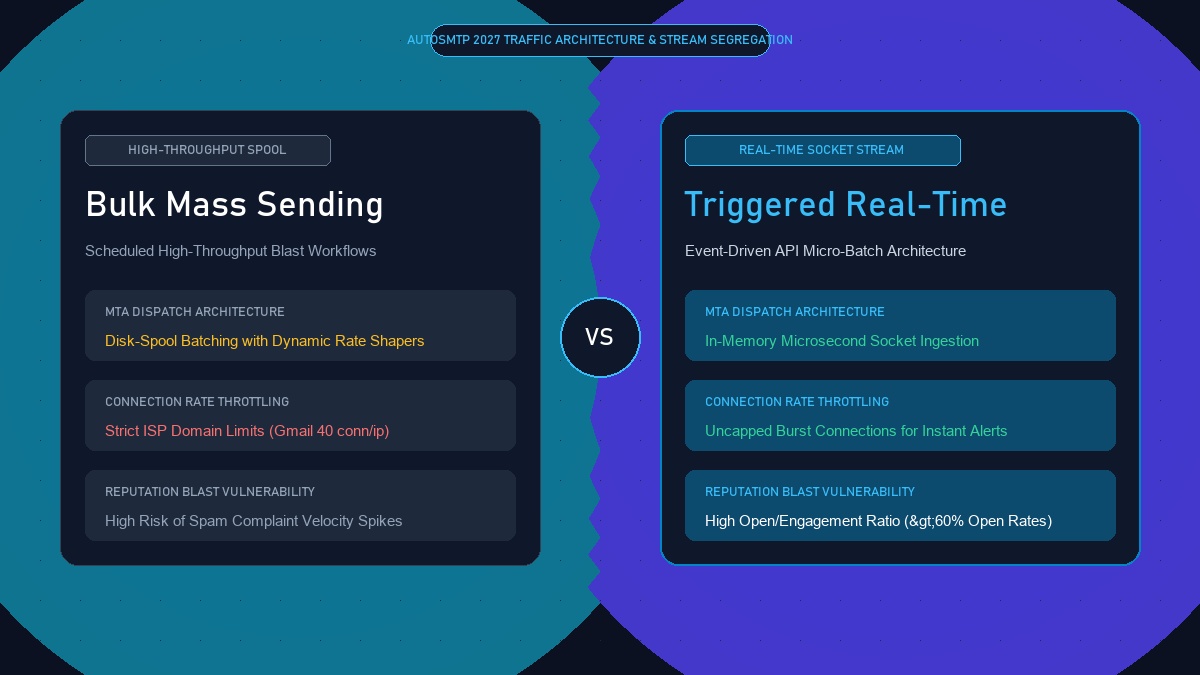
Bulk Email vs Triggered Email Infrastructure: 2027 Event-Driven Pipelines, Queue Segregation & Collision Avoidance
Bulk and triggered email streams represent two fundamentally conflicting engineering patterns. Bulk email infrastructure is pre-scheduled, batch-oriented, and throughput-optimised—designed to blast hundreds of thousands to millions of uniform messages across hours without exceeding receiving MX rate limits. Triggered email infrastructure is real-time, event-driven, and latency-optimised—reacting instantly to behavioral events (abandoned carts, onboarding milestones, telemetry alarms) within seconds while maintaining 3x to 5x higher recipient engagement.
In 2027, treating bulk and triggered email as a unified stream inevitably causes queue starvation, where millions of marketing messages delay critical behavioral triggers, and reputation bleed, where promotional spam complaints suppress high-intent behavioral delivery. This technical guide examines the modern 3-layer architecture (CDP ingestion, event-router orchestration, and dedicated MTA delivery), suppression collision algorithms, and production PowerMTA/KumoMTA queue topologies.
- 1. Fundamental Mechanics: Batch vs Reactive
- 2. Bulk Email Architecture & Throughput
- 3. Triggered Email Event Pipelines
- 4. The 3-Layer Pattern: CDP + Router + MTA
- 5. Behavioral Trigger Sources & Payloads
- 6. Collision Avoidance & Suppression Logic
- 7. Engagement Disparity & Deliverability
- 8. Production PowerMTA & KumoMTA Routing
- 9. 2027 Architectural Comparison Matrix
- 10. Enterprise Field Study: E-Commerce Scale
- 11. Infrastructure Decision Matrix
- 12. The AutoSMTP Dedicated Advantage
1. Fundamental Mechanics: Scheduled Broadcast vs Reactive Event Stream
The operational difference between bulk and triggered email is rooted in how jobs enter the sending queue and what constitutes SLA success:
- Bulk Email (Scheduled Batch): A campaign operator defines a target cohort (e.g., all 450,000 subscribers who opened in the last 60 days), composes marketing assets with static or merge-tag personalization, and schedules execution. The ingestion engine injects 450,000 jobs into the outbound queue simultaneously. Per-message latency is irrelevant: whether recipient #420,000 receives their message at 09:02 or 10:15 does not impact campaign efficacy. The primary optimization constraint is maximum safe aggregate throughput without triggering destination ISP deferrals.
- Triggered Email (Event-Driven Stream): A user action inside a web application, mobile app, or payment gateway fires a webhook event (e.g.,
checkout_abandoned,trial_expiring_48h,security_passkey_enrolled). The message is unique, highly dynamic, and time-critical. The P99 latency SLA from trigger event to recipient MX handshake must be under 30 seconds. If an abandoned cart nudge arrives 4 hours late due to queue congestion, purchase intent has collapsed and the message is discarded.
Bulk Email Constraints
- Spiky Queue Volume: Millions of jobs injected in seconds, followed by complete idle intervals.
- Lower Engagement: Average open rates of 18–25%; spam complaint rates hover near 0.05–0.10%.
- Strict Throttle Compliance: Must pace connections per receiving MX domain (e.g., Gmail 100 conns, Yahoo 40 conns).
- High Resource Contention: Memory and disk I/O bottlenecks when pre-rendering millions of mime envelopes.
Triggered Email Strengths
- Steady Diurnal Stream: Volume follows organic user traffic curves across timezones.
- Exceptional Engagement: Open rates of 45–65%; conversion rates exceeding 30% of clickers.
- Low Destination Friction: Receivers reward high engagement with instant inbox routing and zero throttling.
- Ultra-Low Latency SLA: Requires sub-second queue evaluation and dedicated, unblocked outbound sockets.
2. Bulk Email Architecture & Throughput Optimization
Enterprise bulk infrastructure is engineered around pipeline parallelization. In high-volume operations handling 20M+ monthly messages, message preparation cannot occur inside the core SMTP daemon without starving connection threads.
The 4-Stage Bulk Execution Pipeline
1. Segment Resolution & Sharding: The database compiles recipient lists into memory-mapped batches (shards of 10,000 to 50,000 records) to avoid table locks.
2. Template Compilation: High-performance templating engines (e.g., Liquid or Rust-based mini-jinja) render personalized merge tags and generate unique tracking hashes.
3. RFC 5322 Envelope Assembly & DKIM Signing: Headers, MIME multipart boundaries, and 2048-bit cryptographic DKIM signatures are generated asynchronously.
4. Queue Ingestion: The compiled messages are injected via local UNIX socket or HTTP batch API directly into the spool directory of high-throughput MTAs like PowerMTA or KumoMTA.
The primary architectural risk of bulk sending is receiver-side backpressure. If 1,000,000 emails hit Gmail or Outlook simultaneously, destination servers respond with 421 4.7.0 Try again later or 452 4.5.3 Too many recipients. The MTA must dynamically park delayed messages in deferred retry queues while keeping active worker threads open for non-deferred domains.
3. Triggered Email Event Pipelines & Low-Latency SLAs
Triggered email infrastructure completely inverts the batch paradigm. Instead of pulling records from a static database, the system sits behind a real-time message broker (Apache Kafka, RabbitMQ, or AWS SQS) consuming an asynchronous stream of behavioral telemetry.
Each incoming event triggers a deterministic micro-pipeline:
- Event Validation & Deduplication: Checks incoming event UUIDs against an in-memory Redis cache with an idempotency TTL (e.g., 60 minutes) to eliminate duplicate sends caused by client retries.
- State Evaluation: Checks whether downstream business conditions still hold true (e.g., has the user already checked out between cart abandonment and the scheduled 15-minute reminder?).
- Frequency & Quiet-Hours Gating: Evaluates recipient contact limits and suppresses non-critical triggers if the user resides in an active quiet-hours window (e.g., 22:00–08:00 recipient local time).
- Dynamic Rendering: Queries the product catalog or customer profile to inject live cart images, custom discount codes, and deep-link authorization tokens.
- Express Route Dispatch: Immediately hands off the MIME payload to an uncontended, high-priority MTA virtual queue.
4. The 3-Layer Pattern: CDP + Router + MTA
Monolithic email platforms (e.g., Mailchimp, basic legacy ESPs) attempt to bundle data collection, journey orchestration, and SMTP delivery into a single black-box application. At enterprise scale, this monolithic design creates insurmountable latency bottlenecks and deliverability risks. The industry standard in 2027 is the decoupled 3-Layer Architecture:
| Layer | Component Responsibility | Representative 2027 Tech Stack | Key Performance Metrics |
|---|---|---|---|
| Layer 1: Customer Data Platform (CDP) | Ingests telemetry from mobile SDKs, webhooks, and backend databases. Normalizes disparate customer identities into unified master profiles. | Segment, RudderStack, Snowplow, Snowflake/BigQuery streaming tables | Event ingestion throughput (>50k ops/sec), schema validation latency (<20ms) |
| Layer 2: Event-Router & Orchestration | Evaluates conditional trigger rules, manages multi-step branching journeys, applies cross-channel frequency capping, and resolves state. | Customer.io, Braze, Iterable, Klaviyo Flows, custom Temporal/Kafka workflows | Journey step evaluation latency (<100ms), deduplication accuracy (100%) |
| Layer 3: Delivery Engine (MTA Tier) | Manages physical SMTP socket pooling, RFC 5321 handshakes, DKIM-2048 signing, destination domain rate-limiting, and bounce parsing. | AutoSMTP Managed PowerMTA, KumoMTA Bare-Metal Clusters, Postfix Dedicated Relay | Queue transit time (<2s), connection reuse ratio (>85%), inbox placement (>99%) |
The Architectural Decoupling Benefit: If your marketing automation platform experiences an outage or UI lockup, your critical transactional and triggered pipelines running over dedicated MTAs remain 100% operational. Furthermore, marketing teams can adjust journey logic in Layer 2 without altering network configurations or SMTP connection pools in Layer 3.
5. Behavioral Trigger Sources & Payloads
Triggered sending spans diverse business functions. The table below outlines the primary behavioral triggers operating in 2027, their latency tolerances, and operational priorities:
| Trigger Category | Event Names | Max Latency SLA | Business Priority | Default Queue Class |
|---|---|---|---|---|
| Account Security | password_reset, 2fa_challenge, suspicious_login |
< 5 seconds | P0 (Mission Critical) | transactional-p0 |
| Billing & Revenue | invoice_created, payment_failed, subscription_renewed |
< 30 seconds | P1 (High) | transactional-p1 |
| Cart Abandonment | checkout_started, cart_abandoned_30m |
< 60 seconds | P2 (Revenue Trigger) | triggered-behavioral |
| Product Onboarding | feature_completed, team_member_invited, milestone_reached |
< 5 minutes | P2 (Engagement) | triggered-behavioral |
| Re-engagement & Churn | inactivity_14d, churn_risk_score_high |
< 1 hour | P3 (Standard) | triggered-nudge |
| Milestones & Anniversaries | birthday_today, annual_renewal_approaching |
< 2 hours | P3 (Standard) | triggered-nudge |
6. Collision Avoidance & Suppression Logic
When organizations operate bulk marketing and behavioral triggers simultaneously, message collision is the most common customer experience failure. Consider this disastrous sequence:
- At 09:30, a user abandons a $450 shopping cart containing high-margin winter apparel.
- At 09:45, the triggered pipeline sends an automated recovery email offering free express shipping.
- At 09:47, the scheduled marketing bulk blast delivers a 30% sitewide clearance newsletter to the entire master list.
- The customer reads the clearance blast, ignores the cart recovery email, or complains about receiving duplicate promotional pitches within two minutes.
Production Collision Avoidance Rules (Orchestration Engine Level)
Rule 1 — Journey Priority Exclusivity: Any user currently enrolled in an active high-intent triggered sequence (e.g., Cart Recovery, Onboarding Welcome Series) is dynamically excluded from all scheduled bulk campaigns.
Rule 2 — Rolling Frequency Capping: A global limit of no more than 1 marketing/triggered email per 24 hours per recipient, unless the message is an explicit security/billing transactional alert.
Rule 3 — Category Precedence: Real-time behavioral triggers always override bulk promotional sends. If an event trigger fires within 4 hours of a planned bulk blast, the bulk send is suppressed for that specific recipient hash.
Rule 4 — Local Quiet-Hours Enforcement: Marketing and behavioral triggers hold in a local buffer between 21:30 and 08:30 based on recipient geo-IP timezone, releasing at 08:35 the following morning.
7. Engagement Disparity & Deliverability Implications
The gap in recipient engagement between bulk and triggered email is massive. Because triggered emails arrive when the recipient is actively interacting with the brand, mailbox providers (Gmail, Microsoft, Yahoo) observe dramatically higher positive signals:
| Deliverability Metric | Bulk Marketing Campaigns | Triggered Behavioral Emails | ISP Reputation Impact |
|---|---|---|---|
| Average Open Rate | 18.4% – 24.8% | 48.6% – 68.2% | High positive engagement builds primary tab affinity |
| Click-Through Rate (CTR) | 1.2% – 2.6% | 6.8% – 14.5% | Receivers weight link clicks heavily in anti-spam filters |
| Purchase Conversion | 0.8% – 1.5% | 28.0% – 34.5% (of clickers) | Critical driver of email ROI and customer lifetime value |
| Spam Complaint Rate | 0.04% – 0.09% | < 0.01% (rarely marked) | Triggered emails almost never receive user spam flags |
| Unsubscribe Rate | 0.20% – 0.45% | 0.05% – 0.08% | Low list churn preserves domain reputation health |
The Deliverability Trap: If you send bulk promotional newsletters from the exact same dedicated IP pool or subdomain as your triggered behavioral emails, the lower engagement and higher spam complaints of the bulk blast will drag down the reputation of your high-converting triggered messages. Mailbox providers calculate reputation at the (DKIM d= domain, Outbound IP) pair level. Segregation is non-negotiable.
8. Production PowerMTA & KumoMTA Routing Configurations
Below are production configurations demonstrating how to configure segregated Virtual MTAs, dedicated IP pools, and priority queue handling in both PowerMTA and KumoMTA.
# ==============================================================================
# AutoSMTP PowerMTA Configuration: Segregated Bulk vs Triggered Queues
# ==============================================================================

# Virtual MTA: Triggered Behavioral Stream (High Priority, Clean IPs)
<virtual-mta vmta-triggered-pool>
    smtp-source-ip 162.251.122.170
    smtp-source-ip 162.251.122.171
    host-name notify.yourbrand.com
</virtual-mta>

# Virtual MTA: Scheduled Bulk Marketing Stream (Standard Priority)
<virtual-mta vmta-bulk-pool>
    smtp-source-ip 162.251.122.172
    smtp-source-ip 162.251.122.173
    host-name promo.yourbrand.com
</virtual-mta>

# Virtual MTA Pool Groupings
<virtual-mta-pool pool-triggered>
    virtual-mta vmta-triggered-pool
</virtual-mta-pool>

<virtual-mta-pool pool-bulk>
    virtual-mta vmta-bulk-pool
</virtual-mta-pool>

# Queue Priority & Throttling Rules
<domain *>
    # Default global pacing
    max-smtp-out 120
    max-msg-per-connection 100
    retry-after 10m
    bounce-after 24h
</domain>

# Prioritize Triggered Over Bulk on Delivery Threads
<queue-priority>
    # Triggered behavioral emails bypass bulk backlog
    priority 10 vmta-triggered-pool
    priority 1  vmta-bulk-pool
</queue-priority>

# Destination ISP Optimization: Gmail
<domain gmail.com>
    max-smtp-out 80
    max-msg-per-connection 50
    smtp-421-backoff-period 15m
</domain>-- ==============================================================================
-- AutoSMTP KumoMTA Event Policy: Dynamic Traffic Segregation & Spool Egress
-- ==============================================================================
local kumo = require 'kumo'
kumo.on('init', function()
-- Define Triggered Egress Pool (Ultra-fast, zero-backpressure)
kumo.define_spool {
name = 'triggered-spool',
path = '/var/spool/kumomta/triggered',
}
-- Define Bulk Marketing Egress Pool (Buffered, throttled)
kumo.define_spool {
name = 'bulk-spool',
path = '/var/spool/kumomta/bulk',
}
end)
kumo.on('get_queue_config', function(domain, tenant, campaign)
-- Inspect injection metadata header: X-AutoSMTP-Stream
if tenant == 'triggered' or campaign == 'behavioral' then
return kumo.make_queue_config {
egress_pool = 'triggered-ips',
max_connection_rate = '300/s',
max_deliveries_per_connection = 150,
consecutive_connection_failures_before_delay = 5,
protocol = {
smtp = {
-- 30-second handshake timeout for ultra-low latency
connect_timeout = '30s',
}
}
}
else
-- Bulk marketing fallback policy
return kumo.make_queue_config {
egress_pool = 'bulk-ips',
max_connection_rate = '80/s',
max_deliveries_per_connection = 50,
retry_interval = '15m',
}
end
end)9. 2027 Architectural Comparison Matrix
The matrix below summarizes the operational and technical differences between bulk and triggered email infrastructure:
| Architectural Dimension | Bulk Email Infrastructure | Triggered Email Infrastructure | AutoSMTP Recommended Architecture |
|---|---|---|---|
| Dispatch Trigger | Pre-scheduled manual batch or campaign calendar | Real-time user event or backend state machine change | Decoupled event queue with automated fallback |
| Delivery Latency SLA | 30 minutes to 4 hours (cohort delivery window) | < 15 to 30 seconds (real-time intent window) | Sub-second MTA ingestion with priority queueing |
| Queue Architecture | FIFO bulk spool with destination rate limits | Priority preemption queue with zero head-of-line blocking | Separate physical spool directories and worker threads |
| IP Allocation | Dedicated bulk IP warming pools (higher complaint tolerance) | Dedicated pristine IP pools (zero complaint tolerance) | Strict IP pool segregation by stream type |
| Subdomain Delegation | promo.yourbrand.com / news.yourbrand.com |
notify.yourbrand.com / updates.yourbrand.com |
Isolated DMARC alignment and DKIM selector keys |
| Personalization Source | CSV imports, static merge tags, pre-cached lists | Live CDP JSON payloads, real-time product catalog APIs | High-speed Redis cache + webhook ingest endpoint |
| Collision Risk | High (risks blasting users in mid-onboarding or cart recovery) | Low (frequency capped against bulk blast) | Global orchestration suppression rules enabled |
10. Enterprise Field Study: High-Growth E-Commerce Scale
Separating 12M Bulk and 1.8M Triggered Monthly Emails for Nordic Retailer
The Incident: A European e-commerce group was sending both weekly promotional newsletters (12M sends/month) and triggered cart abandonment/browse recovery emails (1.8M sends/month) through a single shared enterprise ESP pool. During Black Friday week, marketing scheduled a 4-million message promotional blast at 10:00 AM. Outbound queues backed up for 3.5 hours. Cart abandonment reminders triggered at 10:15 AM sat behind 2.8 million unrendered marketing emails. By the time cart recovery emails delivered at 01:45 PM, customers had already purchased from competitors or abandoned their sessions. Cart recovery conversion plummeted from 29% to 4.1%, resulting in an estimated €180,000 revenue loss in 48 hours.
The AutoSMTP Remediation: In Q1 2027, the retailer migrated to a dedicated dual-tier AutoSMTP cluster:
- Triggered Pipeline: Routed through a 2-node KumoMTA bare-metal cluster with 2 dedicated clean IPs, bound to
cart.brand.comwith a strict P99 latency SLA of <15 seconds. - Bulk Pipeline: Managed via MailWizz frontend connected to an 8-IP PowerMTA cluster on
deals.brand.com, utilizing automated destination ISP rate-limiting. - Suppression Synchronization: An automated Redis suppression sync checked cart recovery state before releasing daily promotional cohorts.
The Results: Triggered P99 latency dropped from 3 hours 12 minutes to 4.2 seconds. Cart recovery conversion rebounded to 33.8%, and marketing bulk delivery was completed smoothly without impacting transactional delivery. Total monthly infrastructure costs decreased by 58% compared to their legacy cloud ESP tier.
11. Infrastructure Decision Matrix: When to Split Your Architecture
Stage 1: Unified Single-Platform Architecture (< 50,000 sends/month)
If your total monthly volume is under 50,000 emails and your triggered program consists solely of basic welcome notes and occasional password resets, a unified platform (such as Klaviyo for Shopify or ActiveCampaign for B2B) is operationally acceptable. The engineering overhead of maintaining two separate MTA pipelines is not justified.
Stage 2: Hybrid Decoupled Pipelines (50,000 to 1,000,000 sends/month)
Once monthly volume exceeds 50,000 messages and behavioral triggers generate direct revenue (cart recovery, onboarding trials, churn prevention), you must segregate your sending IPs and subdomains. Deploy a dedicated transactional/triggered relay (such as AutoSMTP High-Priority SMTP) for real-time traffic, while keeping bulk campaigns on marketing platforms.
Stage 3: Full 3-Layer Dedicated Bare-Metal Topology (> 1,000,000 sends/month)
At enterprise scale (1M+ to 100M+ sends/month), full architectural decoupling is mandatory. Implement a dedicated Customer Data Platform (Segment/RudderStack), an event orchestration layer (Customer.io/Iterable), and private bare-metal MTAs (PowerMTA or KumoMTA) deployed across dedicated IPv4 subnets. This guarantees zero queue cross-talk, deterministic sub-second latency, and immune deliverability reputation.
The 4-Step Migration Roadmap to Segregated Infrastructure
- Subdomain & Authentication Split: Delegate distinct subdomains (e.g.,
notify.yourdomain.comfor triggered,news.yourdomain.comfor bulk). Configure individual 2048-bit DKIM keys and separate SPF includes. - Dedicated IP Allocation: Assign separate IPv4 addresses to each stream. Never allow bulk marketing blasts to originate from your triggered IP pool.
- Orchestration Frequency Gating: Implement collision suppression rules in your event router so recipients never receive conflicting marketing blasts while in high-intent triggered journeys.
- MTA Queue Prioritization: Configure strict Virtual MTA priority weighting to guarantee that real-time behavioral webhooks immediately preempt batch queues.
The AutoSMTP Dedicated Segregation Engine
Eliminate queue starvation and protect your critical revenue triggers with AutoSMTP’s fully managed, dedicated bare-metal email infrastructure.
Provisions fully licensed PowerMTA and KumoMTA clusters on enterprise bare-metal with dedicated hardware and flat, predictable pricing.
Monitors Google Postmaster spam ratios (<0.1%) and real-time deferrals across clean IPv4 subnets for safe, automated ramp-up.
RFC 5321 in-band 550 bounce suppression and automated Yahoo/Outlook CFL ingest keep your reputation completely pristine.
Pre-configured rDNS/PTR, SPF, 2048-bit DKIM, strict DMARC, and BIMI integration ready for immediate high-volume sending.
Ready for Dedicated, Segregated Email Infrastructure?
Deploy enterprise PowerMTA and KumoMTA clusters engineered for deterministic sub-second delivery and unshakeable sender reputation.
Deploy Your Dedicated Cluster →