

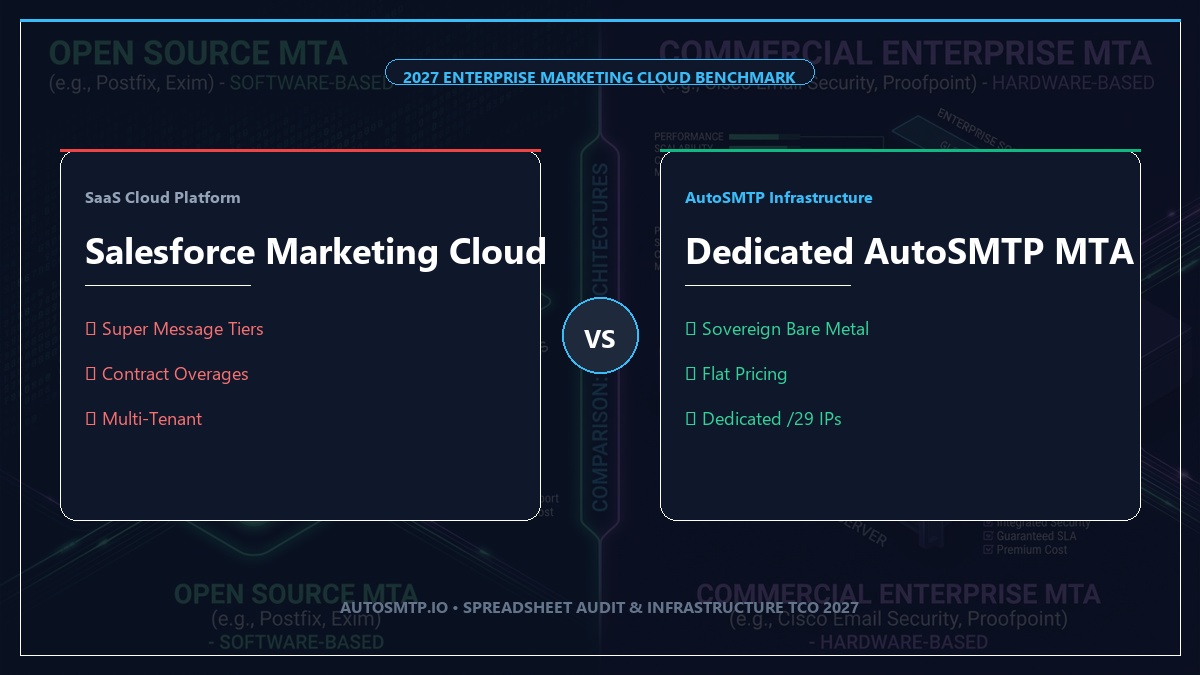
Salesforce Marketing Cloud vs Dedicated AutoSMTP: 2027 Enterprise TCO, Super Message Audits & Sovereign MTAs
Published by Fred Dawson • Senior Deliverability Systems Architect • 22 min read
Salesforce Marketing Cloud (SFMC / ExactTarget) powers digital communication for Global 2000 enterprises. However, SFMC’s commercial packaging—anchored to convoluted “Super Message” consumption units, multi-tenant IP pools, steep annual licensing contracts ($150,000–$500,000+), and opaque deliverability routing—forces high-volume senders into relentless financial escalation. When sending transactional statements, marketing lifecycle journeys, and customer service alerts exceeding 10M to 100M+ messages monthly, enterprises face a decisive fork: remain locked in Salesforce’s metered cloud ecosystem or decouple outbound transport by routing messages through Dedicated AutoSMTP bare-metal MTA clusters. This guide provides an architectural audit of Super Message unit economics, SAP (Sender Authentication Package) limitations, dedicated IP warm-up isolation, and how forward-thinking engineering teams preserve Salesforce CRM logic while offloading high-volume SMTP delivery to dedicated infrastructure.
- 1. The Super Message Tax: Auditing SFMC Unit Economics at Scale
- 2. Sender Authentication Package (SAP), IP Pools & Reputation Contamination
- 3. Transactional REST/SOAP API Latency & Spooling Bottlenecks
- 4. The Decoupled Architecture: Journey Builder Logic + Dedicated MTA Execution
- 5. Salesforce Marketing Cloud vs Dedicated AutoSMTP Technical Matrix
- 6. The AutoSMTP Deliverability Defense Advantage
1. The Super Message Tax: Auditing SFMC Unit Economics at Scale
The foundational driver of escalating costs inside Salesforce Marketing Cloud is the Super Message consumption model. Rather than billing for raw compute or unmetered server throughput, Salesforce sells pre-purchased bundles of Super Message credits:
- Credit Burn Rates: Depending on the destination channel, message complexity, and contractual tier, sending a basic transactional email consumes 1 Super Message, whereas dynamic content with AMPscript or multi-language personalization frequently burns 1.5 to 2 credits per send.
- Steep Overage Penalties: If an enterprise exceeds its pre-purchased annual Super Message quota during a high-velocity fourth-quarter campaign, contract overages are billed at punitive rates—often 2x to 3x higher than the baseline contract price.
- The Dedicated Infrastructure Alternative: AutoSMTP provisions sovereign bare-metal servers equipped with enterprise PowerMTA or KumoMTA daemons. Because you own the underlying compute, sending 10 million or 100 million emails incurs zero per-message surcharges. The effective delivery cost drops from $0.80–$1.50 CPM on SFMC to under $0.04 CPM on dedicated bare metal.
Salesforce Super Message Lock-In
Annual pre-commitments, rigid expiration of unused credits, complex tiering, and $0.0008-$0.0015 per email cost. A 30M/month sender routinely pays upwards of $280,000 annually just for outbound email credits alone.
AutoSMTP Flat-Rate Bare Metal
Predictable, flat monthly pricing regardless of email volume. A 30M/month sender runs on a dedicated 4-node cluster with dedicated /29 IP subnets for under $3,500/month ($42,000/yr), achieving 85% direct infrastructure savings.
2. Sender Authentication Package (SAP), IP Pools & Reputation Contamination
In Salesforce Marketing Cloud, configuring custom domain branding requires purchasing a Sender Authentication Package (SAP). While SAP provides dedicated private labeling, IP pool management presents critical architectural constraints:
Standard SFMC Shared IP Pools: Lower-tier SFMC accounts share IP pools with hundreds of other enterprise tenants. If an unrelated tenant blasts unverified cold lists or suffers an account takeover resulting in a Spamhaus SBL or Gmail reputation downgrade, every tenant sharing that IP pool experiences immediate deferrals, throttling, and junk folder placement.
Dedicated IP Limitations on SFMC: When dedicated IPs are purchased on SFMC, warm-up is managed through rigid manual schedules. If an operator encounters sudden 421 Too Many Connections deferrals at Microsoft 365 or Yahoo, SFMC’s internal routing engines offer limited knobs for fine-grained per-domain connection limits, queue backoff schedules, or automated gas-pedal IP ramping.
AutoSMTP Deliverability Sovereignty: AutoSMTP assigns dedicated, clean /29 or /28 IPv4 subnets strictly isolated to your organization. Every IP has matching Forward-Confirmed Reverse DNS (FCrDNS), 2048-bit DKIM keys, strict DMARC enforcement, and automated IP health monitoring that detects real-time deferrals and adjusts outbound connection parameters instantly.
3. Transactional REST/SOAP API Latency & Spooling Bottlenecks
For modern fintech, e-commerce, and SaaS platforms, latency for password resets, two-factor authentication (2FA) OTP codes, and fraud alerts is mission-critical:
SFMC Transactional API Latency vs Native SMTP Spool
Salesforce Marketing Cloud’s Transactional Messaging REST API requires multiple roundtrips: OAuth token authentication, payload validation against Marketing Cloud Data Extensions, AMPscript rendering, and internal queuing before handoff to the outbound MTA layer. Under peak load, transactional email latency can reach 15 to 45 seconds.
With AutoSMTP, transactional messages are injected via local high-speed SMTP sockets (TCP port 587/25) or lightning-fast REST webhooks directly into PowerMTA’s in-memory spool. Message serialization takes under 4 milliseconds, and delivery to recipient MX servers occurs in sub-500 milliseconds worldwide.
4. The Decoupled Architecture: Journey Builder Logic + Dedicated MTA Execution
Enterprises do not have to abandon Salesforce’s sophisticated Journey Builder, audience segmentation, or customer 360 CRM intelligence to escape Super Message taxation. Leading enterprise architectures employ a Decoupled Hybrid Model:
# 1. Salesforce Marketing Cloud Journey Builder triggers Custom Activity Webhook
POST https://api.autosmtp.io/v1/dispatch
Authorization: Bearer sec_live_enterprise_token_xyz
Content-Type: application/json

{
  "stream": "transactional-high-priority",
  "recipient": "customer@enterprise.com",
  "template_id": "fraud-alert-v3",
  "data": {
    "account_number": "XXXX-8921",
    "transaction_amount": "$450.00",
    "location": "London, UK"
  },
  "routing": {
    "ip_pool": "banking-otp-pool",
    "require_tls": "1.3",
    "max_queue_wait_ms": 2000
  }
}

# 2. AutoSMTP Bare-Metal MTA immediately routes across sovereign dedicated IPs
# Result: 0 Super Message consumption; 180ms recipient inbox delivery!
5. Salesforce Marketing Cloud vs Dedicated AutoSMTP Technical Matrix
| Architectural Pillar | Salesforce Marketing Cloud (SFMC) | Dedicated AutoSMTP Infrastructure | Enterprise Business Impact |
|---|---|---|---|
| Pricing & Metering | Pre-purchased Super Message credits + overages | Flat monthly fee; unmetered outbound email | AutoSMTP reduces annual delivery costs by 70% to 85% |
| Hardware & Compute | Multi-tenant proprietary cloud stack | Dedicated bare-metal servers (AMD EPYC, NVMe) | Zero noisy neighbor contention or queue starvation |
| IP Reputation Control | Manual warming; complex SAP add-on packaging | Dedicated /29 IPv4 subnets + Automated Gas-Pedal | Total domain and IP isolation with granular reputation tuning |
| Transactional Latency | 15s – 45s under peak queue congestion | Sub-second (180ms – 500ms global delivery) | Instant OTP, 2FA, and critical security alert dispatch |
| Bounce & FBL Handling | Batched asynchronous DSN reports in Data Extensions | Real-time in-band RFC 5321 550 socket suppression | Prevents spam trap hits and instant ISP reputation drops |
| Contract Flexibility | Multi-year enterprise lock-in with minimum spends | Month-to-month or annual with zero lock-in | Ultimate financial flexibility and infrastructure ownership |
Slashing $340,000 in Annual Super Message Overages
A Tier-1 online banking platform delivering 45 million monthly transaction receipts, fraud notifications, and monthly statements was spending over $380,000 annually in Salesforce Super Message overages. By adopting the decoupled hybrid architecture—keeping customer segmentation in Salesforce but dispatching outbound messages via an AutoSMTP 4-node dedicated bare-metal PowerMTA cluster—the bank reduced annual email delivery expenditures to a flat $36,000/yr. Average delivery latency dropped from 24 seconds to 380 milliseconds, and zero transactional messages were delayed during peak cyber-shopping spikes.
The AutoSMTP Deliverability Defense Advantage
Inbound and outbound filtering pipelines require robust underlying transport hardware. AutoSMTP provisions sovereign, dedicated bare-metal MTA infrastructure engineered for high-throughput filtering, synchronous 550 bounce suppression, and permanent reputation control.
Provisions fully licensed PowerMTA and KumoMTA clusters on enterprise bare-metal with dedicated IPv4 subnets and predictable flat pricing.
Monitors Google Postmaster spam ratios (<0.1%) and real-time ISP deferrals with algorithmic volume scaling across your entire IP pool.
RFC 5321 in-band 550 bounce suppression, automated Yahoo/Outlook Complaint Feedback Loops (CFL), and instant bad-IP eviction.
Pre-configured forward and reverse DNS (PTR) per IP, SPF CIDR alignment, 2048-bit DKIM rotation, and strict DMARC enforcement.
Upgrade Your Email Infrastructure with Dedicated Bare Metal
Eliminate filter lag, queue serialization bottlenecks, and noisy neighbor contamination. Deploy a turnkey AutoSMTP cluster today.
Deploy Turnkey MTA Cluster →