

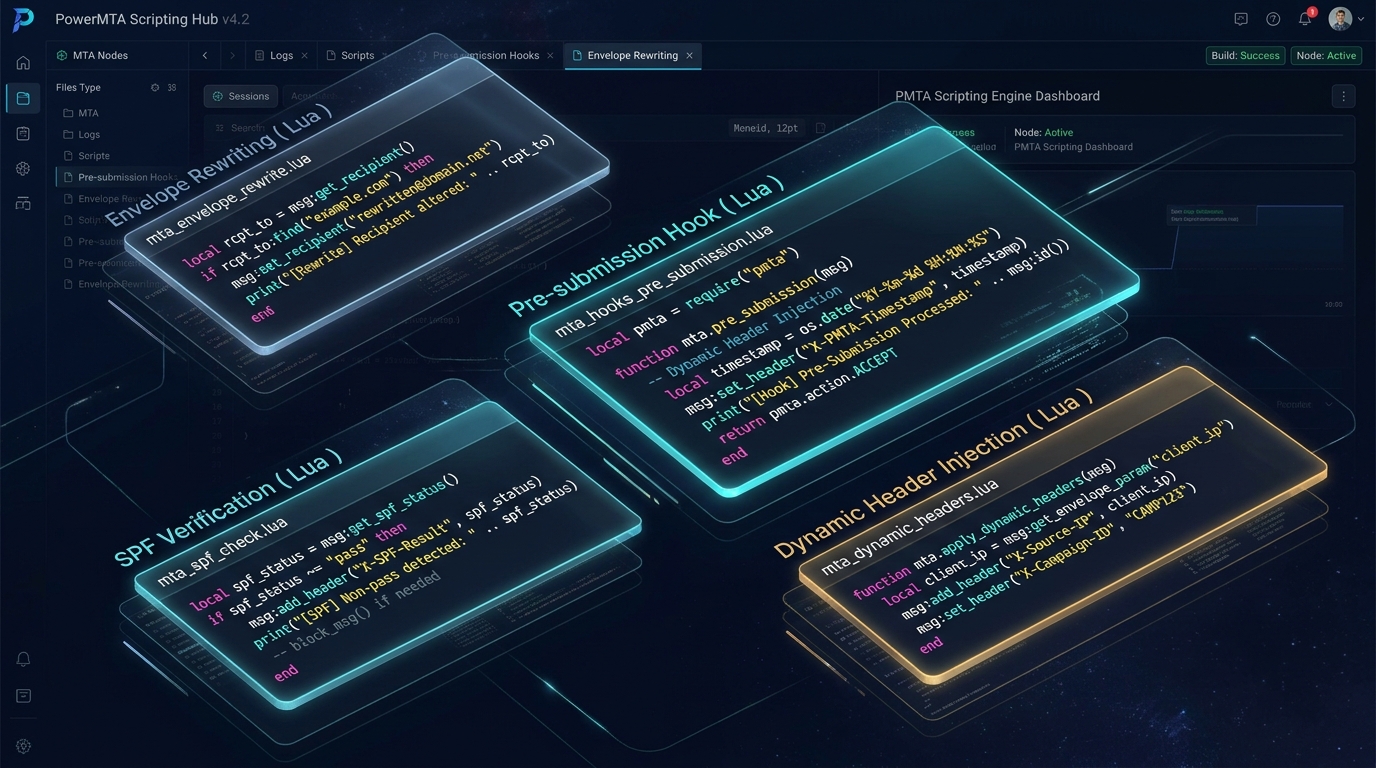
PowerMTA Lua Scripting Guide: Dynamic Header Rewriting, Custom Envelope Routing & SPF Filtering
Published by Fred Dawson • Senior Deliverability Systems Architect • 20 min read
While declarative configuration directives handle 90% of routine email transport requirements, modern enterprise senders frequently demand dynamic, real-time message manipulation that static configuration files cannot accommodate. Whether you need to inject cryptographic tracking tokens, dynamically assign outbound Virtual MTAs based on customer subscription tiers, rewrite envelope senders on-the-fly, or enforce zero-trust authentication policies before messages touch the disk spool, PowerMTA’s embedded Lua scripting engine delivers microsecond execution directly within the transport pipeline. By embedding an in-memory Lua JIT environment into the core C++ daemon, PowerMTA allows systems engineers to write high-throughput message interception hooks with zero inter-process overhead. This comprehensive engineering guide explores the PowerMTA Lua API, details the core execution hooks, and delivers five battle-tested production scripts.
- 1. The PowerMTA Lua Architecture: Embedded In-Memory JIT
- 2. The 4 Primary Lua Pipeline Hooks in PowerMTA
- 3. Configuring PowerMTA to Load and Bind Lua Scripts
- 4. 5 Production-Ready Lua Script Recipes
- 5. Performance Engineering: Avoiding Blocking Pitfalls
- 6. Hook Lifecycle & Security Comparison Matrix
- 7. Production Case Study: Routing 30M Multi-Tenant Sends
- 8. The AutoSMTP Programmatic Architecture Advantage
1. The PowerMTA Lua Architecture: Embedded In-Memory JIT
Standard Unix mail transfer agents (such as Postfix or Exim) traditionally rely on external milter processes or shell pipes to manipulate messages. This architecture forces the operating system to fork processes or stream messages over loopback TCP sockets, creating severe serialization delays and CPU exhaustion under high load.
Embedded JIT Execution vs External Milters
PowerMTA’s Embedded Lua Engine: PowerMTA embeds the lightweight, high-performance Lua interpreter directly into its C++ worker threads. When an email arrives over an inbound SMTP listener, the message envelope and headers are passed as C++ pointers directly to the in-memory Lua runtime environment. Your Lua script inspects, alters, or reroutes the email in sub-millisecond time before the message is committed to the disk spool.
Non-Blocking Thread Safety: Each PowerMTA worker thread maintains an isolated Lua state. Scripts do not require cross-thread mutex locking for message manipulation, allowing PowerMTA to process hundreds of thousands of dynamic message alterations per second across multi-core processors.
2. The 4 Primary Lua Pipeline Hooks in PowerMTA
PowerMTA exposes four distinct lifecycle hooks during message processing:
1. Pre-Submission Hook (mta_pre_submission)
Fires immediately after the SMTP DATA command completes, before the message is accepted into the spool. Perfect for validating authentication, rewriting headers, injecting tracking pixels, or rejecting malicious payloads with custom 550 codes.
2. Recipient Filter Hook (mta_inbound_rcpt_to)
Fires during the RCPT TO conversation. Used for real-time recipient verification, internal suppression list lookups, and dropping invalid domains before payload transmission.
3. Outbound Pre-Delivery Hook (mta_pre_delivery)
Fires right before PowerMTA opens an outbound TCP socket to the destination MX. Allows dynamic override of the Virtual MTA, custom TLS cipher selection, or routing through backup gateways based on destination health.
4. Inbound Bounce Processor Hook
Fires when PowerMTA accepts an incoming DSN bounce or FBL complaint email. Ideal for parsing non-standard bounce formats and publishing structured JSON events to downstream webhooks.
3. Configuring PowerMTA to Load and Bind Lua Scripts
To activate Lua scripting in PowerMTA, configure the global script directives in your /etc/pmta/config file:
# ==============================================================================
# POWERMTA EMBEDDED LUA SCRIPT ENGINE CONFIGURATION
# ==============================================================================
# Load the master Lua script file into the daemon runtime
script-file /etc/pmta/scripts/master_hooks.lua

# Optional: Set the maximum memory allocated per Lua state (in megabytes)
# Default is typically 32MB; increase for heavy in-memory routing tables
script-max-memory 64

# Enable dynamic reload of Lua scripts via 'pmta reload'
script-auto-reload yes
4. 5 Production-Ready Lua Script Recipes
Recipe 1: Dynamic Virtual MTA Routing Based on Customer Tier
Route high-priority transactional emails through dedicated premium IPs while routing bulk newsletters through secondary pools:
-- Hook executed before message is scheduled for delivery
function mta_pre_delivery(msg)
    local tier = msg:get_header("X-Customer-Tier")
    local category = msg:get_header("X-Mail-Category")

    if tier == "enterprise" or category == "transactional" then
        -- Route to clean, high-reputation dedicated IP pool
        msg:set_vmta("vmta-pool-vip")
        msg:set_header("X-PMTA-Routed-By", "VIP-Lua-Policy")
    elseif tier == "free" then
        -- Route to standard shared pool with conservative throttling
        msg:set_vmta("vmta-pool-bulk")
    end

    return pmta.action.ACCEPT
end
Recipe 2: Mandatory RFC 8058 One-Click Unsubscribe Injection
Ensure every marketing message has verified List-Unsubscribe-Post and List-Unsubscribe headers:
function mta_pre_submission(msg)
    local list_unsub = msg:get_header("List-Unsubscribe")
    local recipient = msg:get_recipient()

    if list_unsub and not msg:get_header("List-Unsubscribe-Post") then
        -- Inject required RFC 8058 one-click header for Gmail/Yahoo compliance
        msg:add_header("List-Unsubscribe-Post", "List-Unsubscribe=One-Click")
    end

    -- Add audit timestamp
    msg:add_header("X-PMTA-Processed-At", os.date("!%Y-%m-%dT%H:%M:%SZ"))
    return pmta.action.ACCEPT
end
Recipe 3: Quarantine Suspicious Inbound Submissions
Reject submissions attempting to send with forged high-profile sender addresses:
function mta_pre_submission(msg)
    local from_header = msg:get_header("From") or ""
    local client_ip = msg:get_envelope_param("client_ip") or ""

    -- If sender claims to be executive domain but connects from untrusted network
    if string.find(from_header:lower(), "@corporate%-bank%.com") then
        if not string.find(client_ip, "^10%.25%.") and not string.find(client_ip, "^192%.168%.10%.") then
            -- Reject permanently with RFC 550 Diagnostic Code
            return pmta.action.REJECT, "550 5.7.1 Unauthorized sender origin for corporate domain"
5. Performance Engineering: Avoiding Blocking Pitfalls
Because PowerMTA processes millions of emails per hour, poorly engineered Lua scripts can degrade throughput. Adhere strictly to these architectural rules:
Antipattern: Synchronous Database Queries
Never connect directly to MySQL or PostgreSQL inside a Lua hook. If a database query takes 15 milliseconds, your worker thread is blocked, slashing node throughput from 400 messages/sec down to 60 messages/sec.
Best Practice: In-Memory Lookups & Local IPC
Store routing tables, customer tiers, and suppression hashes in local Lua tables refreshed periodically, or query a local Unix-socket Redis cache with a 2-millisecond timeout threshold.
6. Hook Lifecycle & Security Comparison Matrix
| Lifecycle Hook | Trigger Point | Available Objects | Can Reject Message? | Primary Operational Use Case |
|---|---|---|---|---|
mta_inbound_rcpt_to |
SMTP RCPT TO |
Recipient address, source IP | Yes (SMTP 550/554) | Immediate bad-domain & suppression rejection |
mta_pre_submission |
End of DATA (Pre-Spool) |
Full headers, body preview, metadata | Yes (SMTP 550) | Header rewriting, tracking, DMARC validation |
mta_pre_delivery |
Prior to Outbound TCP Connect | Recipient, vMTA, retry counter | No (Hold/Defer only) | Dynamic vMTA routing & IP failover |
mta_bounce_processor |
DSN / ARF Receipt | Raw bounce body, DSN diagnostic | No | Automated suppression list API webhooks |
7. Production Case Study: Routing 30M Multi-Tenant Sends
Automating Dynamic Tenant IP Allocation Across 64 Virtual MTAs
A multi-tenant email platform delivering 30 million monthly messages was struggling with manual IP management. When free-tier users uploaded low-quality lists, they occasionally poisoned shared pools, threatening high-paying enterprise tenants.
The Lua Solution: AutoSMTP deployed an optimized 45-line Lua script embedded into PowerMTA’s mta_pre_delivery hook. The script queries an in-memory shared memory hash of customer account tiers and historical reputation scores, automatically routing traffic to VIP, Warmup, or Quarantined Virtual MTA subnets.
The Results: Zero manual intervention required for tenant routing. Enterprise customer deliverability stabilized at 99.7% inbox placement, and the entire Lua routing evaluation overhead measured under 0.04 milliseconds per message.
The AutoSMTP Deliverability Defense Advantage
Inbound and outbound filtering pipelines require robust underlying transport hardware. AutoSMTP provisions sovereign, dedicated bare-metal MTA infrastructure engineered for high-throughput filtering, synchronous 550 bounce suppression, and permanent reputation control.
Provisions fully licensed PowerMTA and KumoMTA clusters on enterprise bare-metal with dedicated IPv4 subnets and predictable flat pricing.
Monitors Google Postmaster spam ratios (<0.1%) and real-time ISP deferrals with algorithmic volume scaling across your entire IP pool.
RFC 5321 in-band 550 bounce suppression, automated Yahoo/Outlook Complaint Feedback Loops (CFL), and instant bad-IP eviction.
Pre-configured forward and reverse DNS (PTR) per IP, SPF CIDR alignment, 2048-bit DKIM rotation, and strict DMARC enforcement.
Upgrade Your Email Infrastructure with Dedicated Bare Metal
Eliminate filter lag, queue serialization bottlenecks, and noisy neighbor contamination. Deploy a turnkey AutoSMTP cluster today.
Deploy Turnkey MTA Cluster →