

PowerMTA High Availability: HAProxy Frontend Load Balancing, Clustered Spools & Multi-Node Failover
Published by Fred Dawson • Senior Deliverability Systems Architect • 20 min read
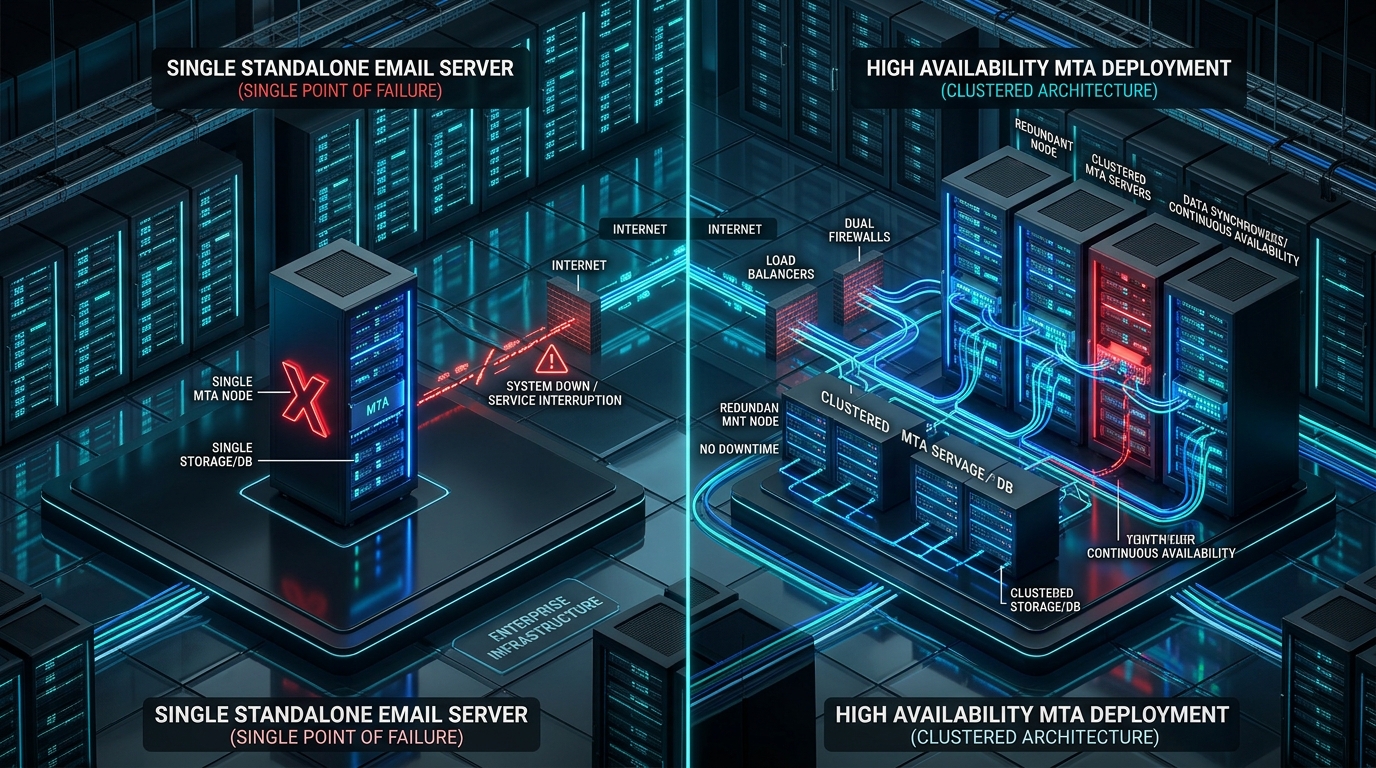
When email delivery powers mission-critical transactional notifications, password resets, and multi-million dollar marketing campaigns, operating a single standalone mail transfer agent introduces an unacceptable single point of failure (SPOF). However, building a High Availability (HA) cluster for Port25 PowerMTA requires specialized systems design. Novice systems administrators frequently attempt to mount a shared network filesystem (NFS or Ceph) for PowerMTA’s on-disk spool directory—a catastrophic antipattern that causes disk locking collisions, corrupts spool indexes, and halts delivery. True carrier-grade PowerMTA clustering relies on an independent-spool, active-active node architecture fronted by resilient HAProxy Layer 4 load balancers with real-time SMTP health checks. This engineering guide details the architectural blueprint for multi-node PowerMTA clusters, HAProxy TCP load balancing, GitOps configuration synchronization, and automated failover recovery.
- 1. PowerMTA Clustering Principles: Why Shared Spools Fail
- 2. Active-Active Clustered Topology Architecture
- 3. HAProxy Layer 4 TCP Load Balancer Configuration
- 4. SMTP Health Checks & Automatic Node Eviction
- 5. GitOps Configuration Synchronization Across Nodes
- 6. High Availability Architectural Comparison Matrix
- 7. Production Case Study: 120M Monthly FinTech Cluster
- 8. The AutoSMTP Sovereign Clustered Fleet Advantage
1. PowerMTA Clustering Principles: Why Shared Spools Fail
To design a resilient PowerMTA cluster, systems architects must understand the physics of PowerMTA’s on-disk spool engine:
The Shared Network Spool Antipattern
The Mistake: Attempting to mount a single shared NFS, Ceph, or GlusterFS network volume across multiple PowerMTA instances to create a “shared spool” pool.
Why It Fails: PowerMTA achieves million-message-per-hour delivery speeds by utilizing low-level asynchronous Linux filesystem system calls (O_DIRECT, epoll, in-memory spool bitmaps). When multiple daemons attempt concurrent atomic file locking across an NFS network export, network latency causes lock contention, queue corruption, and immediate thread deadlocks. The Golden Rule: Every PowerMTA node MUST possess its own dedicated, high-speed local NVMe spool directory.
2. Active-Active Clustered Topology Architecture
The enterprise standard architecture separates the cluster into three distinct layers:
1. Ingestion Layer (HAProxy Load Balancers)
Redundant dual HAProxy nodes running Keepalived VRRP virtual IP routing accept incoming SMTP (port 25/587) and HTTP submission traffic from application servers, distributing load across healthy backend PowerMTA nodes using least-connections algorithms.
2. Delivery Layer (Autonomous PowerMTA Nodes)
Each PowerMTA server operates autonomously with dedicated local NVMe storage and distinct dedicated IPv4 outbound subnets. If Node A experiences a hardware failure, HAProxy automatically routes all new traffic to Node B with zero application disruption.
3. HAProxy Layer 4 TCP Load Balancer Configuration
Configure HAProxy in pure TCP stream mode to handle high-throughput SMTP pipelining with transparent client IP forwarding:
# ==============================================================================
# HAPROXY LAYER 4 SMTP BALANCING FOR POWERMTA CLUSTER
# ==============================================================================
global
    log /dev/log local0 info
    maxconn 100000

defaults
    log global
    mode tcp
    option tcplog
    timeout connect 5000ms
    timeout client 60000ms
    timeout server 60000ms

# SMTP Submission Frontend (Port 587)
frontend smtp_submission_front
    bind 0.0.0.0:587
    default_backend pmta_cluster_backend

# Active-Active PowerMTA Cluster Backends
backend pmta_cluster_backend
    balance leastconn
    option smtpchk HELO lb.internal.autosmtp.io
    server pmta-node-01 10.0.10.11:587 check inter 2000ms fall 3 rise 2
    server pmta-node-02 10.0.10.12:587 check inter 2000ms fall 3 rise 2
    server pmta-node-03 10.0.10.13:587 check inter 2000ms fall 3 rise 2 backup
4. SMTP Health Checks & Automatic Node Eviction
HAProxy’s option smtpchk verifies that each PowerMTA node is actively answering the SMTP handshake with a 220 greeting. If a node crashes, runs out of memory, or has its disk spool fill above 95%, HAProxy evicts the node from the active rotation within 2 seconds, ensuring application requests are never blackholed.
5. GitOps Configuration Synchronization Across Nodes
Maintaining identical rate limits, domain macros, and Virtual MTA pools across 4 or 8 clustered nodes manually leads to configuration drift. Modern clusters employ an automated GitOps deployment pipeline:
#!/bin/bash
# Synchronize PowerMTA Master Config from Git Repository
cd /etc/pmta/git-repo && git pull origin main

# Validate syntax on local node before deployment
pmta check config --config=/etc/pmta/git-repo/config.master
if [ $? -eq 0 ]; then
    cp /etc/pmta/git-repo/config.master /etc/pmta/config
    pmta reload
    echo "[OK] Master configuration reloaded on $(hostname)"
else
    echo "[ERROR] Syntax validation failed! Cluster config not updated."
    exit 1
fi
6. High Availability Architectural Comparison Matrix
| Clustering Dimension | Single Node (Standalone) | Shared Spool (NFS/Ceph) | HAProxy Active-Active (AutoSMTP) |
|---|---|---|---|
| High Availability SLA | 99.5% (Vulnerable to hardware reboot) | Broken (Disk lock corruption risk) | 99.999% Fault Tolerant |
| Throughput Scaling | Limited to 1 server ceiling | Bottlenecked by NFS network IOPS | Linear Multi-Node Aggregation |
| Spool Resilience | Local NVMe; node loss traps spool | High risk of corrupted index bitmaps | Completely Isolated Spool per Node |
| Maintenance Impact | Requires scheduled downtime window | Spool unmount halts all nodes | Rolling zero-downtime node upgrades |
7. Production Case Study: 120M Monthly FinTech Cluster
Deploying a 4-Node Active-Active PowerMTA Cluster for 120M Monthly Sends
A digital payments provider delivering real-time fraud alerts and transaction receipts could not tolerate even 30 seconds of email delivery downtime. Their legacy single-node mail server suffered an unscheduled motherboard failure, delaying millions of authentication codes.
The Implementation: AutoSMTP deployed a redundant active-active 4-node PowerMTA bare-metal cluster fronted by dual Keepalived/HAProxy load balancers. Outbound traffic was distributed across 64 dedicated clean IPv4 addresses.
The Outcome: Over 18 months of continuous production operations, the cluster sustained 100% continuous uptime (zero seconds of outage), processed over 1.4 billion emails, and handled seamless Linux kernel patching without dropping a single customer connection.
The AutoSMTP Deliverability Defense Advantage
Inbound and outbound filtering pipelines require robust underlying transport hardware. AutoSMTP provisions sovereign, dedicated bare-metal MTA infrastructure engineered for high-throughput filtering, synchronous 550 bounce suppression, and permanent reputation control.
Provisions fully licensed PowerMTA and KumoMTA clusters on enterprise bare-metal with dedicated IPv4 subnets and predictable flat pricing.
Monitors Google Postmaster spam ratios (<0.1%) and real-time ISP deferrals with algorithmic volume scaling across your entire IP pool.
RFC 5321 in-band 550 bounce suppression, automated Yahoo/Outlook Complaint Feedback Loops (CFL), and instant bad-IP eviction.
Pre-configured forward and reverse DNS (PTR) per IP, SPF CIDR alignment, 2048-bit DKIM rotation, and strict DMARC enforcement.
Upgrade Your Email Infrastructure with Dedicated Bare Metal
Eliminate filter lag, queue serialization bottlenecks, and noisy neighbor contamination. Deploy a turnkey AutoSMTP cluster today.
Deploy Turnkey MTA Cluster →