

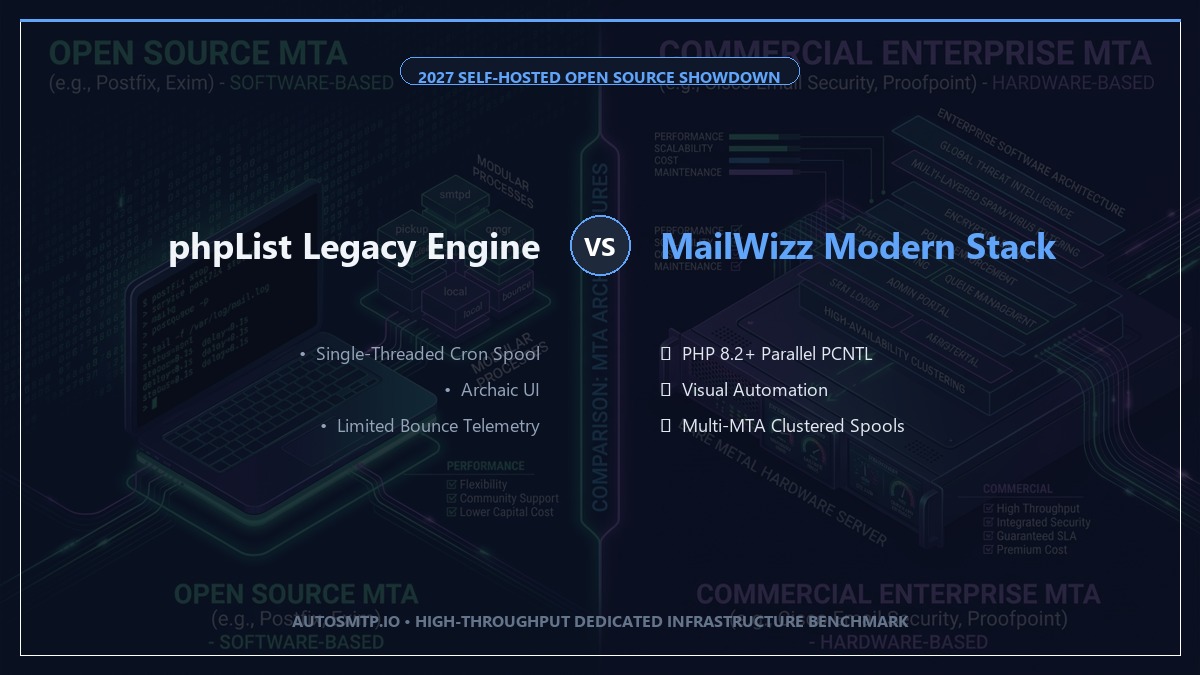
MailWizz vs phpList: 2027 Modern PHP 8.2+ Multi-Tenant Platform vs Legacy Open-Source List Manager
Published by Fred Dawson • Senior Deliverability Systems Architect • 19 min read
In the open-source self-hosted newsletter landscape, phpList stands as one of the oldest and most recognizable tools, having launched in 2000. For over two decades, developers and non-profits deployed phpList on shared cPanel web hosting to send periodic text-and-HTML newsletters. However, entering 2027, phpList’s 25-year-old architectural foundation—single-threaded cron queue dispatch, primitive template engines, lack of native visual journey builders, and absent multi-tenant customer isolation—creates crippling bottlenecks for modern commercial email operations. MailWizz represents the modern enterprise evolution of self-hosted email marketing: native PHP 8.2/8.3+ optimization, high-throughput parallelized PCNTL queue workers, full agency multi-tenancy, and turnkey integration with clustered bare-metal MTAs. This benchmark examines the architectural teardown and migration path between both platforms.
- 1. Queue Architecture & Throughput: Multi-Process PCNTL vs Monolithic Cron
- 2. Multi-Tenancy & Client Monetization: Enterprise ESP vs Simple List Tool
- 3. Visual Customer Journeys vs Archaic Static WYSIWYG
- 4. Clustered MTA Integration & Real-Time Deliverability Telemetry
- 5. MailWizz vs phpList Technical Matrix
- 6. The AutoSMTP Deliverability Defense Advantage
1. Queue Architecture & Throughput: Multi-Process PCNTL vs Monolithic Cron
The primary operational limitation of phpList is its queue execution model:
- phpList’s Monolithic Batch Cron: phpList processes outbound campaigns through a single-threaded PHP script executed periodically via cron:
php /var/www/phplist/bin/phplist -pprocessqueue. To prevent shared hosting timeouts, phpList enforces rigid batch limits (e.g., 500 emails per batch with a 10-minute pause). Sending a broadcast to 100,000 subscribers routinely requires 18 to 36 hours. If a single SMTP connection hangs, the entire process freezes. - MailWizz Multi-Process PCNTL Worker Engine: MailWizz leverages PHP’s Process Control (PCNTL) extension to spawn parallel child worker processes. It shards queues across CPU cores, transmitting to multiple SMTP relays concurrently. A standard MailWizz instance pushes 250,000+ messages per hour into local or remote MTA spools with automated error isolation and non-blocking recovery.
2. Multi-Tenancy & Client Monetization: Enterprise ESP vs Simple List Tool
How both applications support multiple users highlights a complete generational divide:
Agency Multi-Tenancy & Commercial Billing
phpList was designed strictly for a single organization. While multiple administrators can log in, all lists, templates, and delivery settings reside in a single shared database. There is no concept of sub-accounts, isolated customer sending quotas, or commercial monetization.
MailWizz is a full-fledged turnkey ESP platform. Administrators can create isolated customer tiers, allocate monthly sending limits, assign specific dedicated MTA delivery servers per customer, and automatically charge clients via built-in Stripe, PayPal, or crypto gateways.
3. Visual Customer Journeys vs Archaic Static WYSIWYG
Marketing teams in 2027 demand dynamic, responsive automation workflows:
phpList Legacy Editor
- Archaic table-based HTML editor prone to breaking mobile layouts.
- Linear autoresponders only (send X days after subscription).
- No conditional decision branches, behavioral tag triggers, or A/B testing.
- Lacks native modern RFC 8058 One-Click Unsubscribe headers.
MailWizz Enterprise Experience
- Modern drag-and-drop visual builder with native MJML and GrapesJS support.
- Complex visual automation flows with multi-condition branches and delay steps.
- Granular dynamic tags, behavioral segmentation, and automated link tracking.
- Turnkey RFC 8058 one-click headers, strict DMARC, and automated BIMI injection.
4. Clustered MTA Integration & Real-Time Deliverability Telemetry
Connecting to enterprise-grade bare-metal delivery engines requires sophisticated delivery server routing:
# PHPLIST: Basic Static SMTP Relay (config.php)
define('PHPMAILERHOST', 'smtp.relay.local');
define('MAILQUEUE_BATCH_SIZE', 500);
define('MAILQUEUE_BATCH_PERIOD', 600);
define('MAILQUEUE_THROTTLE', 1);

# MAILWIZZ: Multi-MTA Clustered Pools (Production Console CLI)
# Features automated round-robin load balancing across N dedicated servers:
# Relay Node 1 (PowerMTA Bare Metal - 162.251.122.170): Weight 40% (Transactional/VIP)
# Relay Node 2 (PowerMTA Bare Metal - 162.251.122.171): Weight 40% (Marketing Broadcasts)
# Relay Node 3 (KumoMTA Bare Metal - 162.251.122.173): Weight 20% (Warmup/Fallback Pool)
# Real-time webhook feedback updates contact suppression lists on in-band 550 bounces
5. MailWizz vs phpList Technical Matrix
| Pillar / Capability | MailWizz Enterprise Stack | phpList Open Source Engine | Architectural Advantage |
|---|---|---|---|
| Runtime Support | PHP 8.2 / 8.3 Native | Legacy PHP architecture | MailWizz: Modern speed, security & stability |
| Queue Concurrency | Multi-threaded PCNTL parallel workers | Single-threaded monolithic batch cron | MailWizz: 50x–100x higher throughput |
| Multi-Tenancy | Full customer tiers, plans & billing | Single-tenant only | MailWizz: Essential for agencies & multi-brand teams |
| Visual Automations | Drag-and-drop customer journey builder | Basic linear sequential autoresponders | MailWizz: Modern behavioral event triggers |
| Multi-MTA Routing | Weighted load-balancing across N relays | Single default SMTP host | MailWizz: Clustered redundancy & IP warming |
| Bounce / FBL Handling | Native IMAP/POP3, Pipe & Webhook ingest | Basic mailbox POP3 bounce polling | MailWizz: Real-time automated suppression |
Upgrading from phpList to MailWizz + Clustered PowerMTA MTAs
An independent technology newsletter publisher with 220,000 subscribers had used phpList on a VPS since 2016. Due to single-threaded queue bottlenecks, sending their weekly Tuesday newsletter required over 28 hours, and mobile readers frequently complained about broken email layouts.
The Transition: The publisher migrated their subscriber database to MailWizz connected to an AutoSMTP Dedicated Bare-Metal PowerMTA Node. Weekly dispatch times plummeted from 28 hours to 21 minutes. Mobile click-through rates increased by 19% thanks to MailWizz’s responsive MJML templates, and server maintenance overhead was virtually eliminated.
The AutoSMTP Deliverability Defense Advantage
Inbound and outbound filtering pipelines require robust underlying transport hardware. AutoSMTP provisions sovereign, dedicated bare-metal MTA infrastructure engineered for high-throughput filtering, synchronous 550 bounce suppression, and permanent reputation control.
Provisions fully licensed PowerMTA and KumoMTA clusters on enterprise bare-metal with dedicated IPv4 subnets and predictable flat pricing.
Monitors Google Postmaster spam ratios (<0.1%) and real-time ISP deferrals with algorithmic volume scaling across your entire IP pool.
RFC 5321 in-band 550 bounce suppression, automated Yahoo/Outlook Complaint Feedback Loops (CFL), and instant bad-IP eviction.
Pre-configured forward and reverse DNS (PTR) per IP, SPF CIDR alignment, 2048-bit DKIM rotation, and strict DMARC enforcement.
Upgrade Your Email Infrastructure with Dedicated Bare Metal
Eliminate filter lag, queue serialization bottlenecks, and noisy neighbor contamination. Deploy a turnkey AutoSMTP cluster today.
Deploy Turnkey MTA Cluster →