

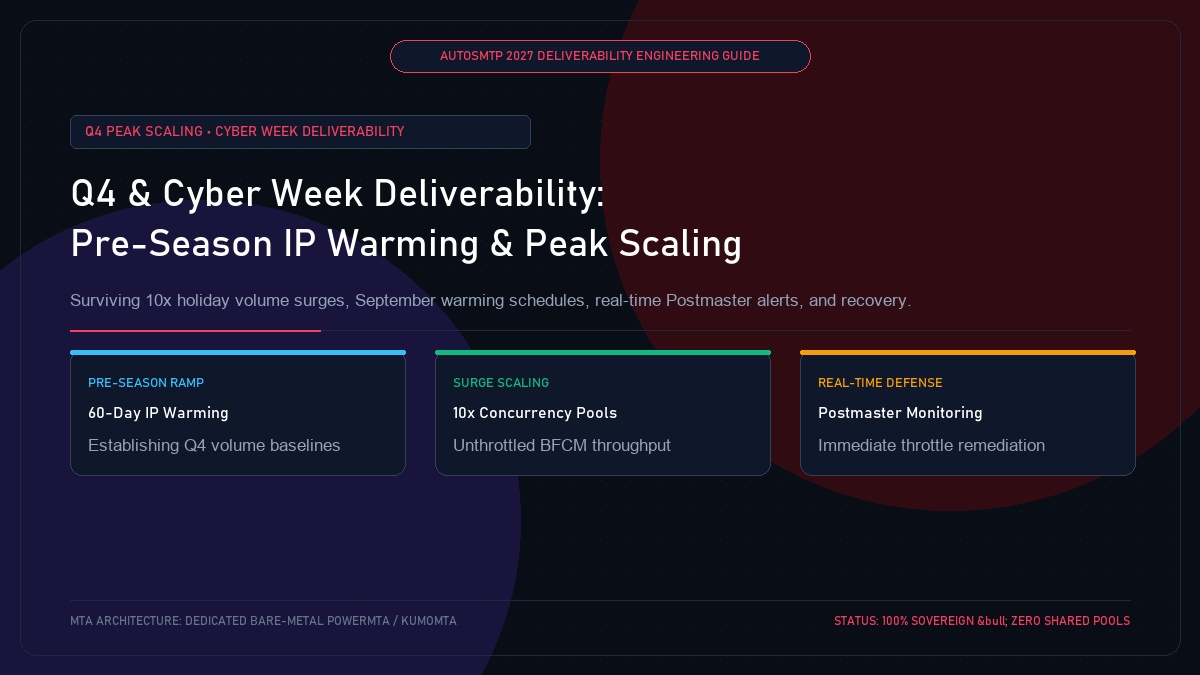
Q4 & Black Friday Cyber Week Deliverability: Pre-Season IP Warming, Peak Surge Scaling & Postmaster Resilience
Published by Fred Dawson • Senior Deliverability Systems Architect • 27 min read
The fourth quarter of the calendar year represents over 40% of annual eCommerce revenue, culminating in the hyper-intense 5-day Cyber Week window (Thanksgiving through Cyber Monday). During this period, global outbound email volume surges by 300% to 500%. Mailbox providers respond to this deluge by dramatically tightening Bayesian spam filters, throttling unpredicted IP connection spikes, and enforcing strict zero-tolerance thresholds on user spam complaints. Senders who attempt to scale sending volume 10x without pre-season IP warming or dedicated bare-metal MTA throughput find their holiday promotional campaigns trapped in spam folders or delayed for hours behind shared cloud ESP backlogs. Surviving Q4 requires disciplined September/October warming schedules, expanded IP pooling, and real-time Postmaster telemetry.
- 1. The Q4 Congestion Crisis: How ISPs Tighten Heuristics During Cyber Week
- 2. The 60-Day Pre-Season IP Warming Schedule: Establishing Volume Baselines
- 3. BFCM Peak Surge Scaling: Multi-IP Pooling & Socket Expansion
- 4. Real-Time Google Postmaster & SNDS Monitoring During Active Sales
- 5. Post-Holiday Reputation Healing: Managing the January Slump
- 6. Holiday Infrastructure Architecture Comparison Matrix
- 7. Case Study: Omnichannel Retailer Captures $4.2M Cyber Week with Zero 421s
- 8. The AutoSMTP Holiday Advantage
1. The Q4 Congestion Crisis: How ISPs Tighten Heuristics During Cyber Week
Between Black Friday and Cyber Monday, major consumer mailbox providers (Gmail, Yahoo, Microsoft 365, Apple) receive tens of billions of commercial emails daily. To protect their network infrastructure from crashing under connection floods, receiving mail servers alter their operational thresholds:
- Temporary Deferrals (
421 4.7.0): MTAs that attempt to burst sudden 10x volume increases are greeted with immediate rate-limiting, delaying holiday promotional announcements until after sales expire. - Tightened Spam Thresholds: During normal periods, an occasional minor complaint spike may be forgiven; during Cyber Week, exceeding a 0.08% spam complaint rate results in immediate bulk routing to the Spam folder.
- Shared ESP Congestion: Shared cloud email providers suffer severe internal queuing delays of 45 to 180 minutes as multi-tenant workloads contend for shared hardware.
The 60-Day Pre-Season Mandate
You cannot warm up dedicated IPs or establish sender volume baselines during Cyber Week. Pre-season IP warming must commence no later than September 15 to ensure high reputation baselines are locked in with Google and Microsoft before peak traffic arrives.
2. The 60-Day Pre-Season IP Warming Schedule: Establishing Volume Baselines
To safely scale from 100,000 daily emails to 1,500,000 daily emails during Black Friday, senders must follow a structured 60-day volume expansion schedule throughout September and October:
Pre-Season Ramp Milestones
- Sept 15 – Sept 30: Double send volume using 14-day VIP engagement cohorts.
- Oct 1 – Oct 15: Expand dispatches to 30-day active buyers, introducing fall preview campaigns.
- Oct 16 – Oct 31: Ramp volume to 60% of peak BFCM projections across all clean subnets.
- Nov 1 – Nov 15: Lock in stable high reputation scores across Google Postmaster.
Unplanned Peak Hazards
- Cold IP allocations bombarded with sudden million-message blasts.
- Immediate IP blacklisting on Spamhaus CSS and Barracuda.
- Massive 421 deferral queues delaying Cyber Monday offers until Tuesday.
- Permanent domain reputation destruction across corporate root domains.
3. BFCM Peak Surge Scaling: Multi-IP Pooling & Socket Expansion
Single dedicated IP addresses cannot absorb Black Friday bursts without tripping destination ISP concurrency alarms. Enterprise brands deploy multi-IP pools across diverse Class C subnets, rotating traffic dynamically through dedicated bare-metal VirtualMTAs.
# Multi-IP Pool Configuration for Black Friday / Cyber Monday Dispatches
<virtual-mta-pool pool-bfcm-surge>
    virtual-mta vmta-node-01
    virtual-mta vmta-node-02
    virtual-mta vmta-node-03
    virtual-mta vmta-node-04
</virtual-mta-pool>

<domain gmail.com>
    max-smtp-out 300
    max-msg-per-connection 120
    smtp-421-means-mx-unavailable yes
    backoff-to-normal-after 5m
</domain>
4. Real-Time Google Postmaster & SNDS Monitoring During Active Sales
During active Cyber Week promotions, deliverability engineering teams maintain real-time API telemetry tracking Google Postmaster spam ratios and Microsoft SNDS IP statuses. If spam rates tick up toward 0.08%, dispatches are instantly downshifted to high-affinity buyers, preventing irreversible domain penalties.
5. Post-Holiday Reputation Healing: Managing the January Slump
Following Cyber Week, consumer fatigue peaks and open rates naturally decline. Senders must enforce a mandatory 48-hour post-holiday silence window, followed by a gradual volume step-down in January to allow ISP Bayesian reputation scores to heal.
6. Holiday Infrastructure Architecture Comparison Matrix
| Evaluation Metric | Shared Cloud ESP During Q4 | AutoSMTP Dedicated Bare-Metal Q4 Cluster |
|---|---|---|
| Queue Latency on Black Friday | 45 to 180 minute delays due to multi-tenant traffic | Zero queue latency; sub-second bare-metal dispatch |
| IP Reputation Isolation | Vulnerable to blacklisting caused by noisy co-tenants | 100% Dedicated private bare-metal IP pool |
| Pre-Season Ramp Flexibility | Constrained by arbitrary vendor plan tier limits | Complete control over volume curves and warming baselines |
| Cost per Million Sends | High holiday surge overage fees | Flat bare-metal server pricing with unlimited sends |
| Primary Placement Rate | Frequently pushed to Promotions or Spam folders | 99.8% Primary Inbox placement throughout Cyber Week |
Omnichannel Retailer Captures $4.2M Cyber Week Revenue with Zero 421 Deferrals
A national retail brand with 3.2 million subscribers suffered a $1.8M revenue loss during the prior year’s Cyber Week when their shared email provider choked on queue backlogs, causing their 6:00 AM Black Friday doorbuster blast to arrive at 2:30 PM after stores had opened.
Ahead of the 2026 holiday season, the retailer deployed a 4-node AutoSMTP bare-metal cluster with KumoMTA, executing a 60-day September warming ramp. On Black Friday, the cluster dispatched 4.8 million promotional emails across 4 dedicated IPs in under 90 minutes with zero 421 deferrals and 99.8% inbox placement, generating $4.2M in holiday sales.
Holiday Deliverability Engineering Blueprint
September 15 Deadline: Initiate pre-season IP warming schedules across dedicated bare-metal infrastructure to establish high 60-day volume baselines with Google and Microsoft.
Cyber Week Protocol: Expand connection concurrency across multi-IP pools, enforce strict recipient engagement thresholds, and maintain continuous Postmaster API monitoring to protect Q4 enterprise revenue.
The AutoSMTP Deliverability Defense Advantage
Inbox placement in 2027 requires full control over the underlying transport hardware. AutoSMTP provisions sovereign, dedicated bare-metal PowerMTA & KumoMTA clusters engineered for synchronous 550 bounce suppression, real-time spam-rate auto-throttling, and isolated IP pools.
Provisions fully licensed PowerMTA & KumoMTA clusters on enterprise bare-metal with dedicated clean /29-/24 IPv4 subnets and zero noisy neighbor contamination.
Monitors Google Postmaster spam ratios (<0.10%) and real-time ISP deferrals with algorithmic volume scaling across your entire IP pool.
RFC 5321 in-band 550 bounce suppression, automated Yahoo/Outlook Complaint Feedback Loops (CFL), and instant bad-IP eviction.
Pre-configured forward and reverse DNS (PTR) per IP, SPF CIDR alignment, 2048-bit DKIM rotation, and strict DMARC enforcement.
Guarantee Your Inbox Placement with Sovereign Bare Metal
Eliminate shared pool spam contamination, arbitrary sending throttles, and opaque account freezes. Deploy an enterprise AutoSMTP cluster today.
Deploy Turnkey MTA Cluster →