

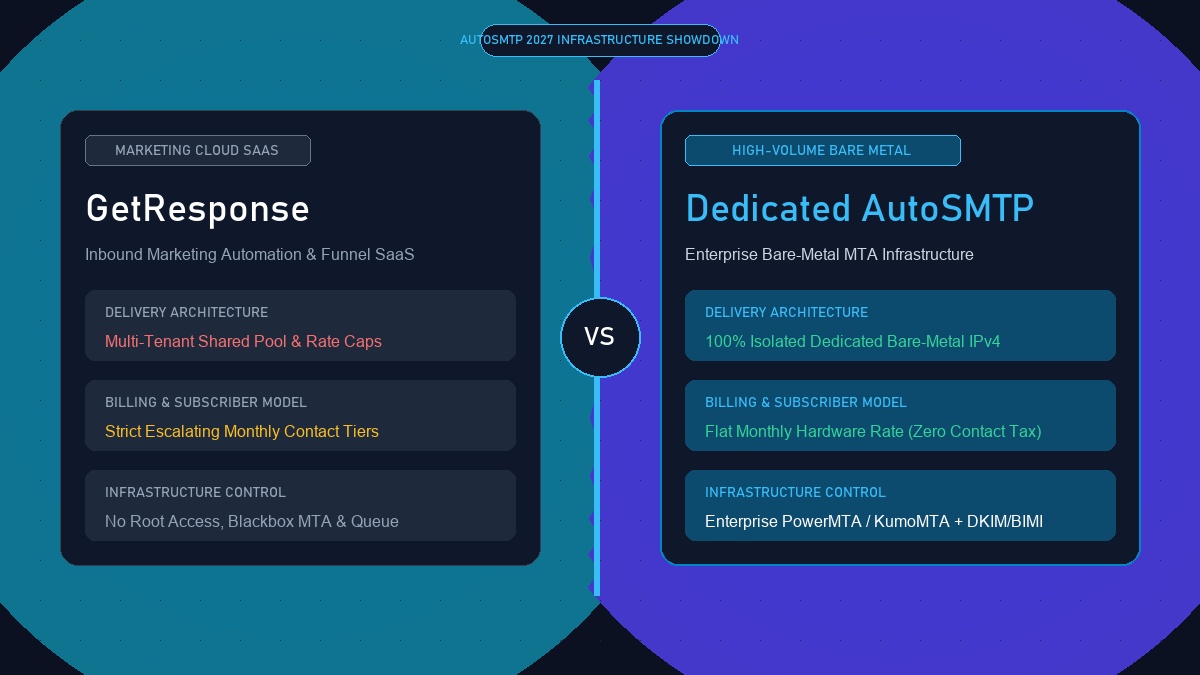
GetResponse vs Dedicated Infrastructure: 2027 All-in-One Marketing Cloud vs Dedicated Bare-Metal MTAs
Headquartered in Gdańsk, Poland, GetResponse represents one of the most successful bootstrapped software companies in tech history. Founded in 1998 by Simon Grabowski without raising outside venture capital, GetResponse has grown to over 400,000 customers by bundling email marketing, webinars, automated sales funnels, and AI course builders into a single portal. However, as high-growth businesses scale past 50,000 to 100,000 contacts, GetResponse’s steep contact-based subscription tiers ($899 to $1,049+/month) and strict gating of dedicated IPs behind custom MAX2 enterprise contracts create massive financial and operational friction. Transitioning to dedicated AutoSMTP bare-metal MTA infrastructure decouples high-volume delivery from list-size penalties, delivers unmetered throughput on private clean IPv4 subnets, and slashes total email delivery costs by over 75%.
- 1. The 1998 Bootstrapped Heritage of GetResponse
- 2. Architectural Divide: Bundled Suite vs Pure MTA
- 3. The Escalating Contact Tax & Pricing Matrix
- 4. Deliverability Isolation: Shared Pools vs Private Subnets
- 5. Deep Technical Comparison Matrix
- 6. API Payloads & Webhook Integration Benchmarks
- 7. Production Field Study: E-Commerce Publisher
- 8. Strategic Decision Framework
- 9. The AutoSMTP Dedicated MTA Solution
1. The 1998 Bootstrapped Heritage of GetResponse
Launched the same year as Google, GetResponse is among the longest-running active platforms in the email industry. Under founder and CEO Simon Grabowski, the Gdańsk-based company built a $150M+ revenue business without institutional venture capital. This independence spared GetResponse the frantic quarterly boom-and-bust cycles that plagued many VC-funded competitors.
Over nearly three decades, GetResponse evolved from a simple sequential autoresponder into an all-in-one digital marketing ecosystem. Today, it packages visual email newsletters, event-triggered automations, webinar hosting rooms (up to 1,000 attendees), landing page builders, and AI-assisted content generators into a unified subscription. For solopreneurs and small e-commerce merchants who want a single login for their entire funnel, GetResponse offers remarkable operational breadth.
2. Architectural Divide: Bundled Suite vs Pure MTA
- Turnkey Multi-Channel Suite: Host webinars, construct sales funnels, generate landing pages, and send emails in one app.
- Visual Workflow Automation: Drag-and-drop workflow canvas for tagging, lead scoring, and abandoned cart recovery.
- AI Copywriting Tools: Integrated generative AI prompts to draft newsletter copy and generate subject lines.
- Contact-Based Surcharges: Escalating monthly tiers that penalize businesses simply for storing unengaged contacts.
- Enterprise Gating for Dedicated IPs: IP isolation is strictly reserved for custom MAX2 enterprise contracts.
- 100% Private Clean IPv4 Subnets: Complete reputation sovereignty with zero multi-tenant noise or throttling.
- Zero Subscriber Penalties: Store 50,000 or 5,000,000 contacts in your own database with zero monthly contact fees.
- Industrial PowerMTA / KumoMTA: High-throughput memory-mapped spool engines processing 250,000+ emails/hr effortlessly.
- In-Band 550 Bounce Handling: Native RFC 5321 socket interception and automatic Yahoo/Outlook CFL loop processing.
- Decoupled Architecture: Pair high-powered bare metal with modern frontends (MailWizz, Relay, or internal APIs).
3. The Escalating Contact Tax & Pricing Matrix
The primary economic friction point for GetResponse users is the subscriber volume curve. Because pricing is pegged directly to contact counts, companies with large customer databases pay massive monthly fees even if their sending frequency is modest:
- At 10,000 contacts, GetResponse Marketing Automation costs ~$169/month.
- At 50,000 contacts, the price jumps to ~$449/month.
- At 100,000 contacts, the fee escalates to $899/month on Marketing Automation and $1,049/month on Ecommerce.
| Contact List Size | GetResponse Marketing Automation | AutoSMTP Dedicated Bare-Metal | Monthly Cost Delta |
|---|---|---|---|
| 1,000 contacts | $59 / mo | Dedicated Pro Node | GetResponse competitive for micro-businesses |
| 10,000 contacts | $169 / mo | Dedicated Pro Node | Parity with full marketing suite inclusions |
| 25,000 contacts | ~$299 / mo | Bare-Metal NVMe Server | AutoSMTP is 50% cheaper |
| 50,000 contacts | ~$449 / mo | Dedicated High-Volume Node (2 IPs) | AutoSMTP is 67% cheaper ($300/mo savings) |
| 100,000 contacts | $899 / mo | Enterprise Dual-Node PowerMTA (/29 IP Pool) | AutoSMTP is 78% cheaper ($700/mo savings) |
| 250,000 contacts | Custom MAX2 ($1,500+ / mo) | Multi-Server Bare-Metal Cluster | AutoSMTP is 80%+ cheaper ($1,200+/mo savings) |
4. Deliverability Isolation: Shared Pools vs Private Subnets
On GetResponse’s standard tiers, outgoing emails route through large shared IP pools shared among thousands of other accounts. While GetResponse actively monitors compliance, shared pools inherently suffer from periodic sender contamination:
When an affiliate marketer or unsegmented retail sender blasts an unverified list on a shared pool, Gmail and Microsoft 365 apply domain and IP-level rate-limiting. For innocent senders sharing that pool, critical campaign delivery slows down, and messages are frequently routed to the “Promotions” or “Spam” tabs. To get a dedicated IP address on GetResponse, customers must negotiate the MAX2 Enterprise plan, requiring lengthy sales discussions and substantial annual budget commitments.
5. Deep Technical Comparison Matrix
| Infrastructure Feature | GetResponse Cloud SaaS | Dedicated AutoSMTP (Bare Metal) |
|---|---|---|
| IP Governance | Shared Multi-Tenant (MAX2 Gated) | 100% Private Dedicated Clean IPv4 Subnets |
| Delivery Engine | Proprietary Shared Sending Core | Bare-Metal PowerMTA v5.5 or Rust KumoMTA |
| Contact List Restrictions | Strict Metered Tiers (Pay Per Contact) | Unmetered (Zero Contact Tax) |
| Throughput Capacity | Shared Pool Rate Limits | 250,000+ emails/hr per dedicated node |
| Bounce Management | Asynchronous Webhook Notifications | Synchronous RFC 5321 in-band 550 suppression |
| Custom Auth & Keys | Standard CNAME / TXT delegation | Full 2048-bit DKIM, strict DMARC & BIMI VMC |
| System Observability | Basic UI Dashboard Stats | Real-Time Command-Line & Prometheus Spool Telemetry |
6. API Payloads & Webhook Integration Benchmarks
curl -X POST   https://api.getresponse.com/v3/newsletters   -H "X-Auth-Token: api-key your_gr_key"   -H "Content-Type: application/json"   -d '{
    "content": {"html": "<h1>Special Announcement</h1>"},
    "flags": ["openrate", "clicktracks"],
    "name": "Weekly Digest",
    "type": "broadcast",
    "subject": "Exclusive Insights This Week",
    "fromField": {"fromFieldId": "xyz123"},
    "campaign": {"campaignId": "cmp_456"},
    "sendSettings": {"selectedCampaigns": ["cmp_456"]}
}'220 smtp.domain.com ESMTP PowerMTA v5.5
EHLO engine.app.lan
250-smtp.domain.com
250-PIPELINING
250-8BITMIME
250 STARTTLS
MAIL FROM:<news@domain.com>
250 2.1.0 Sender ok
RCPT TO:<subscriber@gmail.com>
250 2.1.5 Recipient ok
DATA
354 End data with <CR><LF>.<CR><LF>
DKIM-Signature: v=1; a=rsa-sha256; d=domain.com; ...
250 2.6.0 Message accepted for delivery (0.038s)7. Production Field Study: E-Commerce Publisher
Digital Publishing & E-Commerce Network (180,000 active contacts): Operating on GetResponse Marketing Automation, the publisher was paying over $1,250 every month. Because the list grew steadily from lead generation funnels, monthly subscription invoices continued to climb despite consistent sending frequency. By decoupling customer data management from the sending infrastructure—keeping lead capture on their CMS and dispatching campaigns via a dedicated AutoSMTP dual-node PowerMTA cluster with MailWizz frontend—the company reduced monthly email delivery expenses from $1,250 to a flat $179, saving over $12,800 annually while cutting campaign delivery times from 4 hours to 28 minutes.
8. Strategic Decision Framework
- You actively use the built-in webinar hosting, landing page builders, and course creators in your daily marketing operations.
- Your subscriber list remains under 20,000 contacts, where bundled SaaS pricing remains manageable.
- You lack technical staff or developers to manage self-hosted campaign frontends or internal databases.
- You do not require isolated IPv4 subnets or fine-grained control over outbound connection pooling.
- Your contact database exceeds 50,000 subscribers and SaaS contact fees are draining marketing margins.
- You only need high-volume, reliable email dispatch and find bundled webinars and landing pages unnecessary overhead.
- You require dedicated clean IPv4 subnets without committing to expensive MAX2 enterprise contracts.
- You want the peace of mind of 100% server ownership with zero risk of sudden account suspension.
Deploy Dedicated Bare-Metal MTA Clusters
Stop paying monthly penalties for growing your subscriber list. AutoSMTP provisions dedicated bare-metal PowerMTA or KumoMTA clusters on enterprise hardware, giving you 100% private clean IPv4 subnets, zero subscriber taxes, and automated 24/7 deliverability engineering.
Dedicated enterprise MTA engines on bare-metal NVMe servers with 100% private IPv4 subnets and zero shared resource contention.
Intelligent warmup pacing monitoring Google Postmaster spam ratios (<0.1%) and real-time deferrals across clean IPv4 subnets.
RFC 5321 in-band 550 bounce suppression and automated Yahoo/Outlook Complaint Feedback Loop processing directly into your sending queues.
Pre-configured rDNS/PTR, SPF, 2048-bit DKIM, strict DMARC, and BIMI SVG certificates managed 24/7 by deliverability specialists.
Stop paying cloud volume markups. Scale your email sending with dedicated bare-metal MTA power today.